
[Paper Review] Explosive growth from AI automation: A review of the arguments
This paper evaluates whether artificial intelligence capable of broadly substituting for human labor could trigger explosive economic growth—defined as a tenfold acceleration in GDP growth—by analyzing three key mechanisms: increasing returns to scale, rapid expansion of AI labor forces, and transitory effects from fast automation. It finds that while such growth is plausible under ideal conditions, high confidence in this outcome remains unwarranted due to unresolved uncertainties around regulation, physical bottlenecks, and automation speed.
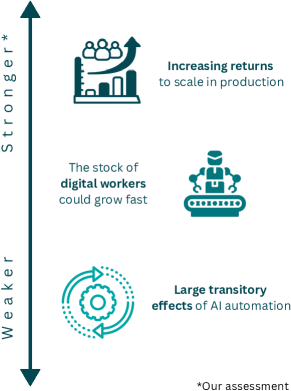
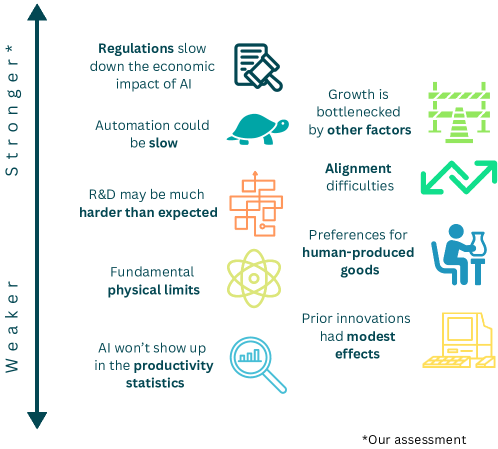
We examine whether substantial AI automation could accelerate global economic growth by about an order of magnitude, akin to the economic growth effects of the Industrial Revolution. We identify three primary drivers for such growth: 1) the scalability of an AI "labor force" restoring a regime of increasing returns to scale, 2) the rapid expansion of an AI labor force, and 3) a massive increase in output from rapid automation occurring over a brief period of time. Against this backdrop, we evaluate nine counterarguments, including regulatory hurdles, production bottlenecks, alignment issues, and the pace of automation. We tentatively assess these arguments, finding most are unlikely deciders. We conclude that explosive growth seems plausible with AI capable of broadly substituting for human labor, but high confidence in this claim seems currently unwarranted. Key questions remain about the intensity of regulatory responses to AI, physical bottlenecks in production, the economic value of superhuman abilities, and the rate at which AI automation could occur.
Motivation & Objective
- To assess whether AI systems capable of broadly substituting for human labor could trigger explosive economic growth, defined as a tenfold increase in GDP growth rate.
- To evaluate three core drivers of such growth: increasing returns to scale, rapid expansion of AI labor, and transitory effects from fast automation.
- To critically assess nine major counterarguments against explosive growth, including regulatory constraints, physical bottlenecks, alignment issues, and slow automation pace.
- To provide a quantitative foundation for evaluating growth acceleration, focusing on parameter sensitivity and robustness to investment delays.
- To identify key open questions regarding regulatory response, physical limits, and the economic value of superhuman AI capabilities.
Proposed method
- Uses growth theory models with constant and increasing returns to scale to simulate post-AGI economic dynamics under varying assumptions.
- Applies a neoclassical growth framework with capital (K), labor (L), and total factor productivity (A), using the Cobb-Douglas production function: Y = A × K^α × L^(1−α).
- Estimates the total factor productivity parameter A using historical US GDP, capital stock, and labor input data from 2017–2019, yielding A ≈ 2337 $^{0.7}·workers^{-0.7}·year^{-1}.
- Models investment delays via a differential equation system where realized investment I adjusts exponentially to savings sY with a forgetting rate η, and derives the asymptotic growth rate as λ = η × [−1 + √(1 + 4As/η)] / 2.
- Assesses robustness of growth predictions by comparing delayed-investment models to instantaneous adjustment models, showing that delays only reduce growth by ~40% if η ≪ 2/3 year⁻¹.
- Tentatively evaluates the force of nine counterarguments using qualitative and quantitative reasoning, focusing on their plausibility and quantitative specificity.
Experimental results
Research questions
- RQ1Under what conditions could AI automation lead to a tenfold acceleration in global economic growth?
- RQ2How do increasing returns to scale, rapid AI labor force growth, and fast automation contribute to explosive growth dynamics?
- RQ3To what extent do regulatory constraints, physical bottlenecks, or human preferences for human-produced goods limit the potential for explosive growth from AI?
- RQ4How robust are growth predictions to delays in investment and capital accumulation?
- RQ5What are the key unresolved uncertainties that prevent high confidence in the explosive growth hypothesis?
Key findings
- The model predicts explosive growth (gy ≥ 0.3/year) if the product s·c̄^(-0.7) exceeds approximately 2.38×10⁻⁴, where s is the savings rate and c̄ is the average capital-labor ratio per worker.
- Investment delays have a modest impact on growth rates unless the adjustment time scale (1/η) exceeds 18 months; under typical assumptions, growth is reduced by only ~40%.
- The golden ratio factor (1/φ ≈ 0.618) emerges as a conservative adjustment for investment delays when η = As, indicating that delay effects are quantitatively minor compared to uncertainty in A and s.
- Most counterarguments against explosive growth—such as physical limits, non-accumulable factors, or human preference for human-produced goods—lack quantitative specificity and fail to robustly bound potential growth accelerations.
- Regulatory or political coordination to restrict AI deployment could prevent explosive growth, but such coordination would require sustained global control over distributed actors, which is considered unlikely given strong incentives and falling AI training costs.
- The paper concludes that explosive growth is plausible under AI systems capable of broadly substituting for human labor, but high confidence in this claim remains unwarranted due to unresolved uncertainties in regulation, bottlenecks, and automation speed.
Read this paper
Open the full text in the Nubint reader and ask about any passage as you read.
Read this paper on NubintThis review was generated by AI from the original paper. Please check the paper before citing it.