
[论文解读] Extracting higher central charge from a single wave function
该论文提出一种方法,通过单个波函数中部分旋转算符的期望值,从2+1D玻色子拓扑序的边缘提取更高阶中心电荷——即阻碍边缘能隙化的障碍。该方法经共形场论和ν=1/2 Laughlin态及Kitaev蜂窝模型的数值模拟验证,可实现量子计算可处理的评估,并完全确定阿贝尔拓扑序在chiral中心电荷c₋之外的能隙化可能性。
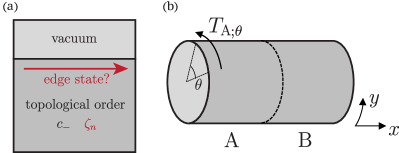
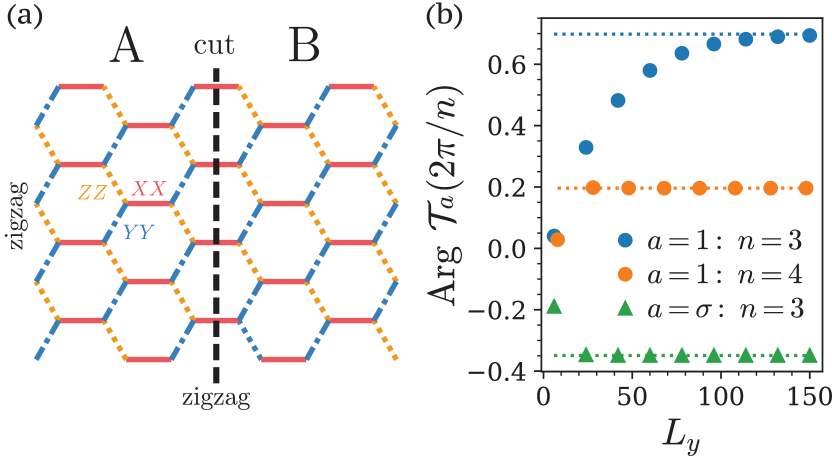
A (2+1)D topologically ordered phase may or may not have a gappable edge, even if its chiral central charge c_{-} is vanishing. Recently, it was discovered that a quantity regarded as a "higher" version of chiral central charge gives a further obstruction beyond c_{-} to gapping out the edge. In this Letter, we show that the higher central charges can be characterized by the expectation value of the partial rotation operator acting on the wave function of the topologically ordered state. This allows us to extract the higher central charge from a single wave function, which can be evaluated on a quantum computer. Our characterization of the higher central charge is analytically derived from the modular properties of edge conformal field theory, as well as the numerical results with the ν=1/2 bosonic Laughlin state and the non-Abelian gapped phase of the Kitaev honeycomb model, which corresponds to U(1)_{2} and Ising topological order, respectively. The Letter establishes a numerical method to obtain a set of obstructions to the gappable edge of (2+1)D bosonic topological order beyond c_{-}, which enables us to completely determine if a (2+1)D bosonic Abelian topological order has a gappable edge or not. We also point out that the expectation values of the partial rotation on a single wave function put a constraint on the low-energy spectrum of the bulk-boundary system of (2+1)D bosonic topological order, reminiscent of the Lieb-Schultz-Mattis-type theorems.
研究动机与目标
- 建立(2+1)D玻色子拓扑序中更高阶中心电荷的微观波函数表征。
- 克服此前仅通过拓扑量子场论定义的、拓扑波函数与更高阶中心电荷之间缺乏直接微观联系的问题。
- 提供一种数值上可行且兼容量子计算的协议,以判断拓扑序是否存在能隙边缘,超越chiral中心电荷c₋所隐含的信息。
- 推导一种通用的数值方法,仅使用单个波函数即可完全确定阿贝尔拓扑序的能隙化可能性。
提出的方法
- 论文提出利用作用于波函数子系统的部分旋转算符的期望值,提取更高阶中心电荷ζₙ。
- 该方法依赖于边缘共形场论的模性质,通过关系式ζₙ = exp(2πi/n × (hₐ − c₋/24 − ηₕL²/(2πℏ)))将部分旋转振幅的相位与更高阶中心电荷关联,其中a为任意任何ons子空间。
- 该协议通过拓扑波函数的矩阵乘积态(MPS)表示进行数值实现,部分旋转作为作用于子系统的幺正操作。
- 采用动量极化技术提取共形维度hₐ和chiral中心电荷c₋,再与部分旋转相位结合以计算ζₙ。
- 在ℓ_B²/L_y²的比值上进行有限尺寸外推,以提取ζₙ,a在热力学极限下的值。
- 该方法在ν=1/2玻色子Laughlin态和Kitaev蜂窝模型的非阿贝尔相上进行了测试,结果与CFT预测进行比较。
实验结果
研究问题
- RQ1能否从单个微观波函数中提取更高阶中心电荷,这些电荷会阻碍c₋之外的边缘能隙化?
- RQ2是否存在一种与量子计算兼容的、基于波函数期望值的更高阶中心电荷的直接操作定义?
- RQ3部分旋转算符的期望值能否可靠地提取出不同任意任何ons子空间和系统尺寸下的ζₙ?
- RQ4该方法是否允许完全确定阿贝尔拓扑序的能隙化可能性,超越仅依赖c₋所能实现的程度?
- RQ5与动量极化相比,可靠提取更高阶中心电荷所需的数值尺度要求和精度约束是什么?
主要发现
- 在单个波函数上对部分旋转算符的期望值可得到更高阶中心电荷ζₙ,其振幅的相位通过共形场论与ζₙ直接关联。
- 对于ν=1/2玻色子Laughlin态,该方法正确提取出c₋ = 1和hₛ = 1/4,拓扑移位𝒮 = 1.998,与CFT预测𝒮 = 2高度一致。
- 扭曲的更高阶中心电荷ζₙ,ₐ随系统尺寸L_y增大而收敛至预期值(例如,U(1)₂×U(1)₋₄中ζ₃ = −1),证实了方法的准确性。
- 由于pₐ中误差随L_y呈二次增长,而ζₙ,a中不呈此趋势,该协议所需保真度χ和局域玻色子截断N_Boson远低于动量极化方法。
- 为可靠提取n ≥ 5的ζₙ,a,需L_y ≥ 64ℓ_B的系统尺寸,对应L_y > n²ξ_r,其中ξ_r ≈ √(2/3)πℓ_B为Laughlin态的相干长度。
- 通过将ζₙ,a与c₋结合,该方法可完全确定阿贝尔拓扑序的能隙化可能性,当满足gcd(n, N_FS/gcd(n,N_FS)) = 1时,存在充分条件。
更好的研究,从现在开始
从阅读论文到最终审阅,大幅缩短您的研究时间。
无需绑定信用卡
本解读由 AI 生成,并经人工编辑审核。