
[Paper Review] Fast and Reliable Jackknife and Bootstrap Methods for Cluster-Robust Inference
This paper proposes fast, computationally efficient methods for jackknife-based cluster-robust variance estimators (CRVEs), particularly CV3, and introduces new wild cluster bootstrap variants that improve inference reliability in small or unbalanced clusters. The key contribution is that these methods—especially the WCR-S bootstrap—deliver significantly more accurate p-values and confidence intervals than standard approaches when cluster sizes are unequal or the number of clusters is small.
We provide computationally attractive methods to obtain jackknife-based cluster-robust variance matrix estimators (CRVEs) for linear regression models estimated by least squares. We also propose several new variants of the wild cluster bootstrap, which involve these CRVEs, jackknife-based bootstrap data-generating processes, or both. Extensive simulation experiments suggest that the new methods can provide much more reliable inferences than existing ones in cases where the latter are not trustworthy, such as when the number of clusters is small and/or cluster sizes vary substantially. Three empirical examples illustrate the new methods.
Motivation & Objective
- To develop a computationally efficient method for calculating jackknife-based CRVEs, especially CV3, which is often more reliable than the widely used CV1 in small or unbalanced clusters.
- To address the limitations of existing bootstrap methods, which are based on CV1 and can yield unreliable inference when cluster sizes vary or the number of clusters is small.
- To propose new wild cluster bootstrap variants that improve finite-sample performance by incorporating jackknife-based CRVEs or modified data-generating processes (DGPs).
- To provide empirical guidance on when to use CV3, CV1, or bootstrap methods based on cluster balance and effective number of clusters.
- To offer practical, implementable solutions in Stata, R, and Python that outperform standard methods in simulations and real-world examples.
Proposed method
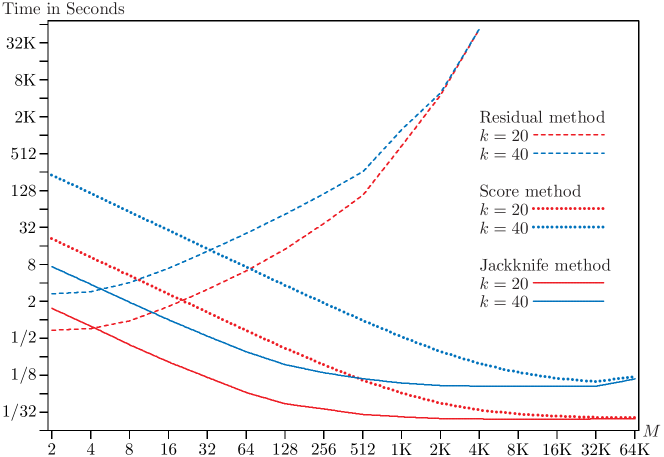
- Introduces an efficient algorithm for computing the cluster jackknife estimator (CV3) by explicitly leveraging cluster-level residuals and leverage statistics, enabling fast computation even in large samples with many clusters.
- Derives algebraic relationships between cluster jackknife estimates and empirical score vectors, enabling the construction of modified bootstrap data-generating processes (DGPs) that better reflect the true underlying structure.
- Proposes new wild cluster bootstrap variants: WCR-S and WCU-S, which use CV1 standard errors but apply jackknife-transformed score vectors in the bootstrap DGP, improving finite-sample performance.
- Employs a modified bootstrap DGP that restricts scores to be orthogonal to the design matrix within each cluster, enhancing robustness under cluster heterogeneity.
- Implements the new methods in efficient software packages (e.g., boottest, fwildclusterboot) for use in Stata, R, Python, and Julia, enabling fast computation with 10,000+ bootstrap replications.
- Validates the methods through extensive simulation experiments and three empirical applications, comparing performance across various cluster configurations and sample sizes.
Experimental results
Research questions
- RQ1How can the cluster jackknife estimator (CV3) be computed efficiently enough to be practical for large samples with many clusters?
- RQ2Do bootstrap methods based on CV3 or modified DGPs provide more reliable inference than standard wild cluster bootstrap methods based on CV1 in small or unbalanced clusters?
- RQ3How do the new bootstrap variants (e.g., WCR-S) compare in performance to classic methods (e.g., WCR-C) when cluster sizes vary substantially or the number of clusters is small?
- RQ4What is the impact of cluster imbalance, leverage, and effective number of clusters on the reliability of standard errors and p-values from CV1 versus CV3?
- RQ5Which bootstrap method—WCR-S, WCR-C, or others—provides the most accurate and robust inference across diverse empirical settings?
Key findings
- The CV3 standard error was 47% larger than CV1 in one empirical example, indicating substantial differences in inference when clusters are unbalanced.
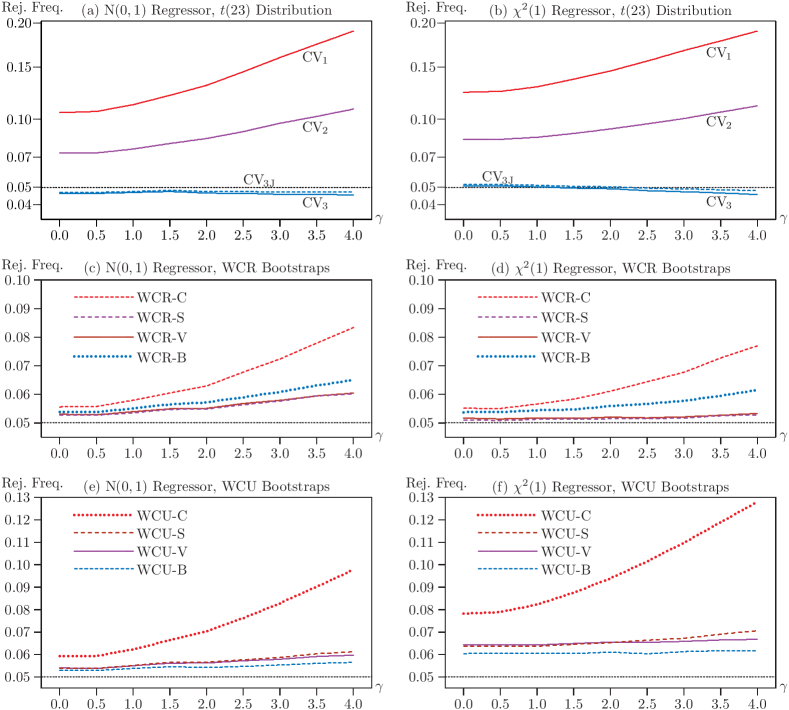
- The WCR-S bootstrap, which uses CV1 standard errors but jackknife-transformed scores in the DGP, consistently outperformed the classic WCR-C bootstrap in simulations, especially under cluster imbalance.
- Bootstrap p-values from the new methods (e.g., WCR-S) were more reliable than conventional t-tests based on CV1 or CV3, particularly when the number of clusters was small or cluster sizes varied widely.
- In simulations, the new methods reduced Type I error rates and improved coverage of confidence intervals, especially in scenarios with few or highly unbalanced clusters.
- The WCR-S bootstrap was found to be the most robust and practical recommendation, offering strong performance with minimal computational cost and easy implementation.
- The use of 10,000+ bootstrap replications was shown to be computationally feasible and essential for reliable inference, especially when cluster structure is complex.
Read this paper
Open the full text in the Nubint reader and ask about any passage as you read.
Read this paper on NubintThis review was generated by AI from the original paper. Please check the paper before citing it.