
[论文解读] Federated Adaptive Causal Estimation (FACE) of Target Treatment Effects
FACE 是一种联邦因果推断框架,通过自适应地整合来自多个异构机构的数据,以提高精度和鲁棒性,估计目标平均处理效应(TATE)。通过使用密度比加权和惩罚回归进行自适应机构加权,FACE 实现了更高的效率,并避免了负迁移,在五个美国退伍军人事务部(VA)机构的真实世界新冠疫苗研究中,标准误降低了 26%–67%。
Federated learning of causal estimands may greatly improve estimation efficiency by leveraging data from multiple study sites, but robustness to heterogeneity and model misspecifications is vital for ensuring validity. We develop a Federated Adaptive Causal Estimation (FACE) framework to incorporate heterogeneous data from multiple sites to provide treatment effect estimation and inference for a flexibly specified target population of interest. FACE accounts for site-level heterogeneity in the distribution of covariates through density ratio weighting. To safely incorporate source sites and avoid negative transfer, we introduce an adaptive weighting procedure via a penalized regression, which achieves both consistency and optimal efficiency. Our strategy is communication-efficient and privacy-preserving, allowing participating sites to share summary statistics only once with other sites. We conduct both theoretical and numerical evaluations of FACE and apply it to conduct a comparative effectiveness study of BNT162b2 (Pfizer) and mRNA-1273 (Moderna) vaccines on COVID-19 outcomes in U.S. veterans using electronic health records from five VA regional sites. We show that compared to traditional methods, FACE meaningfully increases the precision of treatment effect estimates, with reductions in standard errors ranging from $26\%$ to $67\%$.
研究动机与目标
- 开发一种联邦因果推断框架,以在异构医疗保健机构之间实现对目标平均处理效应(TATE)的稳健且高效的估计。
- 解决多机构因果推断中的挑战,包括协变量偏移、模型误设以及数据共享限制。
- 通过基于惩罚回归的自适应方法,降低不兼容或有偏的源机构权重,防止负迁移。
- 通过仅共享各机构的汇总统计量,确保通信效率和隐私保护。
- 支持灵活指定目标人群,包括特定医疗机构或感兴趣的子人群。
提出的方法
- FACE 使用密度比加权方法,以考虑各机构间协变量分布的机构层面异质性。
- 采用基于惩罚回归的自适应加权程序,选择并组合来自源机构的估计器,确保一致性与最优效率。
- 该框架将全局估计量构建为各机构特定高效估计器的线性组合,其权重通过最小化方差确定。
- 该方法具有通信效率,仅需在各机构间共享一次汇总统计量,从而保护隐私。
- FACE 利用影响函数和双重稳健估计,提升对模型误设的鲁棒性。
- 在理想条件下,即所有源机构均兼容时,估计器渐近达到半参数效率界限。
实验结果
研究问题
- RQ1如何整合来自多个医疗机构的异构观察性数据,以估计特定目标人群的治疗效应?
- RQ2何种自适应加权策略可确保对模型误设的鲁棒性,并避免联邦因果推断中的负迁移?
- RQ3与传统单机构方法相比,联邦因果估计在多大程度上能提高估计精度?
- RQ4在保持分布式数据源之间协作因果推断的同时,如何维持隐私和通信效率?
- RQ5该框架能否扩展至同时包含观察性研究和随机对照试验数据的情境?
主要发现
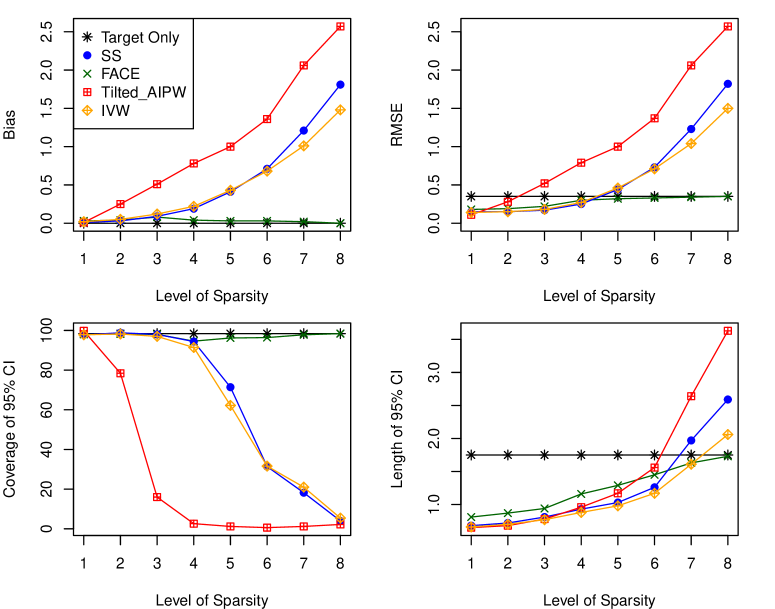
- 在一项针对美国退伍军人的mRNA疫苗真实世界研究中,FACE 相较于传统方法,将治疗效应估计的标准误降低了 26% 至 67%。
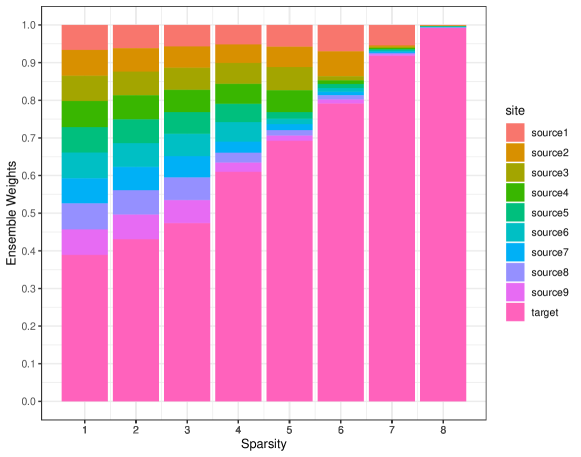
- 自适应加权程序成功降低了不兼容或有偏的源机构权重,有效防止了负迁移。
- FACE 通过基于惩罚回归的选择机制,最优地组合了多个机构的估计器,实现了更高的估计效率。
- 即使在模型误设和各机构间协变量偏移的情况下,该框架仍保持了鲁棒性和一致性。
- 该方法在使用五个 VA 区域机构电子健康记录的真实世界应用中表现有效,展示了实际应用价值。
- FACE 可扩展至包含随机对照试验数据的情境,在此类场景中,可通过利用相似人群的观察性数据,降低治疗效应估计的方差。
更好的研究,从现在开始
从阅读论文到最终审阅,大幅缩短您的研究时间。
无需绑定信用卡
本解读由 AI 生成,并经人工编辑审核。