
[Paper Review] Few shot chain-of-thought driven reasoning to prompt LLMs for open ended medical question answering
This paper proposes a novel few-shot chain-of-thought prompting method—incremental reasoning—tailored for open-ended medical question answering using LLMs. By mimicking real clinical reasoning and integrating a human-verified reward model for response verification, the approach significantly outperforms standard CoT prompting, achieving 86% expert agreement on reasoning quality and accuracy in a 100-question evaluation using Llama2-7B.
In this paper, we propose a modified version of the MedQA-USMLE dataset, named MEDQA-OPEN, which contains open-ended medical questions without options to mimic clinical scenarios, along with clinician-approved reasoned answers. Additionally, we implement a prompt driven by Chain of Thought (CoT) reasoning, CLINICR, to mirror the prospective process of incremental reasoning, reaching a correct response to medical questions. We empirically demonstrate how CLINICR outperforms the state-of-the-art 5-shot CoT-based prompt (Liévin et al., 2022). We also present an approach that mirrors real-life clinical practice by first exploring multiple differential diagnoses through MCQ-CLINICR and subsequently narrowing down to a final diagnosis using MCQ-ELIMINATIVE. Finally, emphasizing the importance of response verification in medical settings, we utilize a reward model mechanism, replacing the elimination process performed by MCQ-ELIMINATIVE.
Motivation & Objective
- To address the gap in existing medical question-answering datasets, which are primarily multiple-choice, by creating a modified MedQA-USMLE dataset without options for open-ended reasoning.
- To develop a prompting strategy that emulates real-life clinical decision-making through step-by-step, incremental reasoning rather than single-step CoT.
- To improve response verifiability in medical LLMs by training a reward model on human-evaluated reasoning-answer pairs to distinguish high-quality from low-quality responses.
- To evaluate the effectiveness of the incremental reasoning prompt and verifier-based selection against baseline prompting methods like Codex CoT and prompt chaining.
Proposed method
- Modified the original MedQA-USMLE dataset by removing answer options to enable open-ended response generation, creating a new dataset called MedQA-No-Opt.
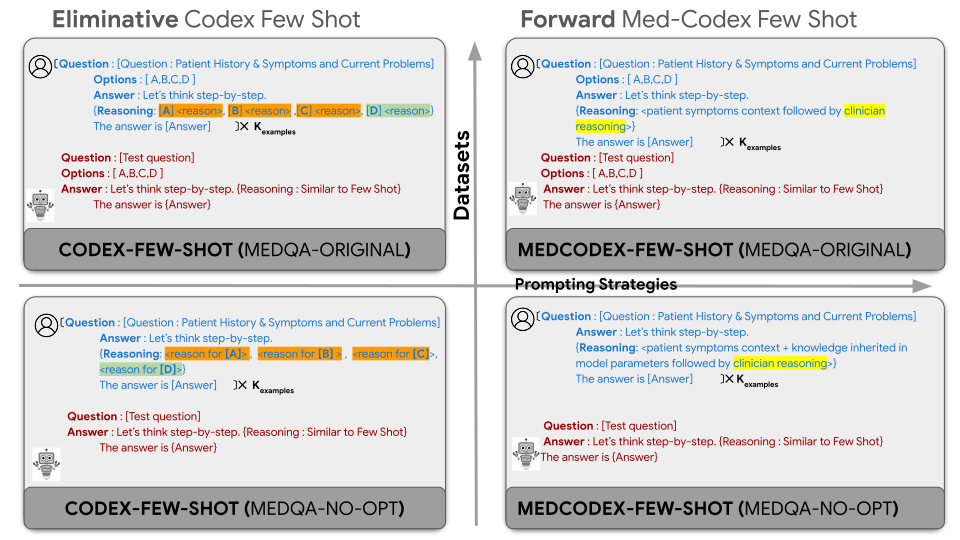
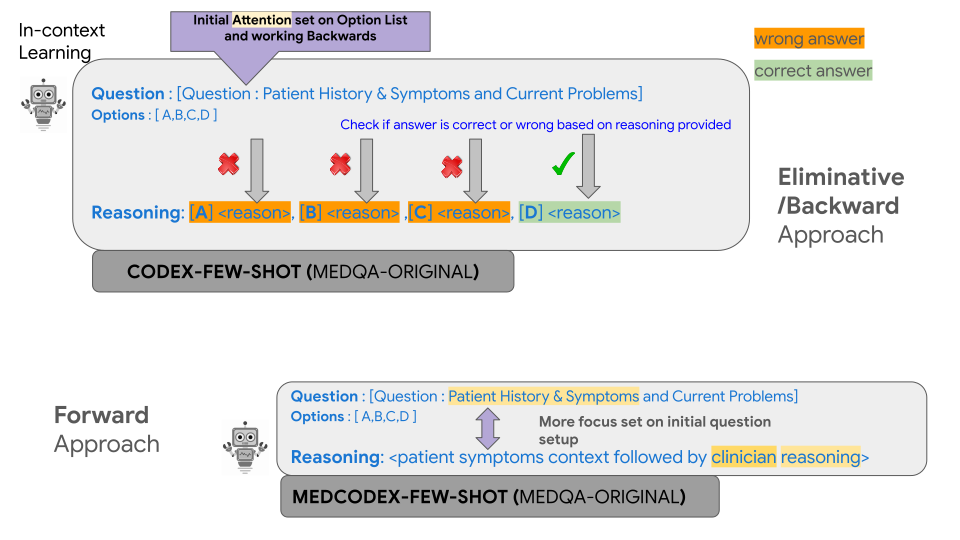
- Designed an incremental reasoning prompt that guides the LLM to generate step-by-step, forward-looking clinical reasoning, emulating real diagnostic workflows.
- Generated reasoning traces using the Llama2-7b-chat model prompted with the incremental reasoning template, then validated these by medical experts.
- Constructed a reward model using pairwise preference learning: positive (correct) and negative (incorrect) response-reasoning pairs from the same question, with a reward margin of 0.4.
- Fine-tuned the Llama2-7b-chat model with LoRA for reward modeling using the loss function: $\mathcal{L}^{rw} = -\log(\sigma(r_{\boldsymbol{\phi}}(q_i, o^{c}_i) - r_{\boldsymbol{\phi}}(q_i, o^{r}_i) - m(r)))$.
- Used the trained reward model to select the highest-scoring response from four options generated via MedCodex few-shot prompting, enabling verifier-driven answer selection.
Experimental results
Research questions
- RQ1Can incremental reasoning prompting improve the quality and accuracy of LLM-generated responses in open-ended medical question answering compared to standard few-shot CoT prompting?
- RQ2To what extent does a reward model trained on human-verified reasoning-answer pairs improve the selection of high-quality responses in medical LLMs?
- RQ3Does the verifier-based response selection strategy outperform traditional prompting methods like prompt chaining and eliminative reasoning in clinical reasoning tasks?
- RQ4How does the performance of the incremental reasoning method vary across different LLM parameter scales, particularly when applied to smaller models like Llama2-7B?
- RQ5Can a reward model trained on reasoning quality effectively guide LLMs to select accurate answers even when the model is not fine-tuned on medical data?
Key findings
- The incremental reasoning prompt achieved 86% expert agreement on reasoning quality and final answer accuracy in a 100-question evaluation on the MedQA-No-Opt dataset using the Llama2-7B model.
- The verifier-based response selection strategy significantly outperformed baseline prompting methods, including prompt chaining and eliminative reasoning, in selecting accurate and explainable responses.
- The incremental reasoning method outperformed the modified 5-shot-Codex-CoT prompt in specific clinical reasoning scenarios, particularly those requiring multi-step diagnostic reasoning.
- Greedy decoding with the incremental reasoning method yielded better results than other decoding strategies, indicating its robustness and reliability in generating coherent reasoning.
- The reward model trained on human-verified reasoning pairs demonstrated strong capability in distinguishing correct from incorrect responses, with medical experts reliably identifying flaws in reasoning even when answers were correct.
- The approach shows potential to outperform larger models through improved prompting and verification, suggesting that advanced prompting and verification can compensate for model size limitations.
Read this paper
Open the full text in the Nubint reader and ask about any passage as you read.
Read this paper on NubintThis review was generated by AI from the original paper. Please check the paper before citing it.