
[Paper Review] Galaxy archaeology for wet mergers: Globular cluster age distributions in the Milky Way and nearby galaxies
This paper proposes that multimodal globular cluster (GC) age distributions serve as tracers of past wet mergers in galaxies, leveraging the Milky Way and nearby galaxies (M31, NGC 1407, NGC 3115) as laboratories. By comparing observed GC age distributions with simulated merger histories, it demonstrates that younger GC populations—especially those formed during gas-rich mergers—leave distinct age peaks that correlate with wet merger events, enabling inference of otherwise untraceable merger histories.
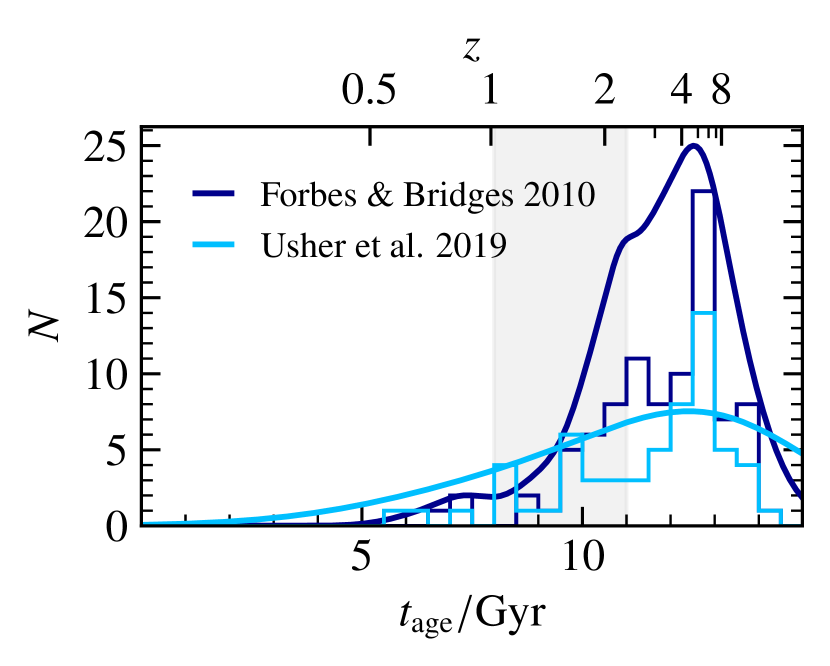
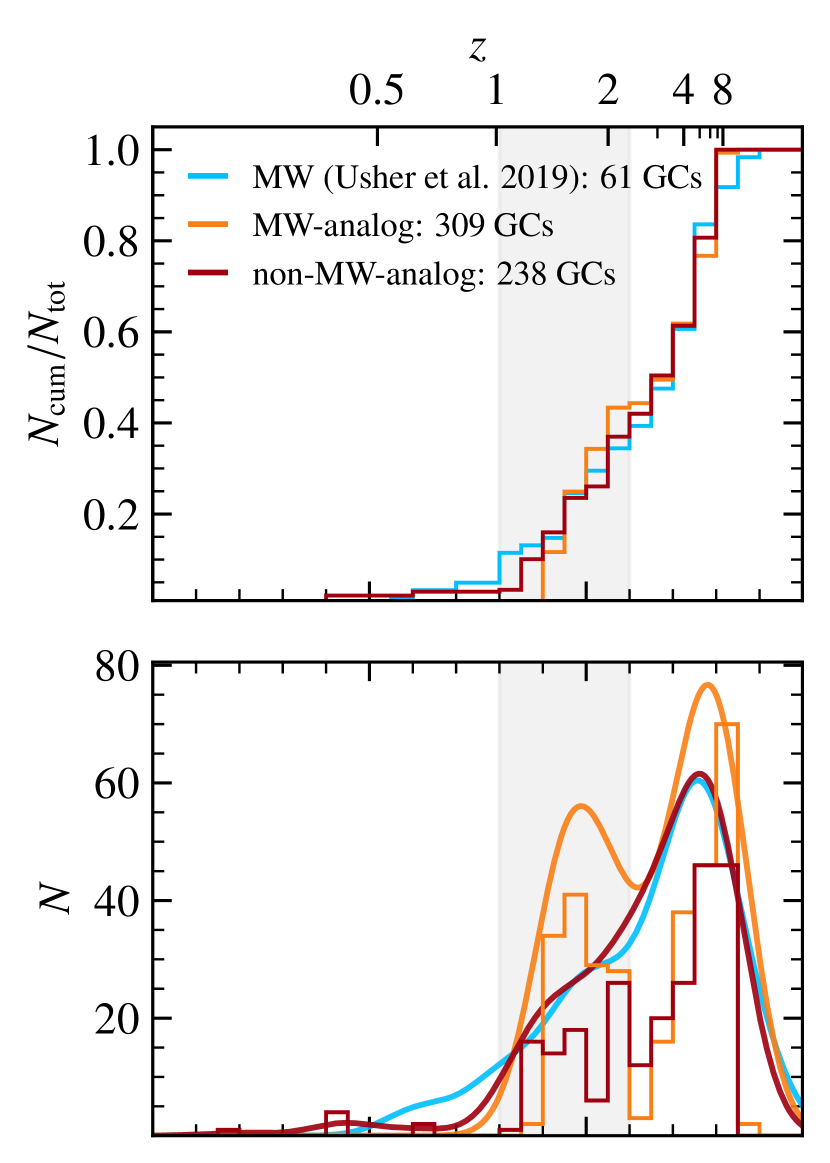
Identifying past wet merger activity in galaxies has been a longstanding issue in extragalactic formation history studies. Gaia's 6D kinematic measurements in our Milky Way (MW) have vastly extended the possibilities for Galactic archaeology, leading to the discovery of early mergers in the MW's past. As recent work has established a link between young globular clusters (GCs) and wet galaxy merger events, the MW provides an ideal laboratory for testing how GCs can be used to trace galaxy formation histories. To test the hypothesis that GCs trace wet mergers, we relate the measured GC age distributions of the MW and three nearby galaxies to their merger histories and interpret the connection with wet mergers through an empirical model for GC formation. For the MW, we cross-match the GCs with their associated progenitor host galaxies to disentangle the connection to the GC age distribution. We find that the MW GC age distribution is bimodal, mainly caused by younger GCs associated with Gaia-Sausage/Enceladus (GSE) and in part by unassociated high-energy GCs. The GSE GC age distribution also appears to be bimodal. We propose that the older GSE GCs were accreted together with GSE, while the younger ones formed through the merger. For the nearby galaxies, we find that peaks in the GC age distributions coincide with early gas-rich mergers. Even small signatures in the GC age distributions agree well with the formation histories of the galaxies inferred through other observed tracers. From the models, we predict that the involved cold gas mass can be estimated from the number of GCs found in the formation burst. Multimodal GC age distributions can trace massive wet mergers as a result of GCs being formed through them. From the laboratory of our own MW and nearby galaxies we conclude that the ages of younger GC populations of galaxies can be used to infer the wet merger history of a galaxy.
Motivation & Objective
- To test whether globular cluster (GC) age distributions can serve as empirical tracers of wet merger events in galaxy formation.
- To investigate the connection between observed GC age distributions in the Milky Way and nearby galaxies and their inferred merger histories.
- To determine whether the presence of younger GC populations correlates with past wet (gas-rich) mergers, especially in galaxies with limited observable merger tracers.
- To develop and validate a model linking GC formation bursts during wet mergers to observable age distribution features in galaxies.
- To assess the feasibility of using GC age distributions as a diagnostic tool for constraining the timing and nature of wet mergers in extragalactic systems.
Proposed method
- Compiled observed GC age distributions from multiple studies for the Milky Way, M31, NGC 1407, and NGC 3115 for comparative analysis.
- Cross-matched Milky Way GCs with their progenitor hosts (e.g., Gaia-Sausage/Enceladus) to disentangle age distribution contributions from accreted systems.
- Used empirical models of GC formation to simulate galaxy merger histories that reproduce observed GC age distributions.
- Identified simulated galaxies with GC age distributions matching observed ones and compared their accretion histories to observational tracers.
- Tracked the formation of young GCs in simulations to link them to wet merger events, particularly those with high cold gas fractions.
- Evaluated the detectability of wet merger signatures by assessing the prominence of age peaks in GC distributions, especially in systems with low merger mass ratios.
Experimental results
Research questions
- RQ1Can multimodal globular cluster age distributions be used to identify past wet merger events in galaxies?
- RQ2To what extent do the age distributions of globular clusters in the Milky Way and nearby galaxies reflect the timing and nature of wet mergers?
- RQ3How do the age distributions of globular clusters associated with accreted systems (e.g., Gaia-Sausage/Enceladus) compare to those of in-situ clusters?
- RQ4Can small or minor wet merger events leave observable signatures in the globular cluster age distribution?
- RQ5What is the relationship between the number of GCs formed in a merger burst and the cold gas mass involved in the wet merger?
Key findings
- The Milky Way's globular cluster age distribution is bimodal, primarily due to younger clusters associated with the Gaia-Sausage/Enceladus (GSE) merger and a population of unassociated high-energy GCs.
- The GSE's GC age distribution is also bimodal, with older clusters accreted with the system and younger ones formed during the merger, indicating in-situ formation triggered by wet merger dynamics.
- Clear peaks in the GC age distributions of NGC 3115, M31, and NGC 1407 coincide with early phases of gas-rich merger activity, supporting the link between GC formation bursts and wet mergers.
- Even small, low-mass wet merger events leave detectable, albeit subtle, signatures in the form of minor peaks in the GC age distribution, particularly in systems like NGC 3115 and NGC 1407.
- Simulations show that galaxies with GC age distributions matching the Milky Way and NGC 3115 underwent a major wet merger around 8–10 Gyr ago, consistent with observed merger histories.
- The model predicts that the number of GCs formed in a burst can be used to estimate the cold gas mass involved in a wet merger, providing a quantitative link between GC formation and merger properties.
Better researchstarts right now
From reading papers to final review, dramatically reduce your research time.
No credit card · Free plan available
This review was created by AI and reviewed by human editors.