
[Paper Review] Generative AI for Cyber Threat-Hunting in 6G-enabled IoT Networks
This paper proposes a novel generative adversarial network (GAN) and Transformer-based model for proactive cyber threat-hunting in 6G-enabled IoT networks. Leveraging a new cybersecurity dataset, the Transformer-based model achieves 95% overall accuracy in detecting IoT attacks, demonstrating the potential of generative AI for enhancing security in next-generation connected systems.
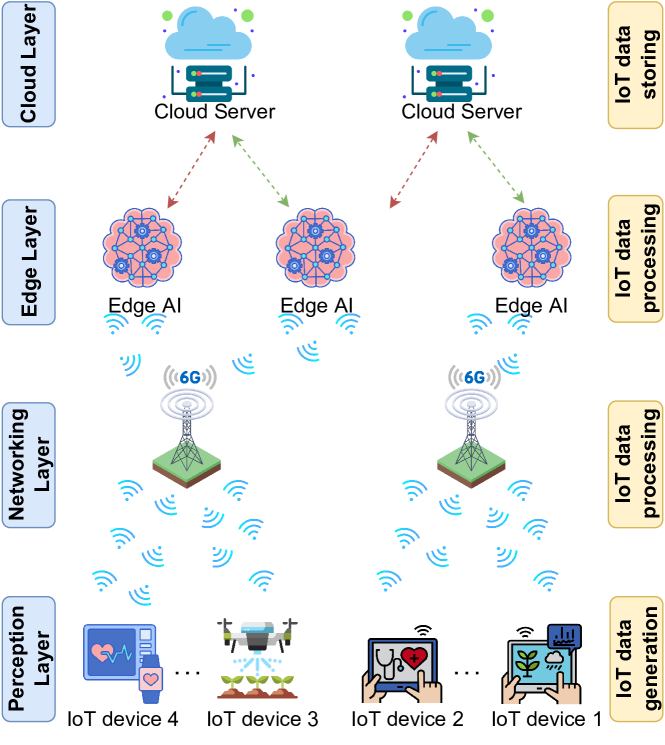
The next generation of cellular technology, 6G, is being developed to enable a wide range of new applications and services for the Internet of Things (IoT). One of 6G's main advantages for IoT applications is its ability to support much higher data rates and bandwidth as well as to support ultra-low latency. However, with this increased connectivity will come to an increased risk of cyber threats, as attackers will be able to exploit the large network of connected devices. Generative Artificial Intelligence (AI) can be used to detect and prevent cyber attacks by continuously learning and adapting to new threats and vulnerabilities. In this paper, we discuss the use of generative AI for cyber threat-hunting (CTH) in 6G-enabled IoT networks. Then, we propose a new generative adversarial network (GAN) and Transformer-based model for CTH in 6G-enabled IoT Networks. The experimental analysis results with a new cyber security dataset demonstrate that the Transformer-based security model for CTH can detect IoT attacks with a high overall accuracy of 95%. We examine the challenges and opportunities and conclude by highlighting the potential of generative AI in enhancing the security of 6G-enabled IoT networks and call for further research to be conducted in this area.
Motivation & Objective
- Address the rising cyber threat surface in 6G-enabled IoT networks due to massive device connectivity and ultra-low latency requirements.
- Explore the potential of generative AI in proactive threat detection, moving beyond signature-based methods to identify novel and evolving attack patterns.
- Propose a novel hybrid GAN and Transformer-based architecture tailored for cyber threat-hunting in 6G-IoT environments.
- Evaluate the performance of generative AI models—including GAN, GPT, and BERT variants—on a newly collected cybersecurity dataset for IoT.
- Identify and analyze key challenges such as data quality, privacy, energy efficiency, and scalability in deploying generative AI for IoT security.
Proposed method
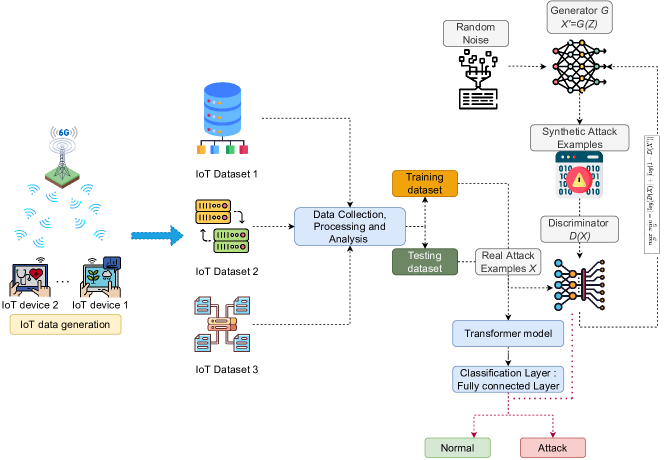
- Design a hybrid generative model combining a Generative Adversarial Network (GAN) for synthetic data generation and anomaly simulation with a Transformer-based encoder for sequence-level feature extraction from network traffic.
- Utilize the Transformer architecture to process sequential network traffic data, capturing long-range dependencies and contextual patterns indicative of malicious behavior.
- Train the GAN component on real IoT network traffic to learn the distribution of normal behavior, enabling it to generate realistic adversarial samples for data augmentation.
- Fine-tune the Transformer model on a newly collected, labeled cybersecurity dataset of 6G-IoT network traffic to detect anomalies and attacks with high precision.
- Implement a dual-stage detection pipeline: GAN for data augmentation and anomaly synthesis, followed by the Transformer for real-time threat classification.
- Apply attention mechanisms in the Transformer to weigh critical features in network packets, improving detection sensitivity to subtle attack indicators.
Experimental results
Research questions
- RQ1How effective is a Transformer-based model in detecting cyber threats within 6G-enabled IoT network traffic compared to traditional or other generative AI models?
- RQ2To what extent can a GAN-based component enhance data augmentation and anomaly synthesis for training robust cyber threat-hunting models in IoT environments?
- RQ3What are the key challenges—such as data quality, privacy, energy consumption, and tokenization—when deploying generative AI for cyber threat-hunting in 6G-IoT systems?
- RQ4How does the proposed hybrid GAN-Transformer model perform in terms of detection accuracy, false positive rates, and scalability on a real-world 6G-IoT cybersecurity dataset?
- RQ5What are the implications of decentralized training and model privacy attacks (e.g., model inversion) on the security and deployment of generative AI in distributed 6G-IoT networks?
Key findings
- The proposed Transformer-based cyber threat-hunting model achieves a high overall detection accuracy of 95% on a newly collected 6G-enabled IoT cybersecurity dataset.
- The integration of GAN-based data augmentation improves model robustness by generating realistic attack patterns and enhancing training data diversity.
- Generative AI models, particularly Transformers, outperform traditional AI and other generative models (e.g., GPT, BERT) in detecting complex, evolving IoT-based cyber threats.
- The study identifies significant challenges, including data bias, model inversion attacks, and high energy consumption, particularly for large-scale models like GPT-3.
- Tokenization issues—such as handling out-of-vocabulary (OOV) words and special characters—pose a critical challenge for NLP-based threat detection in heterogeneous IoT traffic.
- Energy efficiency and privacy-preserving training remain major hurdles, with large models requiring substantial computational resources and posing risks of data leakage during fine-tuning.
Read this paper
Open the full text in the Nubint reader and ask about any passage as you read.
Read this paper on NubintThis review was generated by AI from the original paper. Please check the paper before citing it.