
[论文解读] Generative AI is already widespread in the public sector
该研究针对938名英国公共部门专业人士进行调查,显示生成式AI的使用已相当普遍,对生产力提升持乐观态度,但缺乏明确的指南和问责机制。
Generative AI has the potential to transform how public services are delivered by enhancing productivity and reducing time spent on bureaucracy. Furthermore, unlike other types of artificial intelligence, it is a technology that has quickly become widely available for bottom-up adoption: essentially anyone can decide to make use of it in their day to day work. But to what extent is generative AI already in use in the public sector? Our survey of 938 public service professionals within the UK (covering education, health, social work and emergency services) seeks to answer this question. We find that use of generative AI systems is already widespread: 45% of respondents were aware of generative AI usage within their area of work, while 22% actively use a generative AI system. Public sector professionals were positive about both current use of the technology and its potential to enhance their efficiency and reduce bureaucratic workload in the future. For example, those working in the NHS thought that time spent on bureaucracy could drop from 50% to 30% if generative AI was properly exploited, an equivalent of one day per week (an enormous potential impact). Our survey also found a high amount of trust (61%) around generative AI outputs, and a low fear of replacement (16%). While respondents were optimistic overall, areas of concern included feeling like the UK is missing out on opportunities to use AI to improve public services (76%), and only a minority of respondents (32%) felt like there was clear guidance on generative AI usage in their workplaces. In other words, it is clear that generative AI is already transforming the public sector, but uptake is happening in a disorganised fashion without clear guidelines. The UK's public sector urgently needs to develop more systematic methods for taking advantage of the technology.
研究动机与目标
- 评估英国公共服务中对生成式AI的当前认知与使用情况。
- 量化哪些公共部门职业已经采用生成式AI,以及采用率是多少。
- 评估与生成式AI采用相关的感知生产力提升和关注点。
- 识别关于生成式AI输出的指南及问责方面的清晰度与可用性。
提出的方法
- 通过 Qualtrics 于 2023 年 11 月对 938 名英国公共部门专业人员进行的在线调查。
- 通过 Prolific 招募,参与者来自 NHS、急救服务、社会照护、学校和大学。
- 将人工智能类型分为生成式、决策支持和感知型;重点关注 GenAI 的使用情况和认知。
- 使用描述性统计、卡方检验和单因素方差分析在 R 中进行统计分析。
实验结果
研究问题
- RQ1公共部门工作人员对生成式AI的认知程度及实际使用程度如何?
- RQ2哪些部门或职业的 GenAI 使用率较高,使用情况与人口统计特征之间有何关系?
- RQ3员工将 GenAI 与生产力提升相关联的影响是什么,尤其是在减少繁文书工作时间方面?
- RQ4在工作场所使用 GenAI 时,感知的风险、指南和问责方面的关切有哪些?
主要发现
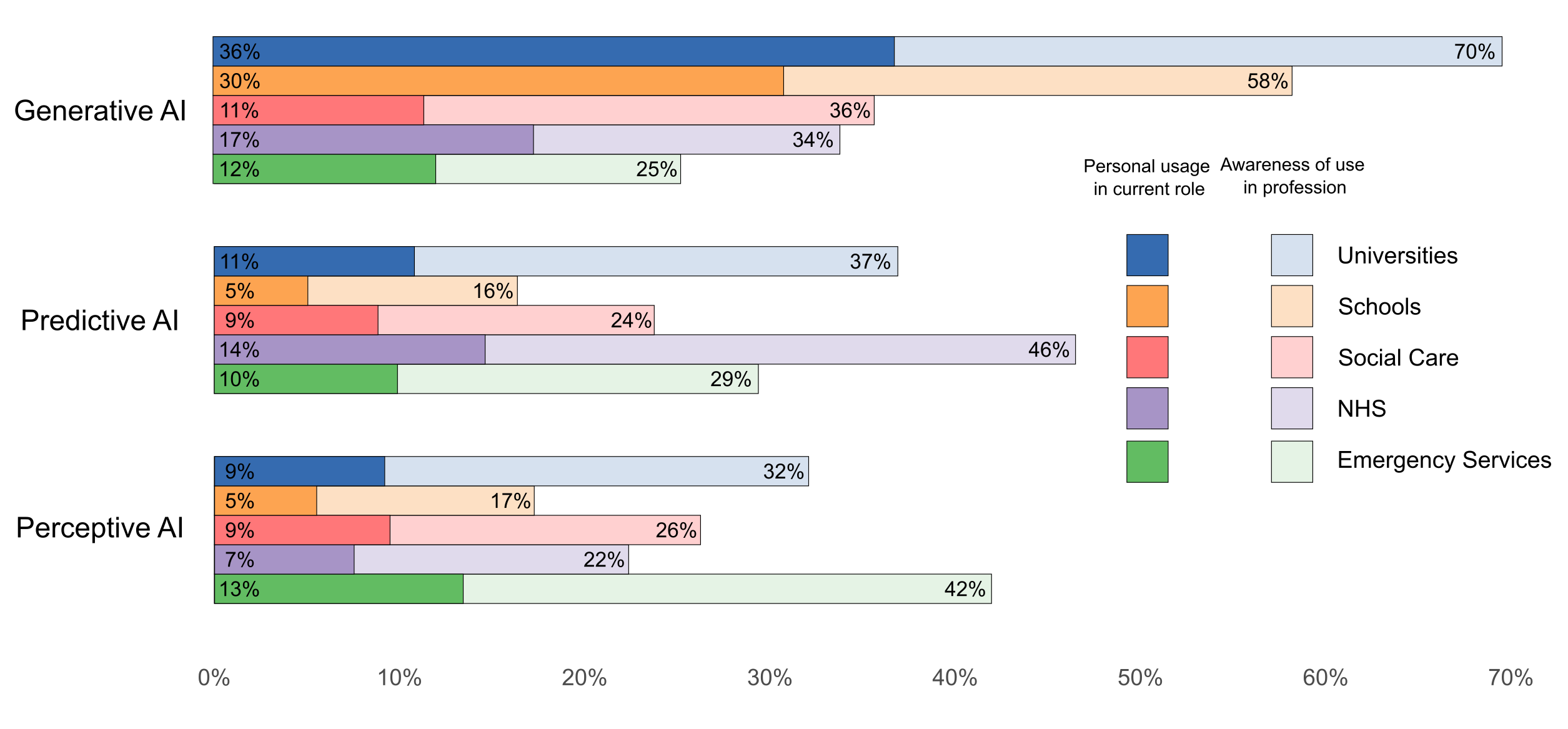
- GenAI 认知度:45% 的受访者了解其工作领域内的 GenAI 使用;22% 实际使用 GenAI 系统。
- uptake varies: 将英文学翻译:部门差异,Universities 36.4% 和 Schools 30.5% 的报告显示更高 GenAI 使用,而 NHS 17%、Emergency Services 12%、Social Care 11% 的采用率较低。
- 在 GenAI 用户(n=209)中,132 人(63%)使用过 ChatGPT;Universities(26.7%)和 Schools(19.6%)更可能报告使用 ChatGPT。
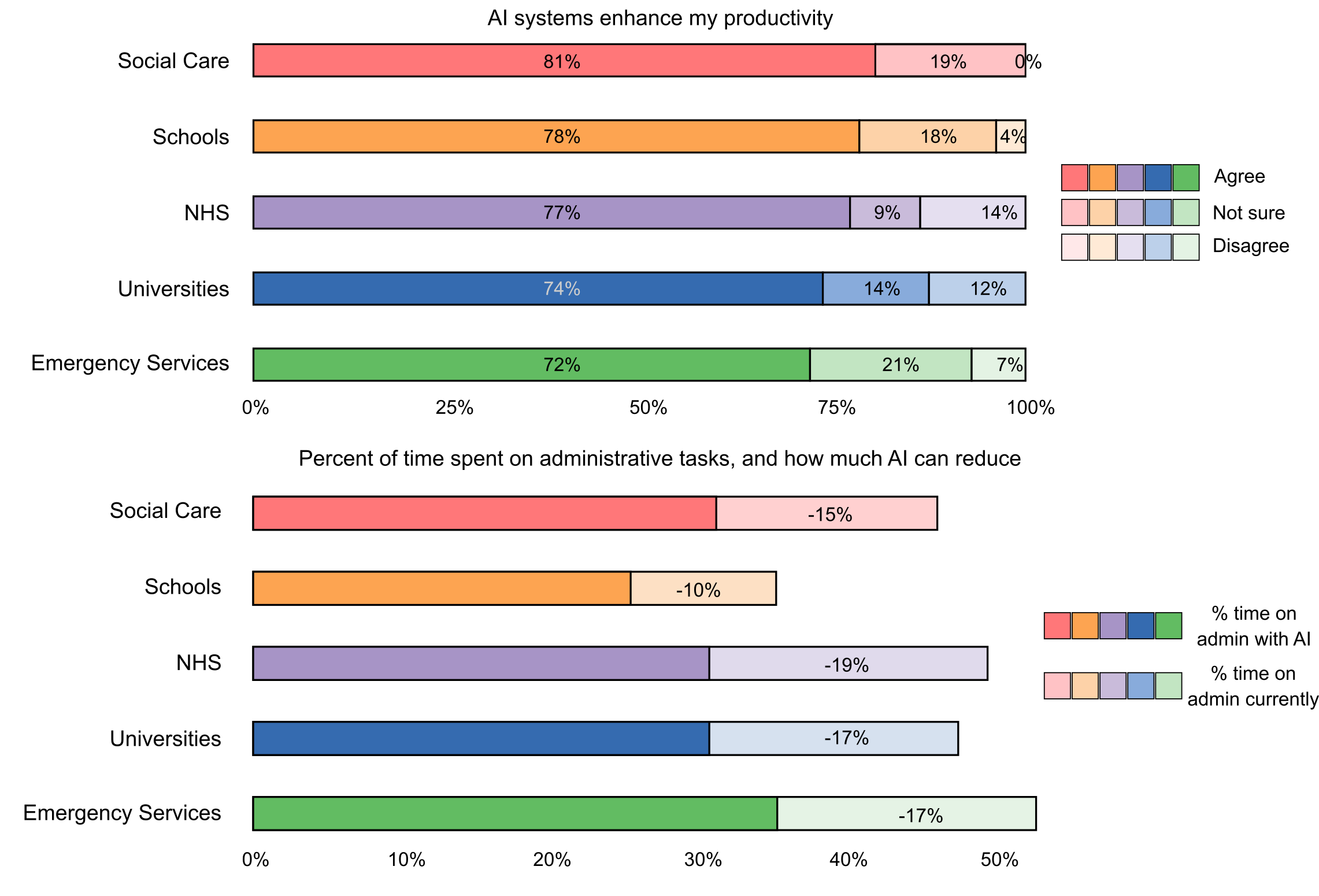
- 使用 GenAI 的受访者感知生产力提升和官僚程序减少,其中 NHS 用户估计官僚时间可以从占比50%降至30%。
- 在用户中对 GenAI 输出的总体信任度较高(61% 的用户);16% 担心自己的工作被取代。
- 多数受访者(76%)认为英国在将 AI 用于公共服务方面错失机会,只有 32% 认为在工作场所对 GenAI 的使用有明确的指导。
更好的研究,从现在开始
从论文设计到论文写作,大幅缩短您的研究时间。
无需绑定信用卡
本解读由 AI 生成,并经人工编辑审核。