
[Paper Review] Golden Reference-Free Hardware Trojan Localization using Graph Convolutional Network
This paper proposes a golden reference-free Hardware Trojan (HT) localization method using Graph Convolutional Networks (GCN) to automatically detect malicious nodes in pre-silicon RTL designs. By converting the circuit into a graph and leveraging GCN for end-to-end node classification, the approach achieves 99.6% accuracy and a false positive rate below 0.009%, eliminating the need for manual feature engineering or trusted reference designs.
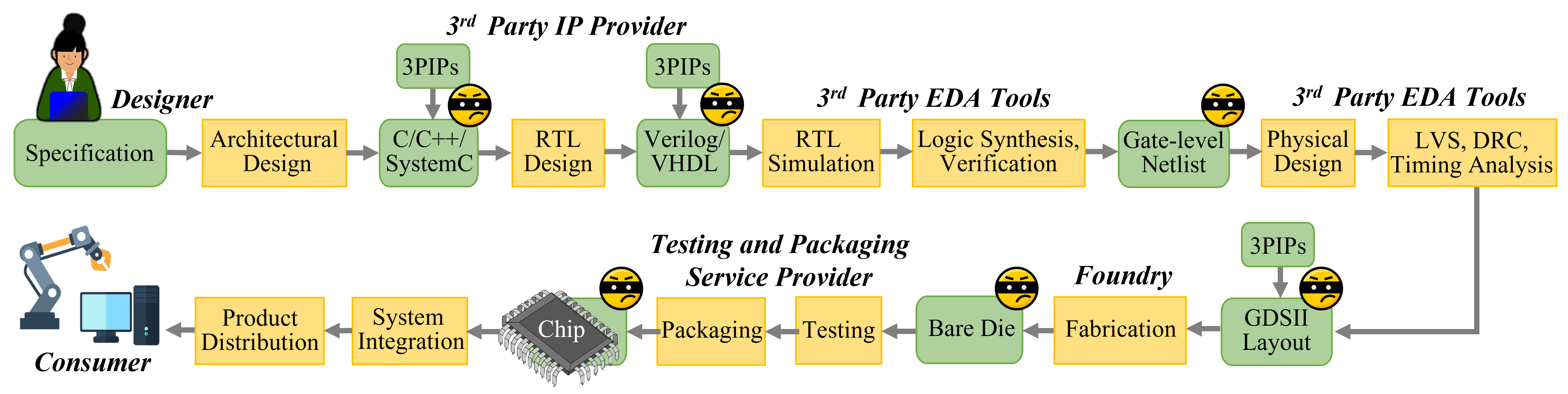
The globalization of the Integrated Circuit (IC) supply chain has moved most of the design, fabrication, and testing process from a single trusted entity to various untrusted third-party entities worldwide. The risk of using untrusted third-Party Intellectual Property (3PIP) is the possibility for adversaries to insert malicious modifications known as Hardware Trojans (HTs). These HTs can compromise the integrity, deteriorate the performance, deny the service, and alter the functionality of the design. While numerous HT detection methods have been proposed in the literature, the crucial task of HT localization is overlooked. Moreover, a few existing HT localization methods have several weaknesses: reliance on a golden reference, inability to generalize for all types of HT, lack of scalability, low localization resolution, and manual feature engineering/property definition. To overcome their shortcomings, we propose a novel, golden reference-free HT localization method at the pre-silicon stage by leveraging Graph Convolutional Network (GCN). In this work, we convert the circuit design to its intrinsic data structure, graph and extract the node attributes. Afterward, the graph convolution performs automatic feature extraction for nodes to classify the nodes as Trojan or benign. Our automated approach does not burden the designer with manual code review. It locates the Trojan signals with 99.6% accuracy, 93.1% F1-score, and a false-positive rate below 0.009%.
Motivation & Objective
- Address the critical gap in Hardware Trojan (HT) localization, which is often overlooked despite extensive research on HT detection.
- Overcome the limitations of existing HT localization methods that rely on golden references, lack generalization, or require manual feature engineering.
- Enable automated, scalable, and high-resolution HT localization in RTL designs without requiring trusted reference circuits.
- Develop a graph-based deep learning framework that preserves topological structure and enables end-to-end classification of Trojan nodes.
- Achieve high detection performance across diverse HT types and circuit sizes while minimizing false positives.
Proposed method
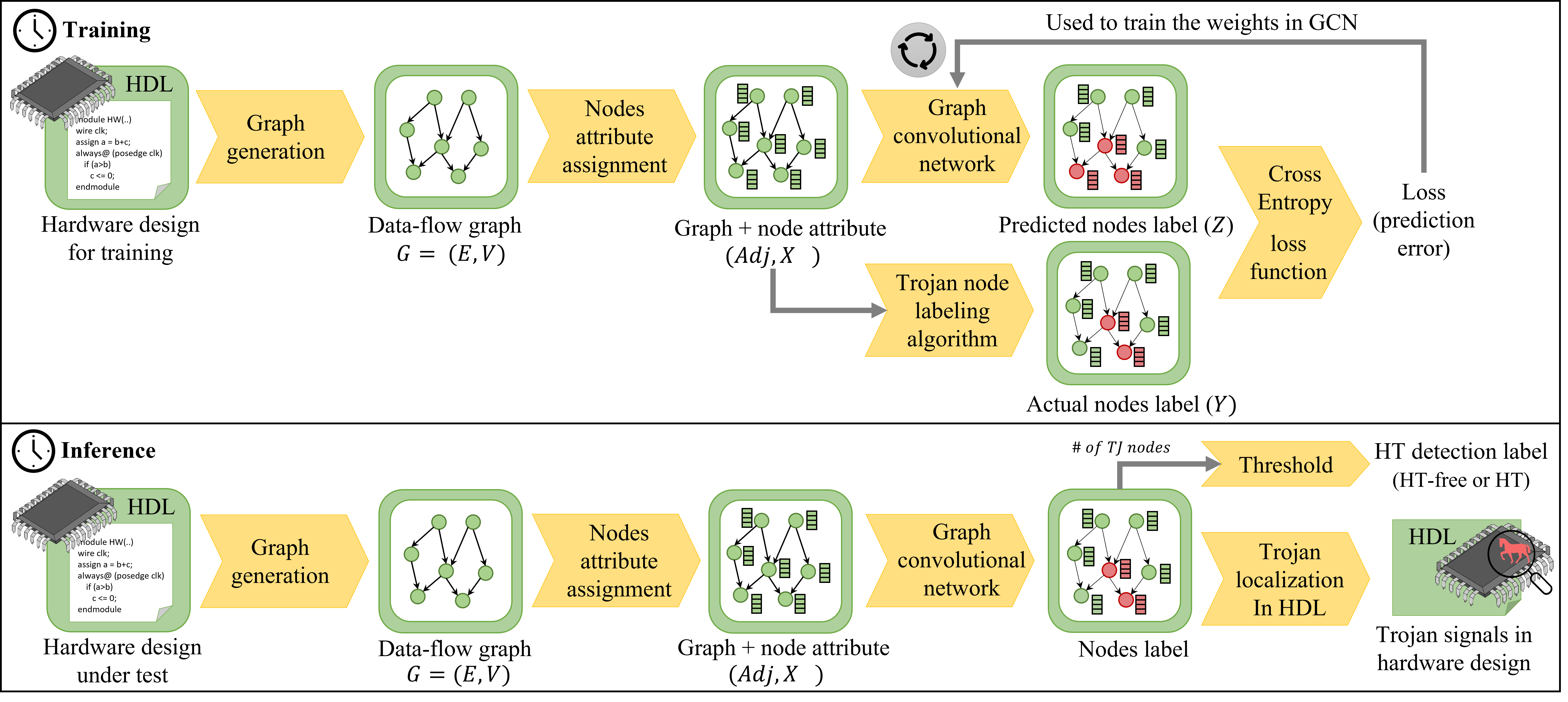
- Transform the Register Transfer Level (RTL) hardware design into a graph data structure, where design entities (e.g., registers, wires, modules) become nodes and their interconnections become edges.
- Extract node attributes from RTL code, such as signal types, control flow, and structural properties, to enrich the graph representation.
- Apply a 4-layer Graph Convolutional Network (GCN) to perform automatic, hierarchical feature learning on the graph, capturing both local and global structural patterns.
- Use a weighted cross-entropy loss function with a 6:1 class weight ratio (Trojan:benign) to address class imbalance caused by the small size of HT circuits.
- Train the GCN model to classify each node as either benign or Trojan, enabling precise localization of malicious components.
- Optimize model architecture and hyperparameters through ablation studies comparing GCN, GAT, and LEC on varying depths (2–4 layers), selecting the best-performing configuration.
Experimental results
Research questions
- RQ1Can a GCN-based approach achieve high-accuracy Hardware Trojan localization without relying on a golden reference design?
- RQ2How effective is graph representation learning in capturing structural and functional anomalies indicative of HTs in RTL designs?
- RQ3To what extent can automated feature learning in GCN outperform manual feature engineering in HT detection and localization?
- RQ4How does class imbalance in HT datasets affect model performance, and what loss weighting strategy optimizes detection and minimizes false positives?
- RQ5Can the proposed method generalize across diverse HT types and circuit sizes with consistent high performance?
Key findings
- The proposed GCN-based method achieves 99.6% accuracy in localizing Hardware Trojans across a diverse set of benchmark circuits.
- The model attains a 93.1% F1-score, indicating a strong balance between precision and recall in identifying Trojan nodes.
- The false positive rate is below 0.009%, demonstrating high reliability in minimizing incorrect alerts.
- The optimal class weight for loss function is determined to be 6:1 (Trojan:benign), which maximizes F1-score by addressing dataset imbalance.
- The 4-layer GCN outperforms GAT and LEC models, with performance improving as depth increases, confirming its suitability for this task.
- The method generalizes well across different HT types (e.g., DES, RC5) and circuit sizes, with average performance across all benchmarks showing robustness.
Read this paper
Open the full text in the Nubint reader and ask about any passage as you read.
Read this paper on NubintThis review was generated by AI from the original paper. Please check the paper before citing it.