
[Paper Review] Gradient-free neural topology optimization: Towards effective fracture-resistant designs
This paper proposes a gradient-free neural topology optimization framework using a pre-trained Latent-Bernoulli Autoencoder (LBAE) to reparameterize designs into a lower-dimensional latent space, reducing iteration count by at least one order of magnitude. The method enables effective optimization of non-differentiable, fracture-resistant designs where gradient-based methods fail, demonstrating strong generalization to out-of-distribution problems and significant performance gains over conventional black-box optimization.
Gradient-free optimizers allow for tackling problems regardless of the smoothness or differentiability of their objective function, but they require many more iterations to converge when compared to gradient-based algorithms. This has made them unviable for topology optimization due to the high computational cost per iteration and the high dimensionality of these problems. We propose a gradient-free neural topology optimization method using a pre-trained neural reparameterization strategy that addresses two key challenges in the literature. First, the method leads to at least one order of magnitude decrease in iteration count to reach minimum compliance when optimizing designs in latent space, as opposed to the conventional gradient-free approach without latent parameterization. This helps to bridge the large performance gap between gradient-free and gradient-based topology optimization for smooth and differentiable problems like compliance optimization, as demonstrated via extensive computational experiments in- and out-of-distribution with the training data. Second, we also show that the proposed method can optimize toughness of a structure undergoing brittle fracture more effectively than a traditional gradient-based optimizer, delivering an objective improvement in the order of 30% for all tested configurations. Although gradient-based topology optimization is more efficient for problems that are differentiable and well-behaved, such as compliance optimization, we believe that this work opens up a new path for problems where gradient-based algorithms have limitations.
Motivation & Objective
- Address the high computational cost and slow convergence of gradient-free optimization in high-dimensional topology optimization problems.
- Overcome the curse of dimensionality and poor scalability of gradient-free methods in topology optimization, especially for non-differentiable objectives like fracture.
- Enable effective optimization of complex, non-smooth objectives—such as fracture resistance—where gradient-based methods are infeasible due to discontinuous or noisy gradients.
- Demonstrate that latent space optimization with a pre-trained LBAE can significantly close the performance gap between gradient-free and gradient-based methods.
- Investigate generalization to out-of-distribution problems and new physics domains without retraining, validating robustness and transferability.
Proposed method
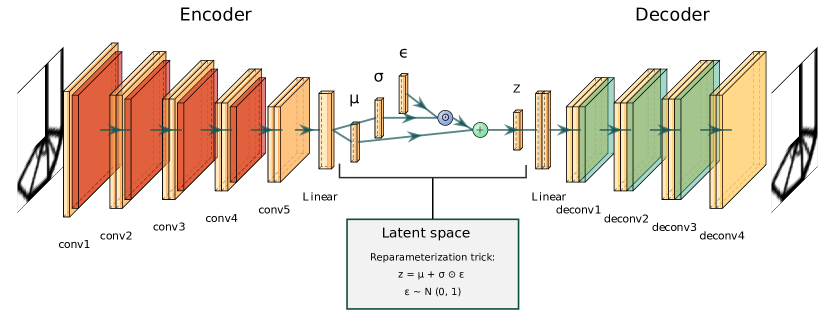
- Employ a Latent-Bernoulli Autoencoder (LBAE) to learn a low-dimensional, disentangled latent representation of topology designs from a diverse dataset of training examples.
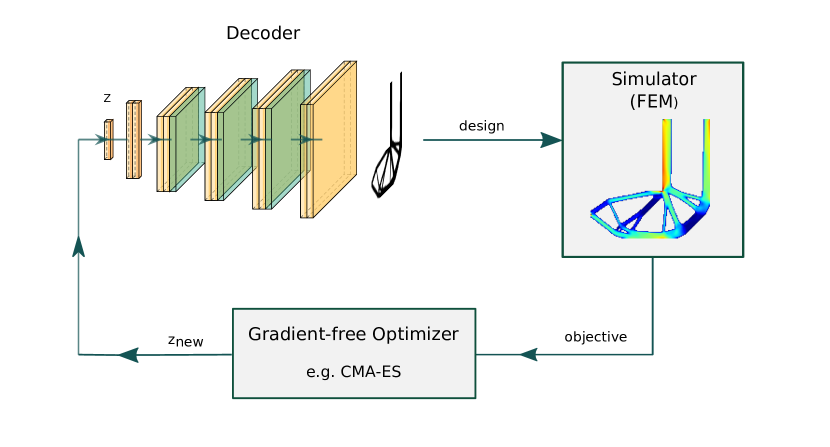
- Reparameterize the topology optimization problem into the latent space of the LBAE, reducing the dimensionality of the design variables and improving optimization efficiency.
- Use a gradient-free optimizer (CMA-ES) in the latent space to iteratively update designs based on performance evaluations via FEM simulations.
- Enforce hard constraints (e.g., volume fraction) in the latent space by restricting optimization to a manifold corresponding to a specific constraint value.
- Train the LBAE on a diverse distribution of designs with varying volume fractions and topologies to improve generalization and expressivity.
- Benchmark performance using a fixed simulation budget (FEM evaluations), while accounting for parallel population evaluation to reflect actual wall-clock time.
Experimental results
Research questions
- RQ1Can latent space reparameterization via a pre-trained autoencoder significantly reduce the number of iterations required for convergence in gradient-free topology optimization?
- RQ2How does the performance of latent-space optimization compare to conventional black-box optimization in terms of convergence speed and solution quality?
- RQ3To what extent can a model trained on one class of topology problems (e.g., structural compliance) generalize to out-of-distribution problems (e.g., thermal compliance) without retraining?
- RQ4Does the proposed method enable effective optimization of non-differentiable objectives such as fracture resistance, where gradient-based methods fail?
- RQ5Can the latent space representation support diverse design features across multiple length scales, or is there a bias toward specific topological patterns?
Key findings
- The proposed latent reparameterization reduces the number of iterations required for convergence by at least one order of magnitude compared to conventional black-box optimization without reparameterization.
- Even in the worst-case scenario—considering only the worst runs across random initializations—the LBAE-based method outperforms the baseline by a significant margin.
- The method generalizes effectively to out-of-distribution problems, including a new physics problem (thermal compliance optimization), achieving performance close to that of gradient-based baselines.
- The model demonstrates promising generalization to designs with significantly different features than those in the training data, indicating robustness and transferability.
- The current approach exhibits a bias toward certain feature length scales, suggesting that more expressive architectures or improved constraint enforcement in latent space could further enhance solution diversity.
- Despite the lack of gradient information, the method achieves performance comparable to gradient-based approaches in non-differentiable settings, particularly for fracture-resistant design.
Better researchstarts right now
From reading papers to final review, dramatically reduce your research time.
No credit card · Free plan available
This review was created by AI and reviewed by human editors.