
[Paper Review] Graph Contrastive Learning for Multi-omics Data
This paper proposes MOGCL, a graph contrastive learning framework that pre-trains graph neural networks on multi-omics data using contrastive self-supervision before fine-tuning on downstream classification tasks. MOGCL outperforms multiple baselines, achieving up to 85.3% accuracy on BRCA and 81.8% on ROSMAP, demonstrating that pre-training with contrastive learning significantly improves representation learning for multi-omics classification.
Advancements in technologies related to working with omics data require novel computation methods to fully leverage information and help develop a better understanding of human diseases. This paper studies the effects of introducing graph contrastive learning to help leverage graph structure and information to produce better representations for downstream classification tasks for multi-omics datasets. We present a learnining framework named Multi-Omics Graph Contrastive Learner(MOGCL) which outperforms several aproaches for integrating multi-omics data for supervised learning tasks. We show that pre-training graph models with a contrastive methodology along with fine-tuning it in a supervised manner is an efficient strategy for multi-omics data classification.
Motivation & Objective
- To address the challenge of integrating heterogeneous multi-omics data (e.g., mRNA, miRNA, DNA methylation) for improved disease classification.
- To explore whether self-supervised pre-training via graph contrastive learning enhances representation learning in multi-omics datasets.
- To evaluate the effectiveness of graph neural networks combined with contrastive learning for supervised downstream classification tasks.
- To investigate the impact of different omics data permutations on model performance and identify the most informative data combinations.
- To demonstrate that pre-training with contrastive learning leads to better downstream performance than end-to-end training or non-contrastive baselines.
Proposed method
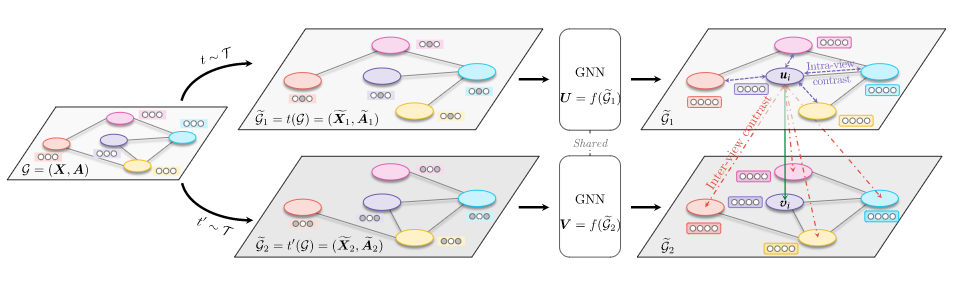
- Constructs a graph from multi-omics data by modeling samples as nodes and computing similarity-based edges using omics feature vectors.
- Applies graph augmentation techniques (e.g., feature masking, topology perturbation) to generate positive and negative view pairs for contrastive learning.
- Utilizes GRACE (deep GRAph Contrastive rEpresentation learning) as the pre-training objective to maximize agreement between augmented views of the same graph.
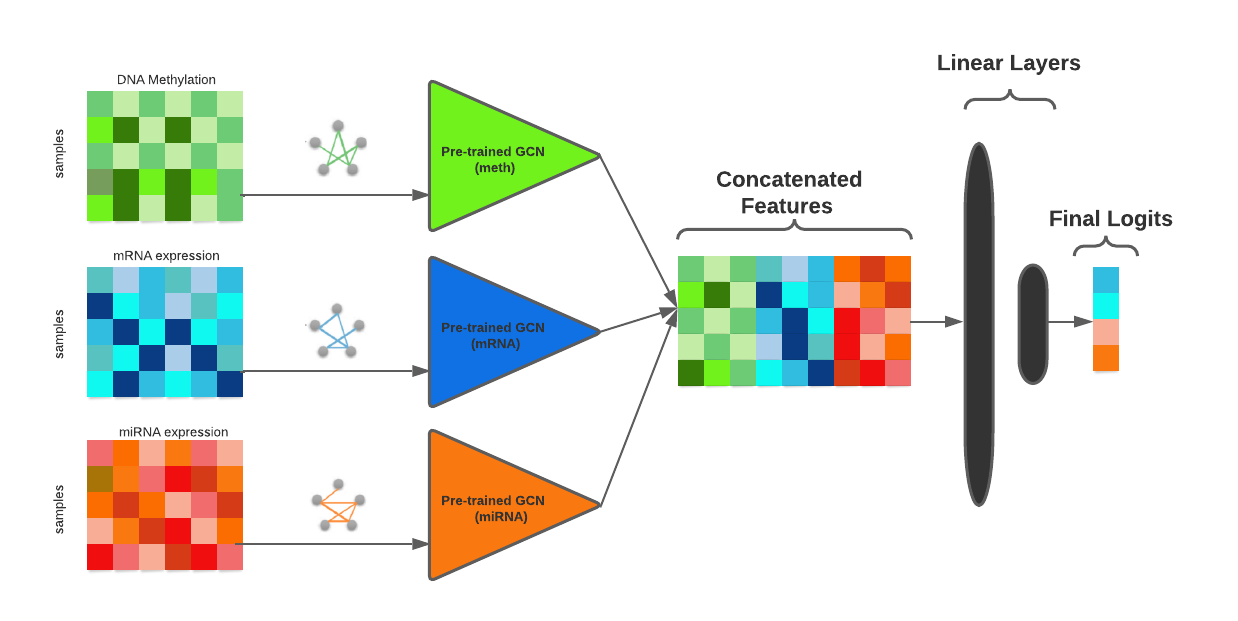
- Employs a Graph Convolutional Network (GCN) as the encoder to learn node representations during pre-training.
- Fine-tunes the pre-trained encoder on downstream classification tasks using true labels via cross-entropy loss.
- Evaluates performance across multiple omics data permutations to assess the contribution of individual omics types to final classification accuracy.
Experimental results
Research questions
- RQ1Can graph contrastive learning improve representation learning for multi-omics data in supervised classification tasks?
- RQ2How does pre-training with contrastive learning compare to end-to-end training or non-contrastive methods in terms of downstream performance?
- RQ3Which combination of omics data types (e.g., mRNA, miRNA, DNA methylation) yields the best classification performance when used in MOGCL?
- RQ4Does the semi-supervised pre-training phase lead to more structured and separable embeddings, as visualized via t-SNE?
- RQ5How does the performance of MOGCL vary across different multi-omics datasets like ROSMAP and BRCA?
Key findings
- MOGCL achieves an accuracy of 85.3% on the BRCA dataset, outperforming MOGONET_NN (80.5%) and other baselines.
- On the ROSMAP dataset, MOGCL reaches 81.8% accuracy, compared to 80.4% for MOGONET_NN, demonstrating consistent improvement through pre-training.
- MOGCL achieves an AUC of 0.866 on ROSMAP and 0.853 on BRCA, indicating strong discriminative performance.
- The F1-macro score for MOGCL is 0.823 on BRCA and 0.818 on ROSMAP, significantly higher than MOGONET_NN’s 0.737 and 0.808 respectively.
- Pre-training with contrastive learning leads to more structured and separable embeddings, as shown by t-SNE visualizations of GCN-encoded features.
- The best performance is achieved when all omics types are concatenated during input, with mRNA and DNA methylation forming the next best combination on BRCA, and mRNA and miRNA on ROSMAP.
Better researchstarts right now
From reading papers to final review, dramatically reduce your research time.
No credit card · Free plan available
This review was created by AI and reviewed by human editors.