
[Paper Review] Gravitational imaging through a triple source plane lens: revisiting the $Λ$CDM-defying dark subhalo in SDSSJ0946+1006
This study reanalyzes the triple-source-plane lens SDSSJ0946+1006 using multi-band HST and VLT-MUSE data to reassess a previously reported dark subhalo that appeared inconsistent with ΛCDM predictions. It finds a 5.9σ substructure with mass log₁₀(M/M☉) = 9.2⁺⁰.⁴₋₀.¹ and concentration log₁₀c = 2.4⁺⁰.⁵₋₀.³, now consistent with CDM simulations, while highlighting that detection significance is highly sensitive to source regularization schemes.
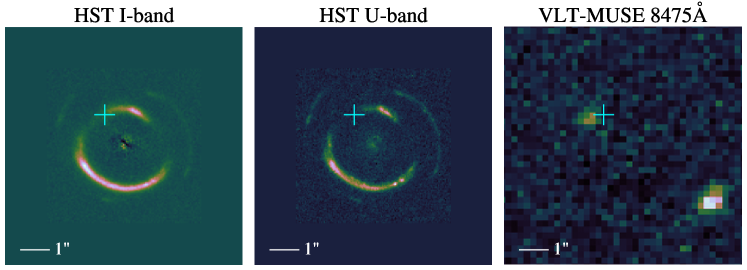
The $Λ$CDM paradigm successfully explains the large-scale structure of the Universe, but is less well constrained on sub-galactic scales. Gravitational lens modelling has been used to measure the imprints of dark substructures on lensed arcs, testing the small-scale predictions of $Λ$CDM. However, the methods required for these tests are subject to degeneracies among the lens mass model and the source light profile. We present a case study of the unique compound gravitational lens SDSSJ0946+1006, wherein a dark, massive substructure has been detected, whose reported high concentration would be unlikely in a $Λ$CDM universe. For the first time, we model the first two background sources in both I- and U-band HST imaging, as well as VLT-MUSE emission line data for the most distant source. We recover a lensing perturber at a $5.9σ$ confidence level with mass $\log_{10}(M_\mathrm{sub}/M_{\odot})=9.2^{+0.4}_{-0.1}$ and concentration $\log_{10}c=2.4^{+0.5}_{-0.3}$. The concentration is more consistent with CDM subhalos than previously reported, and the mass is compatible with that of a dwarf satellite galaxy whose flux is undetectable in the data at the location of the perturber. A wandering black hole with mass $\log_{10}(M_\mathrm{BH}/M_{\odot})=8.9^{+0.2}_{-0.1}$ is a viable alternative model. We systematically investigate alternative assumptions about the complexity of the mass distribution and source reconstruction; in all cases the subhalo is detected at around the $\geq5σ$ level. However, the detection significance can be altered substantially (up to $11.3σ$) by alternative choices for the source regularisation scheme.
Motivation & Objective
- To reassess the existence and properties of a previously reported dark subhalo in the triple-source-plane lens SDSSJ0946+1006, which was claimed to defy ΛCDM predictions.
- To investigate whether the subhalo's high concentration and mass are consistent with cold dark matter (CDM) simulations, given new multi-wavelength data.
- To evaluate the robustness of the subhalo detection against systematic uncertainties in lens modeling, particularly source reconstruction and regularization schemes.
- To determine whether alternative mass models—such as a wandering black hole—can explain the lensing anomalies without invoking a dark subhalo.
- To assess the impact of source regularization (gradient vs. curvature) on substructure detection significance and Bayesian evidence in strong lensing modeling.
Proposed method
- Performs joint lens modeling of I- and U-band HST imaging for the two closer sources (s1 and s2) and VLT-MUSE emission-line data for the distant source (s3).
- Employs a parametric macro-model for the main deflector and a non-parametric substructure model to detect dark perturbers.
- Uses Bayesian evidence and significance testing (via χ² and posterior sampling) to evaluate substructure detection across multiple model variants.
- Systematically varies source regularization schemes: gradient-based (fiducial) vs. curvature-based, to assess their impact on detection significance.
- Tests model robustness by including higher-order multipoles (3rd and 4th order) in the main deflector and allowing ellipticity for s1.
- Compares alternative mass models, including a wandering black hole, to determine if they can reproduce the lensing anomalies without a dark subhalo.
Experimental results
Research questions
- RQ1Is the previously reported dark subhalo in SDSSJ0946+1006 still inconsistent with ΛCDM predictions when reanalyzed with multi-band and multi-instrument data?
- RQ2How does the choice of source regularization (gradient vs. curvature) affect the significance of substructure detection in strong lensing models?
- RQ3Can a wandering black hole with mass ~10⁸.⁹M☉ explain the lensing anomalies as well as a dark subhalo?
- RQ4How robust is the substructure detection when the complexity of the macro-model (e.g., multipoles, ellipticity) is varied?
- RQ5To what extent do the subhalo’s mass and concentration now align with predictions from ΛCDM simulations compared to earlier claims?
Key findings
- A dark substructure is detected at 5.9σ significance with mass log₁₀(M/M☉) = 9.2⁺⁰.⁴₋₀.¹ and concentration log₁₀c = 2.4⁺⁰.⁵₋₀.³, now consistent with CDM simulations at 2.0σc.
- The substructure’s mass is compatible with that of a dwarf satellite galaxy whose light is undetectable in the data at its location.
- Detection significance can vary dramatically—up to 11.3σ—depending on whether curvature or gradient regularization is used for source reconstruction.
- Despite higher significance under curvature regularization, Bayesian evidence strongly prefers the fiducial gradient regularization scheme.
- The inclusion of higher-order multipoles and variable ellipticity in the macro-model does not significantly alter the substructure detection, which remains ≥6σ in the best-fit model.
- A wandering black hole with mass log₁₀(M/M☉) = 8.9⁺⁰.²₋₀.¹ is a viable alternative to the dark subhalo model, though not preferred by evidence.
Better researchstarts right now
From reading papers to final review, dramatically reduce your research time.
No credit card · Free plan available
This review was created by AI and reviewed by human editors.