
[Paper Review] GroupViT: Semantic Segmentation Emerges from Text Supervision
GroupViT introduces a hierarchical Vision Transformer that learns to group image regions into semantically meaningful, arbitrary-shaped segments using only image-text contrastive supervision, achieving zero-shot semantic segmentation with 52.3% mIoU on PASCAL VOC 2012 and 22.4% on PASCAL Context—surpassing fully supervised methods in some cases without any pixel-level annotations or fine-tuning.
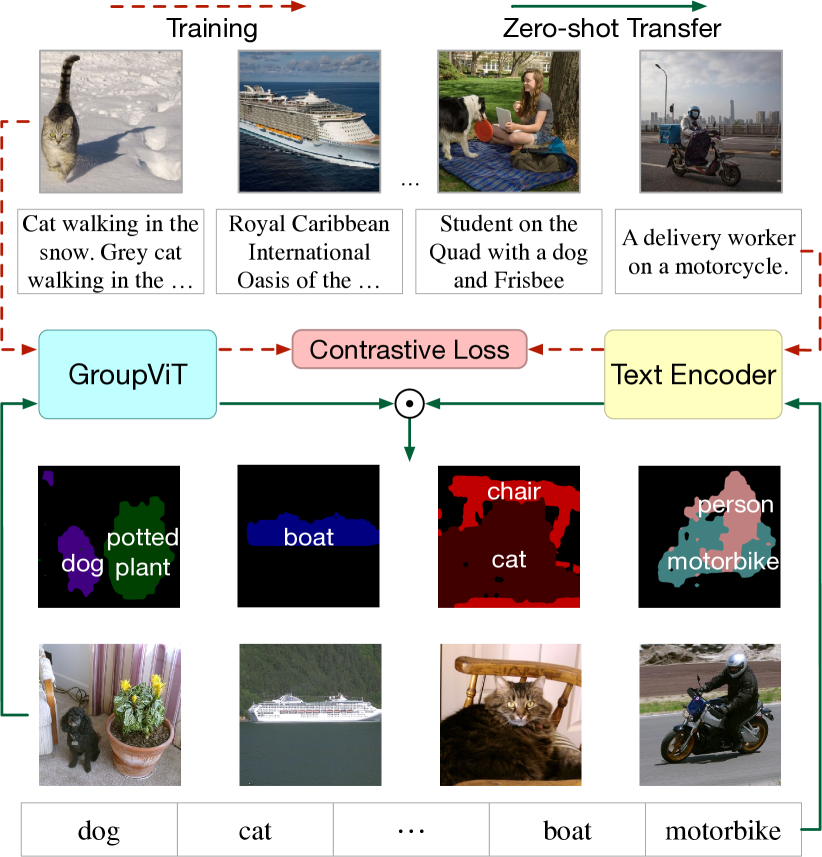
Grouping and recognition are important components of visual scene understanding, e.g., for object detection and semantic segmentation. With end-to-end deep learning systems, grouping of image regions usually happens implicitly via top-down supervision from pixel-level recognition labels. Instead, in this paper, we propose to bring back the grouping mechanism into deep networks, which allows semantic segments to emerge automatically with only text supervision. We propose a hierarchical Grouping Vision Transformer (GroupViT), which goes beyond the regular grid structure representation and learns to group image regions into progressively larger arbitrary-shaped segments. We train GroupViT jointly with a text encoder on a large-scale image-text dataset via contrastive losses. With only text supervision and without any pixel-level annotations, GroupViT learns to group together semantic regions and successfully transfers to the task of semantic segmentation in a zero-shot manner, i.e., without any further fine-tuning. It achieves a zero-shot accuracy of 52.3% mIoU on the PASCAL VOC 2012 and 22.4% mIoU on PASCAL Context datasets, and performs competitively to state-of-the-art transfer-learning methods requiring greater levels of supervision. We open-source our code at https://github.com/NVlabs/GroupViT .
Motivation & Objective
- To enable zero-shot semantic segmentation without any pixel-level annotations by leveraging only image-text supervision.
- To reintroduce explicit visual grouping into deep networks, moving beyond end-to-end implicit grouping in standard CNNs and ViTs.
- To demonstrate that semantic segments can emerge organically from a hierarchical grouping mechanism trained on large-scale image-text data.
- To achieve competitive performance on semantic segmentation benchmarks using only text supervision, outperforming methods requiring fine-tuning or dense annotations.
Proposed method
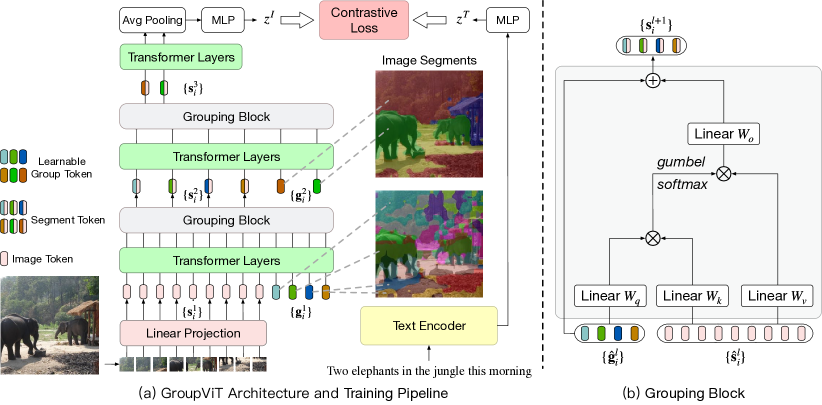
- Proposes a hierarchical Grouping Vision Transformer (GroupViT) that replaces grid-based token processing with dynamic, irregular-shaped region grouping across multiple stages.
- Introduces a learnable grouping module that merges smaller visual tokens into larger, semantically coherent segments using self-attention and feature aggregation.
- Trains GroupViT jointly with a text encoder via contrastive learning on large-scale image-text datasets (e.g., Conceptual Captions, Flickr30k), using image-level text supervision.
- Uses average pooling over final group features to produce image-level embeddings, which are contrasted with text embeddings to align visual segments with textual concepts.
- Performs zero-shot segmentation by computing similarity between group embeddings and text embeddings of class labels in the shared embedding space.
- Employs a multi-stage architecture where early stages learn mid-level concepts (e.g., eyes, limbs), and later stages form high-level concepts (e.g., face, body).
Experimental results
Research questions
- RQ1Can semantic segmentation emerge from text supervision alone, without any pixel-level annotations?
- RQ2Can a hierarchical grouping mechanism in a Vision Transformer learn to form semantically meaningful image segments without explicit supervision?
- RQ3To what extent can a model pre-trained on image-text contrastive learning generalize to zero-shot semantic segmentation tasks?
- RQ4How does the performance of a text-supervised, grouping-based model compare to fully supervised and self-supervised transfer methods in zero-shot segmentation?
Key findings
- GroupViT achieves 52.3% mIoU on PASCAL VOC 2012 and 22.4% mIoU on PASCAL Context in zero-shot semantic segmentation without any fine-tuning or pixel-level annotations.
- The model outperforms CLIP-based baselines using non-parametric grouping by a large margin, demonstrating the superiority of its learned hierarchical grouping.
- GroupViT’s zero-shot performance on PASCAL VOC 2012 (52.3% mIoU) is nearly on par with a fully supervised ViT fine-tuned on both classification and segmentation labels (53% mIoU).
- Despite using only image-level text supervision, GroupViT learns to form semantically coherent groups—evidenced by attention maps showing group tokens attending to specific concepts like 'hands' or 'eyes'.
- The model generalizes to unseen categories and vocabularies, indicating strong zero-shot transferability from text supervision to dense prediction tasks.
- Performance is lower on PASCAL Context than VOC, primarily due to background classes (e.g., ground, road) being underrepresented in text captions, leading to misclassification of grouped segments.
Read this paper
Open the full text in the Nubint reader and ask about any passage as you read.
Read this paper on NubintThis review was generated by AI from the original paper. Please check the paper before citing it.