
[Paper Review] Hi-Fi Multi-Speaker English TTS Dataset
This paper introduces the Hi-Fi Multi-Speaker English TTS dataset, a high-fidelity, multi-speaker corpus of 292 hours from 10 native English speakers (6 female, 4 male), each with at least 17 hours of audio at 44.1 kHz. The dataset ensures high quality through strict filtering for signal bandwidth ≥13 kHz, SNR ≥32 dB, and zero Word Error Rate (WER) via ASR validation, making it ideal for training expressive, high-fidelity TTS models with improved generalization and reduced artifacts.
This paper introduces a new multi-speaker English dataset for training text-to-speech models. The dataset is based on LibriVox audiobooks and Project Gutenberg texts, both in the public domain. The new dataset contains about 292 hours of speech from 10 speakers with at least 17 hours per speaker sampled at 44.1 kHz. To select speech samples with high quality, we considered audio recordings with a signal bandwidth of at least 13 kHz and a signal-to-noise ratio (SNR) of at least 32 dB. The dataset is publicly released at http://www.openslr.org/109/ .
Motivation & Objective
- To address the lack of high-quality, multi-speaker English TTS datasets with sufficient audio quality and speaker diversity.
- To enable training of TTS models that generalize better, produce less noise, and offer wider voice variation.
- To provide a publicly available, ethically sourced dataset with verified text-audio alignment and high signal fidelity.
- To overcome limitations of existing datasets like LJSpeech and M-AILABS, which use low sampling rates and lack rigorous audio quality validation.
- To support research in expressive, high-fidelity TTS by offering a dataset with professional-grade audio quality from non-professional LibriVox readers.
Proposed method
- The dataset was constructed from LibriVox audiobooks and Project Gutenberg texts, both in the public domain.
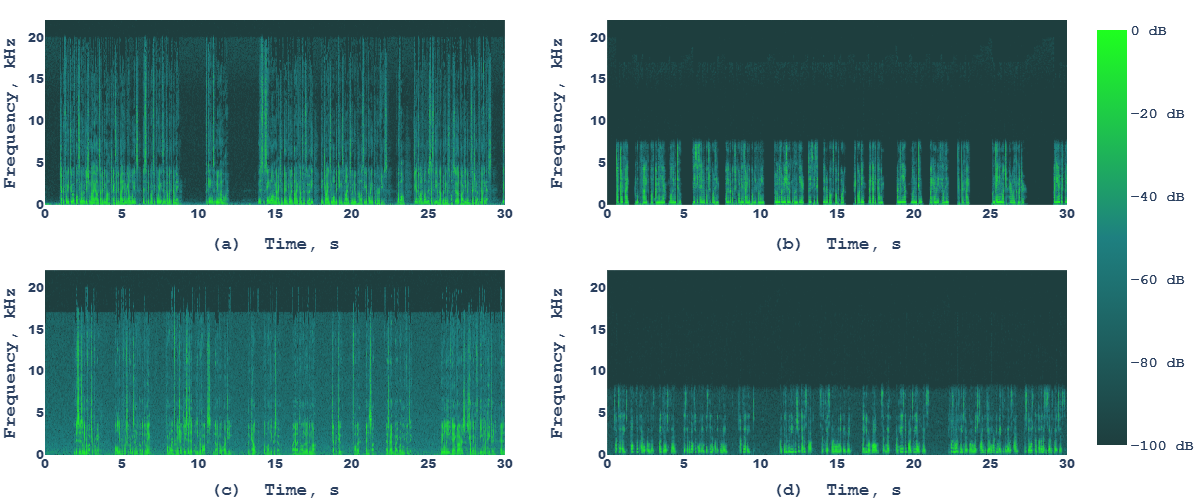
- Speakers were selected based on minimum 50 hours of audio and high-quality recordings with signal bandwidth ≥13 kHz and SNR ≥32 dB.
- Audio files were downsampled to 16 kHz and processed using QuartzNet and Citrinet ASR models to compute WER for text-audio alignment validation.
- Text-audio alignment was performed using CTC-Segmentation with a confidence threshold of -2 in log space to filter poor alignments.
- Only utterances with zero WER across both ASR models were retained, ensuring high-accuracy text-audio matching.
- The final dataset includes two subsets: 'clean' (SNR ≥40 dB) and 'other' (SNR ≥32 dB), with 10 speakers and at least 17 hours per speaker.
Experimental results
Research questions
- RQ1Can a multi-speaker TTS dataset be constructed from public-domain audiobooks that achieves professional-grade audio quality without commercial licensing restrictions?
- RQ2How effective is zero-WER filtering via multiple ASR models in ensuring accurate text-audio alignment in non-professional recordings?
- RQ3To what extent does high SNR and wideband signal content improve TTS model generalization and reduce synthesis artifacts?
- RQ4Can high-fidelity TTS models be trained effectively on non-professional recordings if audio quality and text alignment are rigorously validated?
- RQ5How does the inclusion of diverse, high-quality voices from non-professional readers impact the expressiveness and robustness of TTS systems?
Key findings
- The Hi-Fi TTS dataset contains 292 hours of speech from 10 native English speakers, with each speaker contributing at least 17.7 hours of audio.
- All audio samples were sampled at 44.1 kHz and selected based on a minimum SNR of 32 dB and signal bandwidth of at least 13 kHz.
- The dataset includes two subsets: 'clean' (SNR ≥40 dB) and 'other' (SNR ≥32 dB), with some speakers appearing in both due to variable audio quality across books.
- Text-audio alignment was validated using two ASR models (QuartzNet and Citrinet), and only samples with zero WER were included, ensuring high-fidelity alignment.
- The dataset is publicly released under a CC BY 4.0 license at http://www.openslr.org/109/, with ethical consent obtained from all speakers for voice replication.
- The dataset does not overlap with LJSpeech or M-AILABS, and likely shares some speakers with LibriTTS, but offers superior audio quality and consistency.
Read this paper
Open the full text in the Nubint reader and ask about any passage as you read.
Read this paper on NubintThis review was generated by AI from the original paper. Please check the paper before citing it.