
[Paper Review] High-dimensional and Permutation Invariant Anomaly Detection
This paper proposes a permutation-invariant, high-dimensional density estimator for anomaly detection in particle physics using diffusion models trained on variable-length jet data. By estimating the data density via score matching and maximum likelihood, the method achieves competitive anomaly detection performance—matching supervised classifiers in AUC (0.980) while maintaining invariance to particle ordering and jet size.
Methods for anomaly detection of new physics processes are often limited to low-dimensional spaces due to the difficulty of learning high-dimensional probability densities. Particularly at the constituent level, incorporating desirable properties such as permutation invariance and variable-length inputs becomes difficult within popular density estimation methods. In this work, we introduce a permutation-invariant density estimator for particle physics data based on diffusion models, specifically designed to handle variable-length inputs. We demonstrate the efficacy of our methodology by utilizing the learned density as a permutation-invariant anomaly detection score, effectively identifying jets with low likelihood under the background-only hypothesis. To validate our density estimation method, we investigate the ratio of learned densities and compare to those obtained by a supervised classification algorithm.
Motivation & Objective
- Address the lack of explicit, high-dimensional density estimation methods in particle physics that are invariant to particle permutation and variable jet length.
- Overcome limitations of normalizing flows and autoencoders in handling variable-length, permutation-invariant point cloud data common in jet physics.
- Enable unsupervised anomaly detection by learning an explicit probability density from low-level jet constituents (particles) without signal assumptions.
- Validate the density estimator using likelihood ratios and compare its performance to supervised classifiers and prior methods.
- Demonstrate the method's effectiveness on top quark tagging and semi-visible jet searches in hidden valley models.
Proposed method
- Adapt a point cloud diffusion model to learn the score function of jet particle data, ensuring permutation invariance through a message-passing architecture with attention mechanisms.
- Train the score model using both standard score-matching and maximum-likelihood objectives to estimate the underlying data density explicitly.
- Use the learned score function to compute the negative log-likelihood of events, which serves as an anomaly score for detecting rare physics processes.
- Apply the model to jets represented as variable-length sets of particles (e.g., top quark and QCD jets), with input features including pT, eta, phi, and mass.
- Implement a final classifier head using a transformer-based encoder with a fully connected layer and Sigmoid activation to compare against supervised baselines.
- Evaluate density estimation quality via likelihood ratio tests between models trained on QCD and top quark jets, respectively.
Experimental results
Research questions
- RQ1Can a diffusion model with permutation-invariant architecture provide reliable, explicit density estimation for high-dimensional, variable-length jet data in particle physics?
- RQ2How does the performance of unsupervised anomaly detection based on learned density ratios compare to that of a supervised classifier trained on the same data?
- RQ3Does maximum-likelihood training of the score model improve density estimation and downstream anomaly detection compared to standard score-matching?
- RQ4To what extent does the method maintain invariance to particle ordering and jet size in realistic jet environments?
- RQ5Can the learned density estimator detect anomalies such as top quark jets and semi-visible jets from hidden valley models with high significance?
Key findings
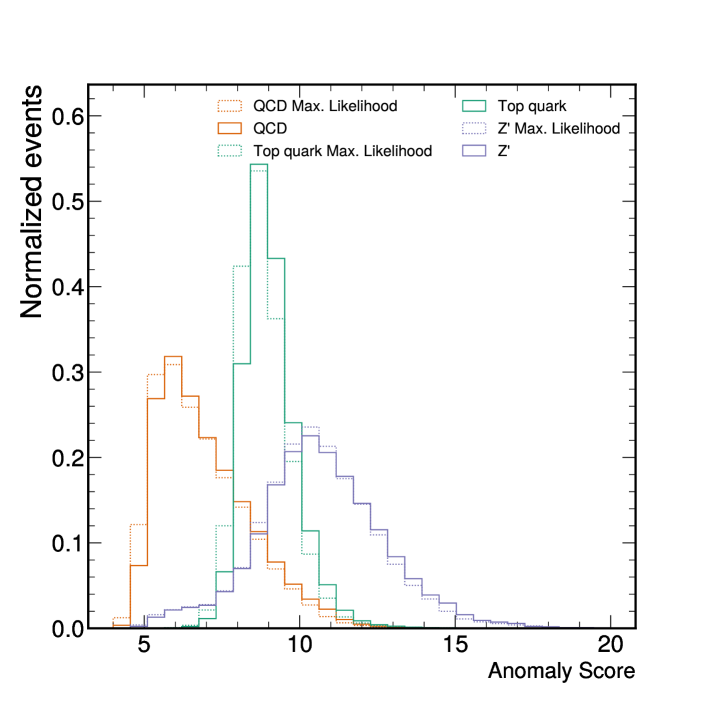
- The method achieves an area under the ROC curve (AUC) of 0.980 in unsupervised anomaly detection between QCD and top quark jets, matching the performance of a dedicated supervised classifier.
- The maximum-likelihood training strategy yields lower negative log-likelihood (improved density estimation) compared to standard score-matching, though this does not translate into better anomaly detection performance.
- The log-likelihood ratio between models trained on QCD and top quark jets achieves an AUC of 0.975, demonstrating strong discriminative power without explicit labels.
- The model achieves a maximum significance (SIC) of 16.0 when detecting top quark jets from QCD backgrounds, indicating strong sensitivity to rare signals.
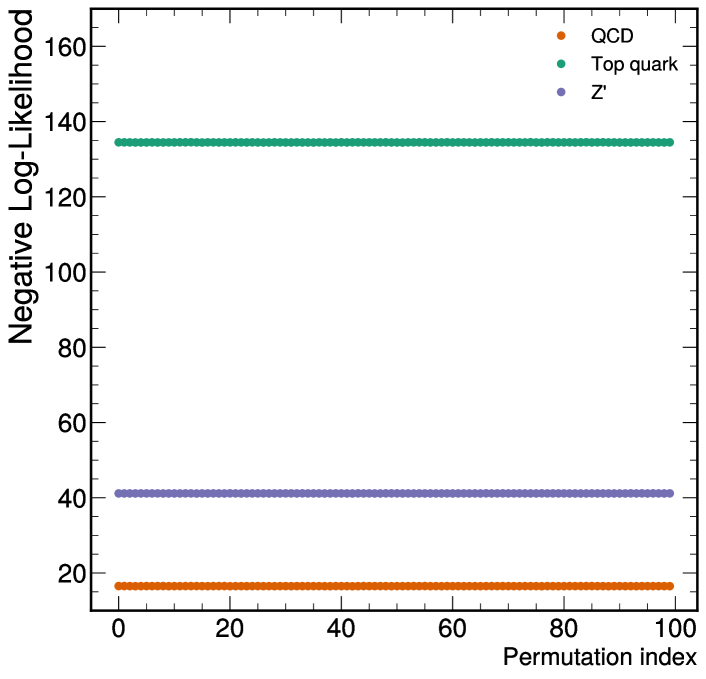
- The method shows robustness to variable jet length and particle permutation, with marginal differences in performance across training strategies.
- The results suggest that while current density estimation is competitive, there remains significant room for improvement in closing the performance gap with supervised methods, especially in the tails of phase space.
Read this paper
Open the full text in the Nubint reader and ask about any passage as you read.
Read this paper on NubintThis review was generated by AI from the original paper. Please check the paper before citing it.