
[论文解读] Hybrid Kerr-electro-optic frequency combs on thin-film lithium niobate
本论文在薄膜铌酸锂上实现了混合 Kerr-电光频率梳,达到 2,589 条线,间距为 29.308 GHz,覆盖 75.9 THz 的带宽,并实现梳间距的片上稳定化。
Optical frequency combs are indispensable links between the optical and microwave domains, enabling a wide range of applications including precision spectroscopy, ultrastable frequency generation, and timekeeping. Chip-scale integration miniaturizes bulk implementations onto photonic chips, offering highly compact, stable, and power-efficient frequency comb sources. State of the art integrated frequency comb sources are based on resonantly-enhanced Kerr effect and, more recently, on electro-optic effect. While the former can routinely reach octave-spanning bandwidths and the latter feature microwave-rate spacings, achieving both in the same material platform has been challenging. Here, we leverage both strong Kerr nonlinearity and efficient electro-optic phase modulation available in the ultralow-loss thin-film lithium niobate photonic platform, to demonstrate a hybrid Kerr-electro-optic frequency comb with stabilized spacing. In our approach, a dissipative Kerr soliton is first generated, and then electro-optic division is used to realize a frequency comb with 2,589 comb lines spaced by 29.308 GHz and spanning 75.9 THz (588 nm) end-to-end. Further, we demonstrate electronic stabilization and control of the soliton spacing, naturally facilitated by our approach. The broadband, microwave-rate comb in this work overcomes the spacing-span tradeoff that exists in all integrated frequency comb sources, and paves the way towards chip-scale solutions for complex tasks such as laser spectroscopy covering multiple bands, micro- and millimeter-wave generation, and massively parallel optical communications.
研究动机与目标
- 以在芯片尺度上实现同时具备大跨距和小间距的光–微波频率梳为目标。
- 利用薄膜铌酸锂(TFLN)上的强 Kerr 非线性和电光(EO)分割。
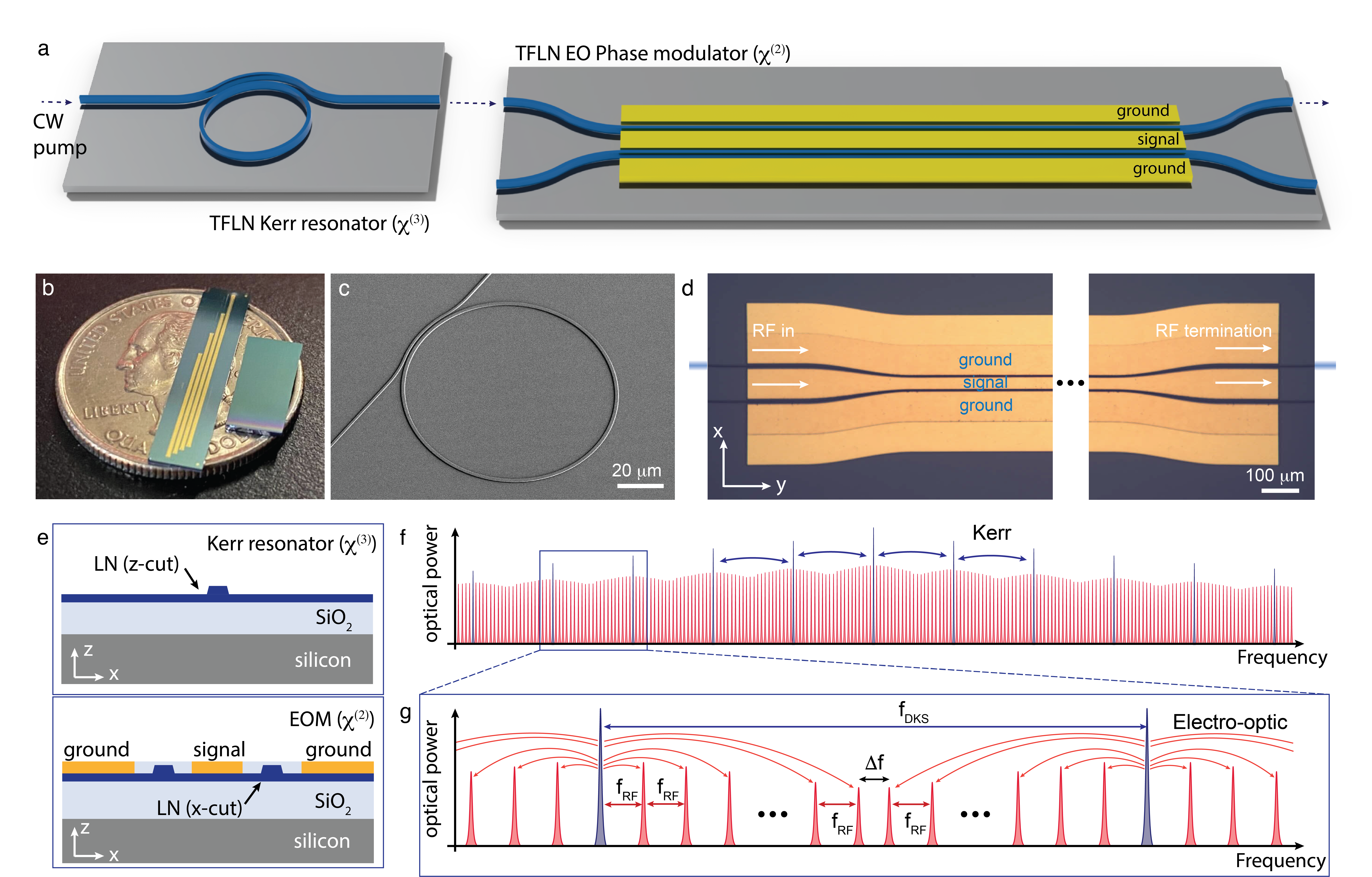
- 在 TFLN 上演示自启动的耗散 Kerr 孤子(DKS)的自启动,并通过级联 EO 旁带产生将间距分割为微波速率。
- 将 Kerr 孤子源与高速 EO 相位调制集成,实现完全集成的混合 Kerr-EO 梳。
- 通过对生成的差频 Δf 的反馈来实现对孤子间距的电子稳定。
提出的方法
- 在色散工程的 TFLN 微腔上产生八度带宽的 DKS,片上泵浦功率约为 100–372 mW。
- 在 TFLN 上使用一个 2 cm 长的集成 EO 相位调制器,在每条 DKS 线上产生以 EO 驱动频率(f_RF)的整数倍为頻率的旁带。
- 用 EO 旁带将 THz 级的 DKS 间距 f_DKS 除以,使之产生间距为 f_RF 的微波速率梳。
- 定义并测量 f_DKS、f_RF 和 Δf,其中 Δf = f_DKS − N·f_RF,N 为实现全分割所需的 EO 旁带数。
- 将 Δf 与微波参考相位锁定,通过对 DKS 泵浦的反馈来稳定 f_DKS。
- 表征调制器的 Vπ、EO 带宽,以及覆盖通信波段的跨波长性能。
实验结果
研究问题
- RQ1在薄膜铌酸锂上采用混合 Kerr-EO 方法,是否能够在单芯片上同时实现大光学带宽和微波速率的梳间距?
- RQ2在集成 EO 调制下,对 THz 级 Kerr 孤子间距进行完全分割时,可达到的分割因子 N 是多少?
- RQ3是否可以通过将 EO-差频 Δf 锁定到一个微波参考来电子稳定 EO 分割梳?
- RQ4在 TFLN 上,Kerr 孤子产生与 EO 调制在多波长之间如何耦合,以实现宽带、芯片尺度的梳?
主要发现
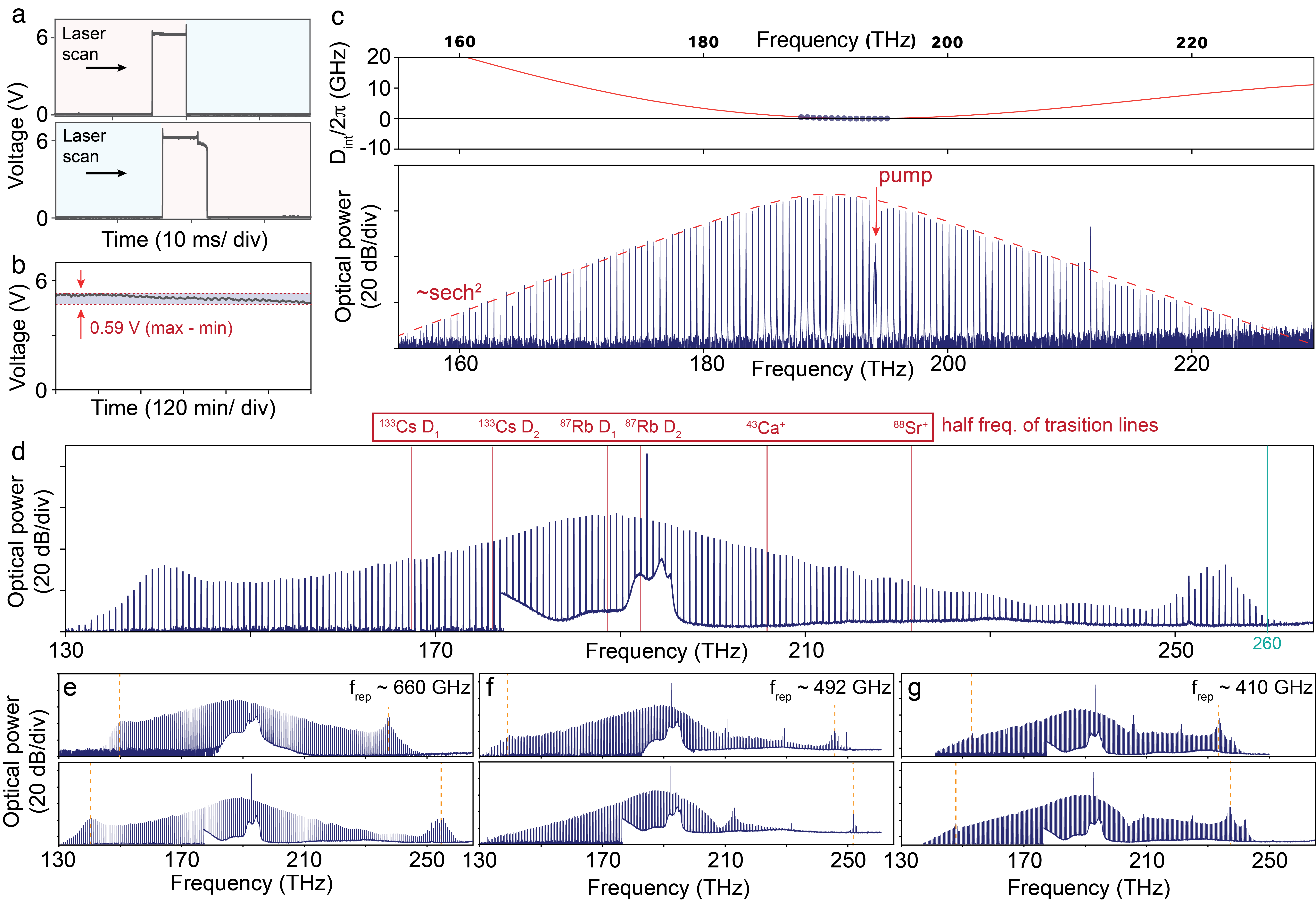
- 在薄膜铌酸锂上实现了带宽为 660 GHz 的八度跨越的 DKS(131.3–263.2 THz 范围)。
- 一个 2 cm 的 EO 调制器实现了 29.158 GHz 的调制频率,将 DKS 间距除以 N=14,得到 29.308 GHz 的混合梳。
- 混合 Kerr-EO 梳端到端覆盖 75.9 THz,覆盖 588 nm,Kerr 与 EO 过程均在片上实现。
- Δf 可以被测量为 EO 拍频并锁定到微波参考,通过对泵浦的反馈来稳定 f_DKS。
- 锁定时 Δf 的线宽约为 30 kHz,证明了对近 THz Kerr 间距的相干控制。
- 该方法为在单一光子平台上实现集成微波综合和双域频率参考铺平了道路。
更好的研究,从现在开始
从论文设计到论文写作,大幅缩短您的研究时间。
无需绑定信用卡
本解读由 AI 生成,并经人工编辑审核。