
[论文解读] Hybrid Quantum Benders' Decomposition For Mixed-integer Linear Programming
本文提出了一种混合量子Benders分解算法,将混合整数线性规划(MILP)的NP难主问题重新表述为可通过D-Wave量子退火器求解的无约束二次二值优化(QUBO)问题。该方法将经典Benders分解与量子计算相结合,在数值模拟中展示了收敛至正确解的能力,从而证明了量子增强型MILP求解的可行性。
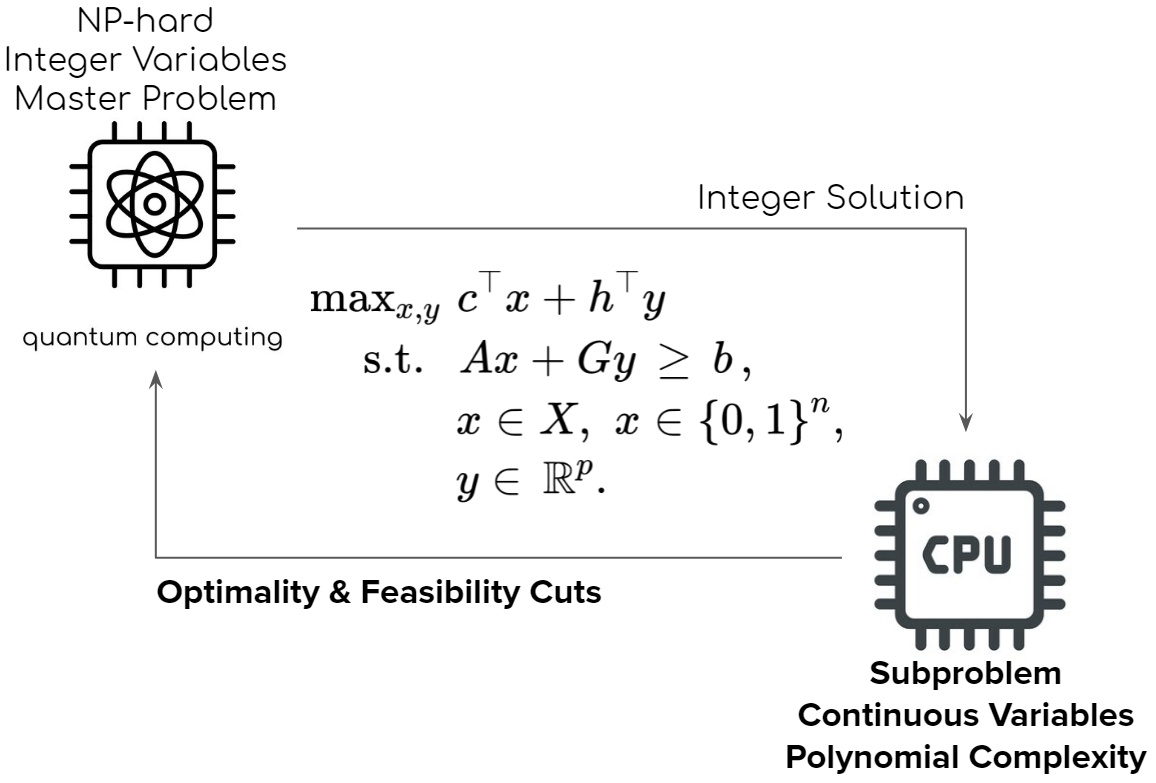
The Benders' decomposition algorithm is a technique in mathematical programming for complex mixed-integer linear programming (MILP) problems with a particular block structure. The strategy of Benders' decomposition can be described as a strategy of divide and conquer. The Benders' decomposition algorithm has been employed in a variety of applications such as communication, networking, and machine learning. However, the master problem in Benders' decomposition is still NP-hard, which motivates us to employ quantum computing. In the paper, we propose a hybrid quantum Benders' decomposition algorithm. We transfer the Benders' decomposition's master problem into the quadratic unconstrained binary optimization (QUBO) model and solve it by the state-of-the-art quantum annealer. Then, we analyze the computational results and discuss the feasibility of the proposed algorithm. Due to our reformulation in the master problem in Benders' decomposition, our hybrid algorithm, which takes advantage of both classical and quantum computers, can guarantee the solution quality for solving MILP problems.
研究动机与目标
- 为解决大规模混合整数线性规划(MILP)问题的计算挑战,此类问题为NP难,经典求解器难以处理。
- 探索将量子计算与经典Benders分解相结合,以加速求解NP难主问题。
- 开发一种将主问题重新表述为与当前量子退火器兼容的QUBO格式的方法。
- 利用D-Wave的Leap™量子云服务,在小规模MILP实例上验证混合量子-经典方法的可行性与正确性。
- 确保混合算法的解质量与经典Benders分解方法保持一致。
提出的方法
- 在MILP框架内,将Benders分解的主问题重新表述为整数线性规划(ILP)模型。
- 将ILP主问题转换为适用于输入量子退火器的QUBO(无约束二次二值优化)模型。
- 通过Leap™量子云服务使用D-Wave的混合量子处理单元(QPU)求解QUBO公式。
- 采用惩罚法在QUBO模型中强制执行约束条件,仔细调节惩罚参数以避免求解器故障或违反约束。
- 将量子求解器的输出整合到经典Benders分解循环中,迭代添加最优性与可行性割线。
- 通过在每次迭代中更新上下界以保持收敛,直至对偶间隙低于预设阈值。
实验结果
研究问题
- RQ1Benders分解中MILP的NP难主问题是否可有效重构为适合量子退火的QUBO模型?
- RQ2混合量子-经典Benders分解算法是否收敛至与经典方法相同的最优解?
- RQ3惩罚参数调节对混合框架中量子求解器的成功率与解质量有何影响?
- RQ4当前的量子硬件(如D-Wave的混合QPU)是否能够以保证的解质量求解实际MILP问题?
- RQ5在收敛速度与计算效率方面,混合算法相较于经典Benders分解的性能如何?
主要发现
- 所提出的混合量子Benders分解算法成功收敛至测试MILP实例的最优解,与经典算法结果一致。
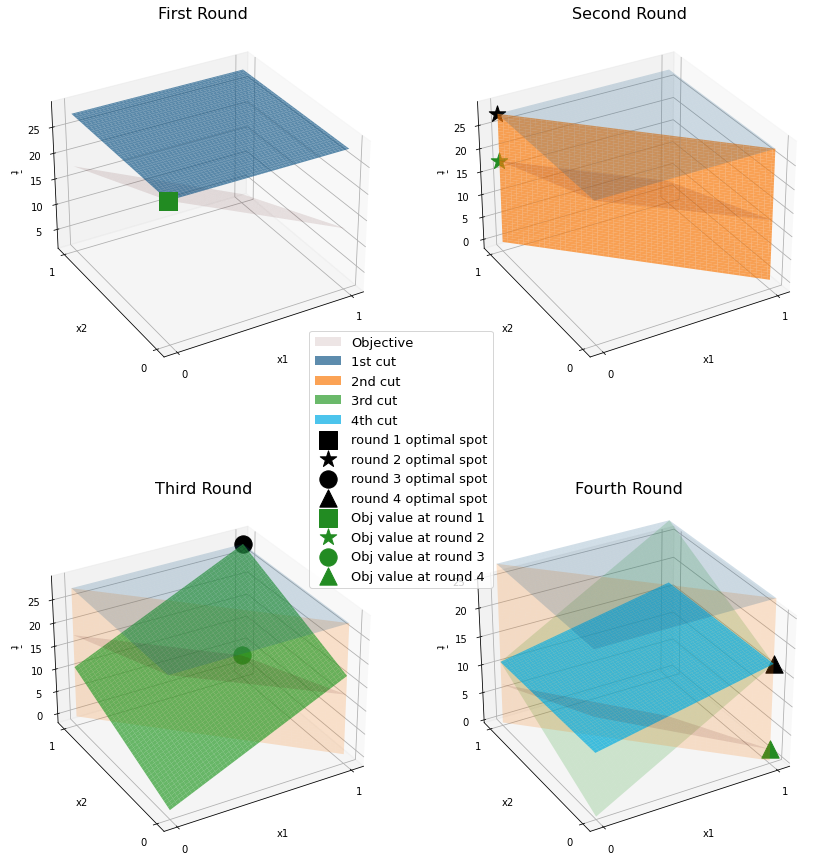
- 该算法在四次迭代内实现收敛,最优性与可行性割线逐步收紧可行区域。
- 下界在两轮内由负无穷大转变为有限值,表明已有效识别可行解。
- 量子求解器返回了有效的二值解,且以高概率正确映射回原始整数变量空间。
- 混合方法保持了解质量与经典Benders分解的数学一致性,确保了正确性。
- 使用D-Wave的混合求解器使算法能够处理直接QPU执行无法处理的更大规模问题实例,验证了其可扩展性潜力。
更好的研究,从现在开始
从阅读论文到最终审阅,大幅缩短您的研究时间。
无需绑定信用卡
本解读由 AI 生成,并经人工编辑审核。