
[论文解读] Identification of hadronic tau lepton decays using a deep neural network
本文提出 DeepTau,一种基于深度神经网络(DNN)的算法,通过在伪快度-方位角(η-φ)空间中处理候选粒子附近的全部重建粒子,利用卷积层提升 CMS 探测器中强子衰变 τ 轻子(强子 τ 候选)的识别能力。该方法在给定背景拒绝率下,使真实 τ 信号效率提升 10–30%,同时将重建范围扩展至此前排除的衰变模式,如包含 π⁰ 介子的三喷胶衰变及重建不佳的带电强子衰变。
A new algorithm is presented to discriminate reconstructed hadronic decays of tau leptons ($τ_\mathrm{h}$) that originate from genuine tau leptons in the CMS detector against $τ_\mathrm{h}$ candidates that originate from quark or gluon jets, electrons, or muons. The algorithm inputs information from all reconstructed particles in the vicinity of a $τ_\mathrm{h}$ candidate and employs a deep neural network with convolutional layers to efficiently process the inputs. This algorithm leads to a significantly improved performance compared with the previously used one. For example, the efficiency for a genuine $τ_\mathrm{h}$ to pass the discriminator against jets increases by 10-30% for a given efficiency for quark and gluon jets. Furthermore, a more efficient $τ_\mathrm{h}$ reconstruction is introduced that incorporates additional hadronic decay modes. The superior performance of the new algorithm to discriminate against jets, electrons, and muons and the improved $τ_\mathrm{h}$ reconstruction method are validated with LHC proton-proton collision data at $\sqrt{s} =$ 13 TeV.
研究动机与目标
- 提升在 LHC 质子-质子对撞中对真实强子 τ 衰变(τh)与背景源(如夸克/胶子喷胶、电子和μ子)的区分能力。
- 解决以往多变量分析(MVA)和基于阈值的判别器的局限性,这些方法对喷胶、电子和μ子分别处理,且仅使用高层次输入变量。
- 通过包含更多 τh 衰变模式(如包含 π⁰ 介子的三喷胶衰变和部分重建的带电强子)提升重建效率。
- 开发一种统一的、端到端的深度学习框架,通过空间不变的卷积处理,同时对所有主要背景源进行 τh 候选分类。
- 使用 13 TeV LHC 质子-质子对撞数据验证新算法的性能,证明其在信号效率和背景拒绝能力方面表现更优。
提出的方法
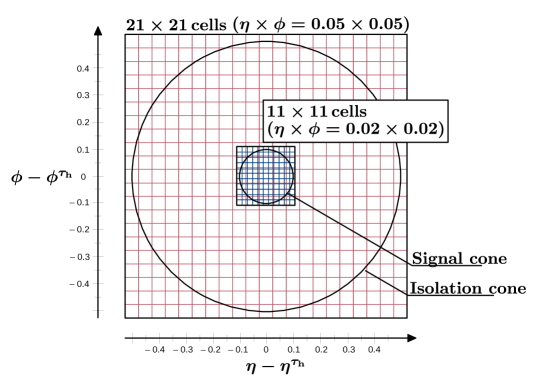
- 采用带有卷积层的深度神经网络(DNN),在伪快度-方位角(η-φ)空间中处理 τh 候选附近的所有重建粒子,利用平移不变性。
- 输入特征包括高层次变量(如横向动量之和)和所有靠近 τh 轴的粒子的原始粒子级信息(如 pT、η、φ、电荷)。
- 使用二维卷积层从粒子的 η-φ 分布中提取局部模式,模仿图像识别技术以学习空间特征。
- 通过联合分类目标训练 DNN,同时将 τh 候选与喷胶、电子和 μ 子区分开。
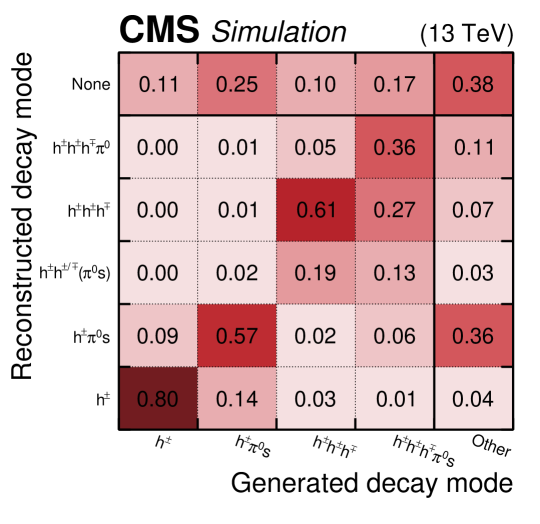
- 将 DNN 集成到新的重建链中,涵盖包含 π⁰ 介子的三喷胶 τh 衰变(占总 τh 衰变的 7.4%)以及一个带电强子未被重建为轨迹或强子的情况。
- 在真实 13 TeV LHC 数据验证前,使用模拟事件优化网络架构和训练流程。
实验结果
研究问题
- RQ1与以往对喷胶、电子和 μ 子分别处理的独立判别器相比,统一的深度神经网络能否提升强子 τ 衰变的识别效率?
- RQ2通过在 η-φ 空间中使用卷积层处理所有邻近重建粒子,对背景源的区分能力提升程度如何?
- RQ3新重建方法包含此前被排除的 τh 衰变模式后,对 τh 识别的整体效率和纯度有何影响?
- RQ4在固定背景拒绝率下,与基于 MVA 的旧方法相比,基于 DNN 的 DeepTau 算法在信号效率方面提升了多少?
- RQ5该新算法在 √s = 13 TeV 的真实 LHC 对撞数据上是否保持鲁棒性和一致性?
主要发现
- 与先前基于 MVA 的判别器相比,DeepTau 算法在给定的夸克和胶子喷胶拒绝率下,使真实强子 τ 轻子效率提升 10–30%。
- 由于能够从密集粒子输入中学习复杂非线性模式,基于 DNN 的方法在所有类别(包括电子和 μ 子)的背景拒绝性能上均有显著提升。
- 包含包含 π⁰ 介子的三喷胶 τh 衰变及部分重建的带电强子,通过恢复此前遗漏的衰变模式,显著提升了整体重建效率。
- 该算法在真实 13 TeV 质子-质子对撞数据上的性能得到验证,证实其在真实实验条件下优于传统方法的鲁棒性和优越性。
- 在邻近粒子的 η-φ 图像上使用卷积层,使网络能比传统基于高层次变量的方法更有效地捕捉 τh 衰变的拓扑特征。
- DeepTau 算法现已部署于 CMS 分析链中,显著提升了涉及强子 τ 衰变的 Higgs 玻色子和新物理搜索的灵敏度。
更好的研究,从现在开始
从阅读论文到最终审阅,大幅缩短您的研究时间。
无需绑定信用卡
本解读由 AI 生成,并经人工编辑审核。