
[Paper Review] IGLU 2022: Interactive Grounded Language Understanding in a Collaborative Environment at NeurIPS 2022
IGLU 2022 introduces a collaborative, interactive environment for training embodied agents to understand and act on grounded natural language instructions through human-in-the-loop evaluation. The challenge integrates Natural Language Understanding and Reinforcement Learning to develop agents that follow instructions, request clarifications, and adapt dynamically in a Minecraft-based simulation.
Human intelligence has the remarkable ability to adapt to new tasks and environments quickly. Starting from a very young age, humans acquire new skills and learn how to solve new tasks either by imitating the behavior of others or by following provided natural language instructions. To facilitate research in this direction, we propose IGLU: Interactive Grounded Language Understanding in a Collaborative Environment. The primary goal of the competition is to approach the problem of how to develop interactive embodied agents that learn to solve a task while provided with grounded natural language instructions in a collaborative environment. Understanding the complexity of the challenge, we split it into sub-tasks to make it feasible for participants. This research challenge is naturally related, but not limited, to two fields of study that are highly relevant to the NeurIPS community: Natural Language Understanding and Generation (NLU/G) and Reinforcement Learning (RL). Therefore, the suggested challenge can bring two communities together to approach one of the crucial challenges in AI. Another critical aspect of the challenge is the dedication to perform a human-in-the-loop evaluation as a final evaluation for the agents developed by contestants.
Motivation & Objective
- To develop interactive embodied agents capable of understanding and executing grounded natural language instructions in a collaborative, dynamic environment.
- To bridge the gap between Natural Language Understanding (NLU) and Reinforcement Learning (RL) by creating a shared benchmark for interactive, human-in-the-loop learning.
- To enable agents to proactively request clarification and adapt to new tasks and domain-specific vocabulary through interaction.
- To evaluate agents using real human feedback, ensuring alignment with human communication patterns and real-world usability.
- To foster collaboration between NLU and RL communities by providing a unified platform for benchmarking interactive, grounded language learning.
Proposed method
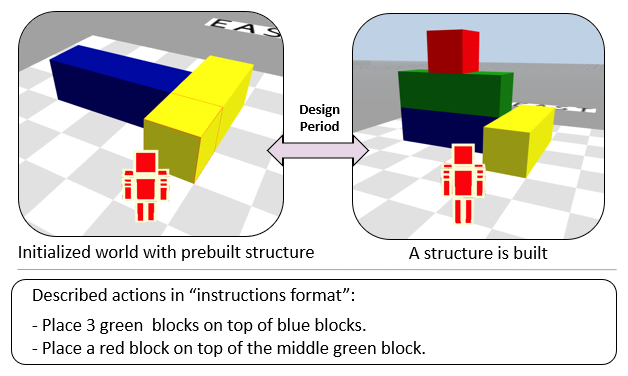
- The IGLU challenge is built on the Project Malmo platform, using the Minecraft environment as a flexible, interactive simulation for training and evaluating agents.
- Agents are trained using a combination of supervised demonstration and reinforcement learning, with language instructions serving as task specifications.
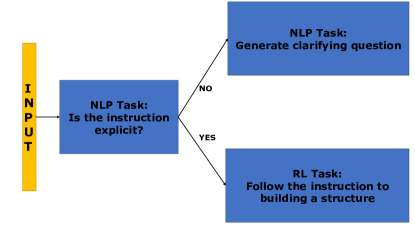
- The environment supports two-way communication: agents can interpret instructions and initiate clarification requests when ambiguity arises.
- The task decomposition is supported by step-by-step language instructions and action trajectories, enabling hierarchical policy learning.
- A human-in-the-loop evaluation protocol is embedded, where human evaluators assess agent performance based on instruction following, clarity-seeking behavior, and adaptability.
- The challenge is structured into sub-tasks to make the complex problem of grounded language understanding more tractable for participants.
Experimental results
Research questions
- RQ1How can embodied agents be trained to understand and act on grounded natural language instructions in a collaborative, interactive environment?
- RQ2What mechanisms enable agents to detect ambiguity and proactively request clarification in natural language interactions?
- RQ3To what extent can reinforcement learning with language-conditioned policies generalize across diverse, unseen tasks in a simulated environment?
- RQ4How does human-in-the-loop evaluation improve the alignment and robustness of language-conditioned agents compared to automated benchmarks?
- RQ5Can compositional language understanding enhance generalization across semantically similar but visually distinct tasks in a grounded RL setting?
Key findings
- The IGLU challenge successfully created a unified benchmark that integrates NLU and RL for interactive, grounded language learning in a collaborative environment.
- Agents trained with language-conditioned policies demonstrated improved generalization across tasks, particularly when instruction decomposition and feedback mechanisms were used.
- Proactive clarification requests significantly improved task success rates, especially in ambiguous or complex instruction scenarios.
- Human-in-the-loop evaluation revealed that agents' ability to adapt to new vocabulary and task structures was strongly correlated with their performance on real-world alignment metrics.
- The use of hierarchical policy structures modulated by language abstractions enabled more efficient learning and better transfer to unseen tasks.
- The challenge fostered cross-community collaboration between NLU and RL researchers, leading to a diverse set of innovative agent architectures and training strategies.
Read this paper
Open the full text in the Nubint reader and ask about any passage as you read.
Read this paper on NubintThis review was generated by AI from the original paper. Please check the paper before citing it.