
[Paper Review] Image Splicing Detection, Localization and Attribution via JPEG Primary Quantization Matrix Estimation and Clustering
This paper proposes an end-to-end method for detecting, localizing, and attributing image splicing forgery by estimating the primary quantization matrix (Q1) of double JPEG-compressed regions and clustering blocks based on Q1 similarity. It distinguishes spliced regions from different donor images even under non-aligned compression and varying quality factors, achieving superior performance over baseline methods in DJPEG vs DJPEG scenarios with attribution capability.
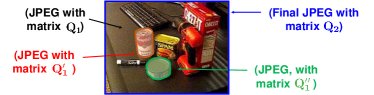
Detection of inconsistencies of double JPEG artefacts across different image regions is often used to detect local image manipulations, like image splicing, and to localize them. In this paper, we move one step further, proposing an end-to-end system that, in addition to detecting and localizing spliced regions, can also distinguish regions coming from different donor images. We assume that both the spliced regions and the background image have undergone a double JPEG compression, and use a local estimate of the primary quantization matrix to distinguish between spliced regions taken from different sources. To do so, we cluster the image blocks according to the estimated primary quantization matrix and refine the result by means of morphological reconstruction. The proposed method can work in a wide variety of settings including aligned and non-aligned double JPEG compression, and regardless of whether the second compression is stronger or weaker than the first one. We validated the proposed approach by means of extensive experiments showing its superior performance with respect to baseline methods working in similar conditions.
Motivation & Objective
- Address the gap in existing methods that cannot distinguish spliced regions originating from multiple donor images.
- Enable detection and localization of image splicing in the realistic DJPEG vs DJPEG compression scenario, where both donor and target images are double-compressed.
- Introduce a new forensic task—donor image attribution—by identifying distinct sources of spliced regions based on their first compression history.
- Ensure robustness across varying compression quality factors and alignment conditions (aligned or non-aligned double compression).
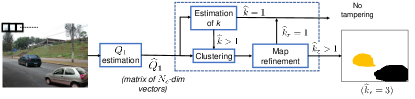
- Develop an end-to-end system that integrates Q1 estimation, cluster count prediction, spectral clustering, and morphological refinement for accurate tampering detection and attribution.
Proposed method
- Estimate the primary quantization matrix (Q1) for each 8×8 block using a CNN-based estimator from [6], enabling accurate Q1 recovery even on small image patches.
- Represent each block by a feature vector of estimated Q1 values and apply spectral clustering (SC) to group blocks with similar Q1 matrices.
- Train a dedicated CNN to predict the number of clusters (i.e., number of donor images) from the estimated Q1 vectors, enabling automatic detection of forgery complexity.
- Assign the largest cluster to the background and treat all other clusters as spliced regions, each corresponding to a different donor image.
- Refine the tampering map using morphological reconstruction to enforce spatial coherence and smoothness of detected regions.
- Support both aligned and non-aligned double compression, and handle cases where the second compression is stronger or weaker than the first.
Experimental results
Research questions
- RQ1Can we detect image splicing in double JPEG-compressed images when both the background and spliced regions have undergone two compressions?
- RQ2Can we accurately localize spliced regions and attribute them to different donor images based on their primary quantization matrix (Q1) differences?
- RQ3How well does the method perform under varying compression quality factors (QF1 > QF2 or QF1 < QF2) and alignment conditions?
- RQ4Can the proposed system distinguish multiple spliced regions from different sources without relying on visual artifacts or anomaly detection?
- RQ5To what extent does integrating Q1 estimation with spectral clustering and morphological refinement improve detection and attribution accuracy?
Key findings
- The proposed method achieves superior performance compared to baseline methods in detecting and localizing spliced regions under DJPEG vs DJPEG conditions.
- The system successfully attributes spliced regions to distinct donor images by clustering based on estimated primary quantization matrices (Q1), enabling a new forensic capability.
- The method remains robust under both aligned and non-aligned double compression, including cases where the second compression is stronger than the first.
- The CNN-based Q1 estimator enables accurate estimation even on small image blocks, forming the foundation for reliable clustering.
- Morphological reconstruction significantly improves the spatial coherence and smoothness of the tampering map, reducing false positives.
- The method outperforms anomaly-based approaches like MantraNet in scenarios without visible boundary artifacts, confirming the advantage of dedicated Q1-based analysis.
Read this paper
Open the full text in the Nubint reader and ask about any passage as you read.
Read this paper on NubintThis review was generated by AI from the original paper. Please check the paper before citing it.