
[论文解读] Impact of decoherence on the fidelity of quantum gates leaving the computational subspace
本文将量子门保真度的分析模型扩展至考虑量子态在门操作期间暂时离开计算子空间时的退相干效应——这一情形在超导量子比特和中性原子中十分常见。通过采用林德布拉德主方程方法,作者推导出在振幅阻尼和去相位作用下的平均门保真度的一般公式,并在CZ和CCZS门上进行了验证,从而实现了对多量子比特量子系统中误差的精确预算管理。
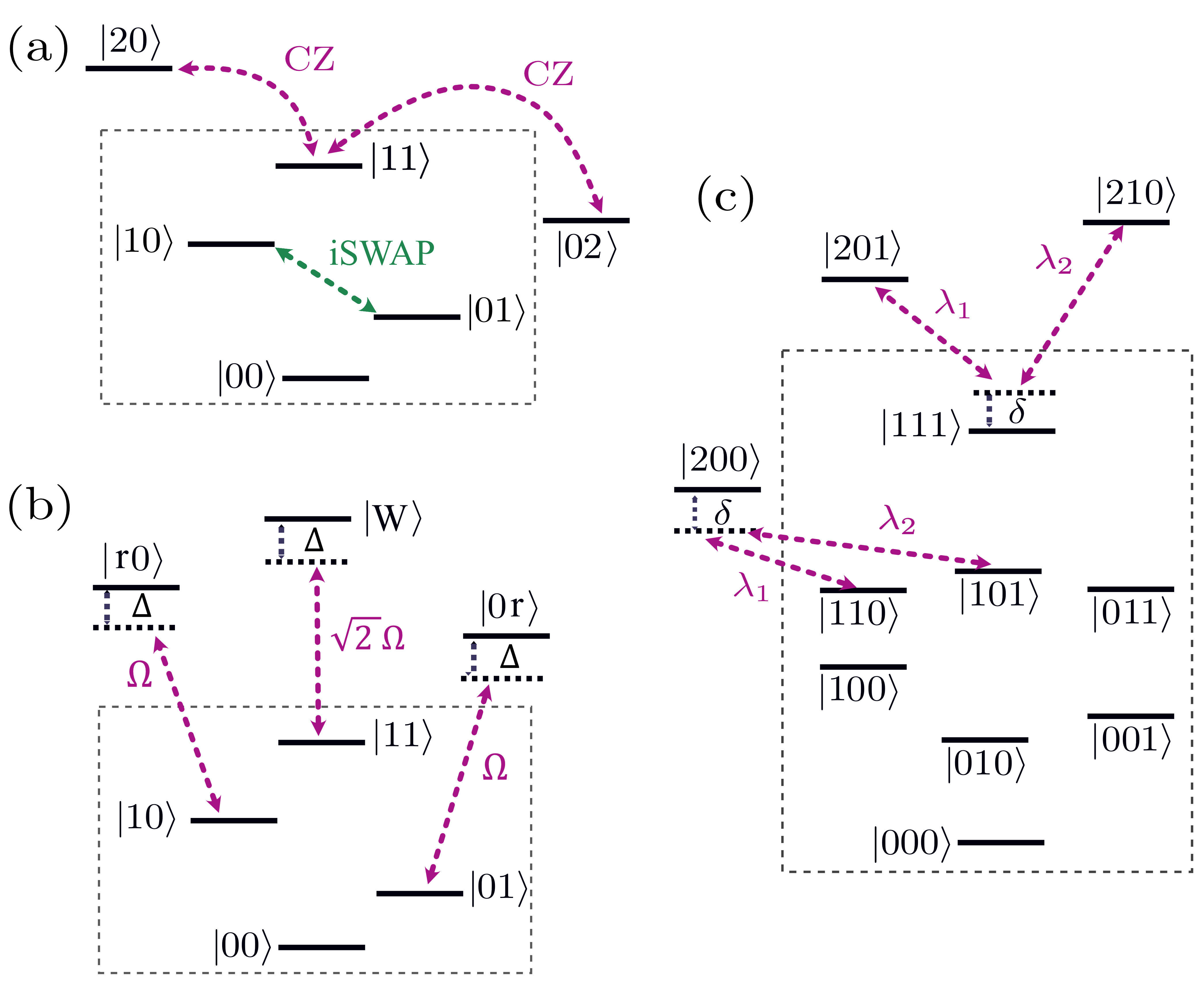
The fidelity of quantum operations is often limited by incoherent errors, which typically can be modeled by fundamental Markovian noise processes such as amplitude damping and dephasing. In Phys. Rev. Lett. 129, 150504 (2022; https://doi.org/10.1103/PhysRevLett.129.150504), we presented an analytical result for the average gate fidelity of a general multiqubit operation in terms of the dissipative rates and the corresponding Lindblad jump operators, provided that the operation remains in the computational subspace throughout the time evolution. Here we generalize this expression for the average gate fidelity to include the cases where the system state temporarily leaves the computational subspace during the gate. Such gate mechanisms are integral to several quantum-computing platforms, and our formula is applicable to all of them; as examples, we employ it for the two-qubit controlled-Z gate in both superconducting qubits and neutral atoms. We also obtain the average gate fidelity for simultaneous operations applied in multiqubit systems. These results are useful for understanding the error budgets of quantum gates while scaling up quantum computers.
研究动机与目标
- 解决现有保真度模型的局限性,即假设门操作始终局限于计算子空间。
- 建立一个通用的平均保真度分析框架,以考虑由于退相干导致的非计算态瞬时占据。
- 实现在超导量子比特和囚禁中性原子等多样化平台中多量子比特量子门的精确误差预算管理。
- 将保真度分析扩展至同时进行的多门操作,例如并行CZ门。
- 为容错量子计算架构中的门保真度优化提供实用工具。
提出的方法
- 利用林德布拉德主方程建模振幅阻尼和去相位引起的马尔可夫退相干,推导平均门保真度。
- 通过积分随时间变化的林德布拉德跃迁算符(包含非计算态跃迁)推导保真度下降的一般表达式。
- 将该形式化方法应用于具体门操作:超导量子比特和中性原子中的受控-Z(CZ)门,以及多量子比特CCZS门。
- 通过在计算子空间上进行迹运算,计算各噪声通道对保真度的贡献。
- 将模型与超导电路中CZ门的已知结果进行对比验证,并将其扩展至同时进行的两量子比特操作。
- 推导在不同噪声速率下保真度退化的解析表达式,涵盖弛豫和去相位两种机制。
实验结果
研究问题
- RQ1当系统在门演化过程中暂时离开计算子空间时,退相干如何影响门保真度?
- RQ2能否建立一个统一的解析框架,描述涉及非计算态瞬时泄漏的多量子比特门的保真度退化?
- RQ3在依赖中间激发态的CZ和CCZS等门中,各噪声通道(振幅阻尼与去相位)对保真度的贡献如何?
- RQ4在具有不同噪声参数的多量子比特系统中,如何对同时进行的两量子比特门实现保真度的精确估计?
- RQ5可用于不同量子计算平台中稳健优化的门保真度定量边界是什么?
主要发现
- 推导出的保真度公式能准确复现超导量子比特中CZ门的已知结果,验证了其正确性。
- 对于在量子比特对(q1,q2)和(q3,q4)上同时执行的两量子比特CZ门,保真度降低项与τ成正比,其中q1/q3的弛豫贡献系数为10/17,q2/q4的弛豫贡献系数为6/17。
- 在相同门配置下,去相位对保真度损失的贡献系数分别为q1/q3的61/68和q2/q4的29/68。
- 该模型可处理因各量子比特对门动力学不同而引起的非对称噪声贡献,从而实现精确的误差预算管理。
- 该框架可基于单个门的保真度估算多量子比特系统中的总门保真度,即使存在泄漏现象亦适用。
- 该解析方法提供了一种稳健且可扩展的保真度估算方法,无需完整过程层析或数值模拟。
更好的研究,从现在开始
从阅读论文到最终审阅,大幅缩短您的研究时间。
无需绑定信用卡
本解读由 AI 生成,并经人工编辑审核。