
[论文解读] Implications of the NANOGrav results for primordial black holes and Hubble tension
本文将 NANOGrav 的随机引力波信号与在暴涨期间形成的原始黑洞(PBHs)联系起来,推导来自 GW 频率的 PBH 热力学量,并将 PBH 蒸发与有效哈勃率联系到哈勃紧张问题。
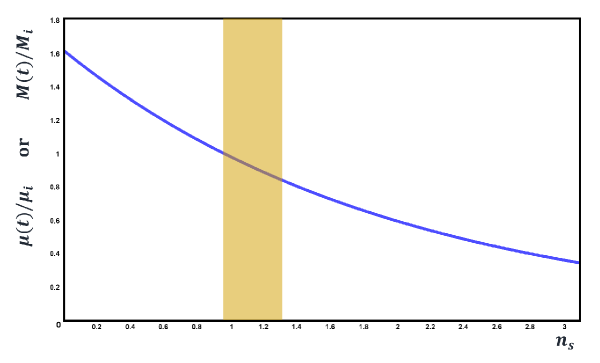
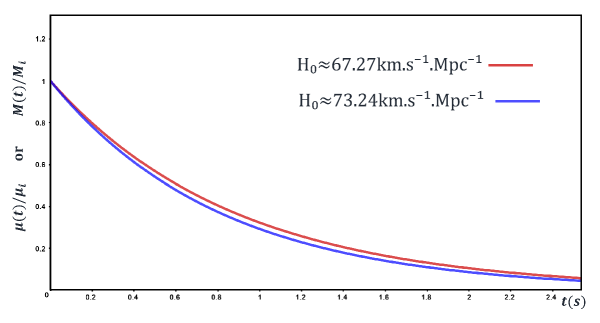
The purpose of this work is to investigate the formation and evaporation of the primordial black holes in the inflationary scenarios. Thermodynamic parameters such as mass, temperature and entropy are expressed in terms of NANOGrav frequency. By numerical calculations we show that the constraint on the mass range $10^{-5}kg-10^{50}kg$ is well confirmed. We discuss the relation between the redshift and the probability for gravitational wave source populations. A new parameter associated with the frequency and Hubble rate is presented, by which for the spectral index $n_{s}\approx 0.996$ and the Hubble constant $H_{0}\approx 67.27km.s^{-1}.Mpc^{-1}$, the effective Hubble constant is calculated to be $H_{eff,0}\approx 73.24km.s^{-1}.Mpc^{-1} $ which is compatible with the observational data. We make a comparison between the Hubble tension and the primordial perturbations and the expression of the mass loss rate, chemical potential and central charge needed to describe the Hawking evaporation will be established.
研究动机与目标
- 激发 NANOGrav 随机 GW 信号与在暴涨期间形成的 PBH 之间联系的动机。
- 将 PBH 的热力学量(质量、温度、熵)表达为 GW 频率的函数。
- 研究 PBH 的形成与蒸发如何与暴涨动力学以及哈勃紧张问题相关。
- 引入一个与 GW 频率和哈勃率相关的新参数,以使 H0 的测量结果趋于一致。
- 通过化学势和中心电荷在 PBH 热力学中的探讨,涉及规范/引力对偶性方面。
提出的方法
- 将 PBH 质量与 GW 频率相关联,式 M ~ c^3/G · N/(16π^2 f) 且 f = PBH 的发射频率(Eq. 2.9)。
- 利用 T ∝ 1/M 来计算 PBH 温度,并通过 T = (2πħ f)/s 且 s = kB N 将其与暴涨的尺度因子 N 联系起来(Eq. 2.6, 2.8)。
- 推导一个慢滚/暴涨框架,以从 ε_H 与 η 求得谱区指数 n_s(Eq. 3.5)。
- 定义有效哈勃率 H_eff = H + N H_f,并将其与 n_s 及宇宙学数据联系起来(Eq. 3.6, 3.7)。
- 通过霍金蒸发对 PBH 质量损失进行建模,并将其与演化中的 H_eff 联系起来(Eq. 4.10–4.13)。
- 在类对偶/全息框架中引入一个与中心电荷 C 共轭的化学势 μ(Eq. 5.2–5.4)。
实验结果
研究问题
- RQ1在暴涨期间形成的 PBH 是否能够解释 NANOGrav 的随机 GW 背景?
- RQ2PBH 热力学量如何表达为 GW 频率的函数,以及这对 PBH 的质量和温度意味着什么?
- RQ3暴涨与全息框架是否能给出一个与本地测量和 CMB 测量兼容的有效哈勃常数?
- RQ4谱指数 n_s 在将 PBH 物理与哈勃紧张联系起来中扮演何种角色?
主要发现
- PBH 质量与 GW 频率成反比量级,f ≈ 5.5 nHz 时得到的 PBH 质量符合分析所示(Table 1 讨论)。
- PBH 温度极低,与冷暗物质解释一致。
- 当 n_s ≈ 0.996 时得到有效哈勃常数 H_eff,0 ≈ 73.24 km/s/Mpc,与一些本地测量一致。
- 推导出 n_s、H_eff,0 与 N 之间的关系,提供了暴涨扰动与哈勃紧张之间的可能联系。
- 霍金蒸发导致的质量损失通过与频率相关的速率来量化,影响 PBHs 与 H_eff 的演化。
- 全息视角引入化学势 μ 和中心电荷 C,将 PBH 热力学与边界/体对偶联系起来。
更好的研究,从现在开始
从论文设计到论文写作,大幅缩短您的研究时间。
无需绑定信用卡
本解读由 AI 生成,并经人工编辑审核。