
[Paper Review] Improving Multimodal Interactive Agents with Reinforcement Learning from Human Feedback
This paper proposes a framework that improves multimodal interactive agents using Reinforcement Learning from Human Feedback (RLHF) without relying on programmatic reward functions. By collecting human judgments on agent progress during simulated 3D interactions and modeling them via a novel Inter-temporal Bradley-Terry (IBT) reward model, the method trains agents via BC+RL, achieving 93% of human performance in live interactions, with some tasks exceeding average human success rates.
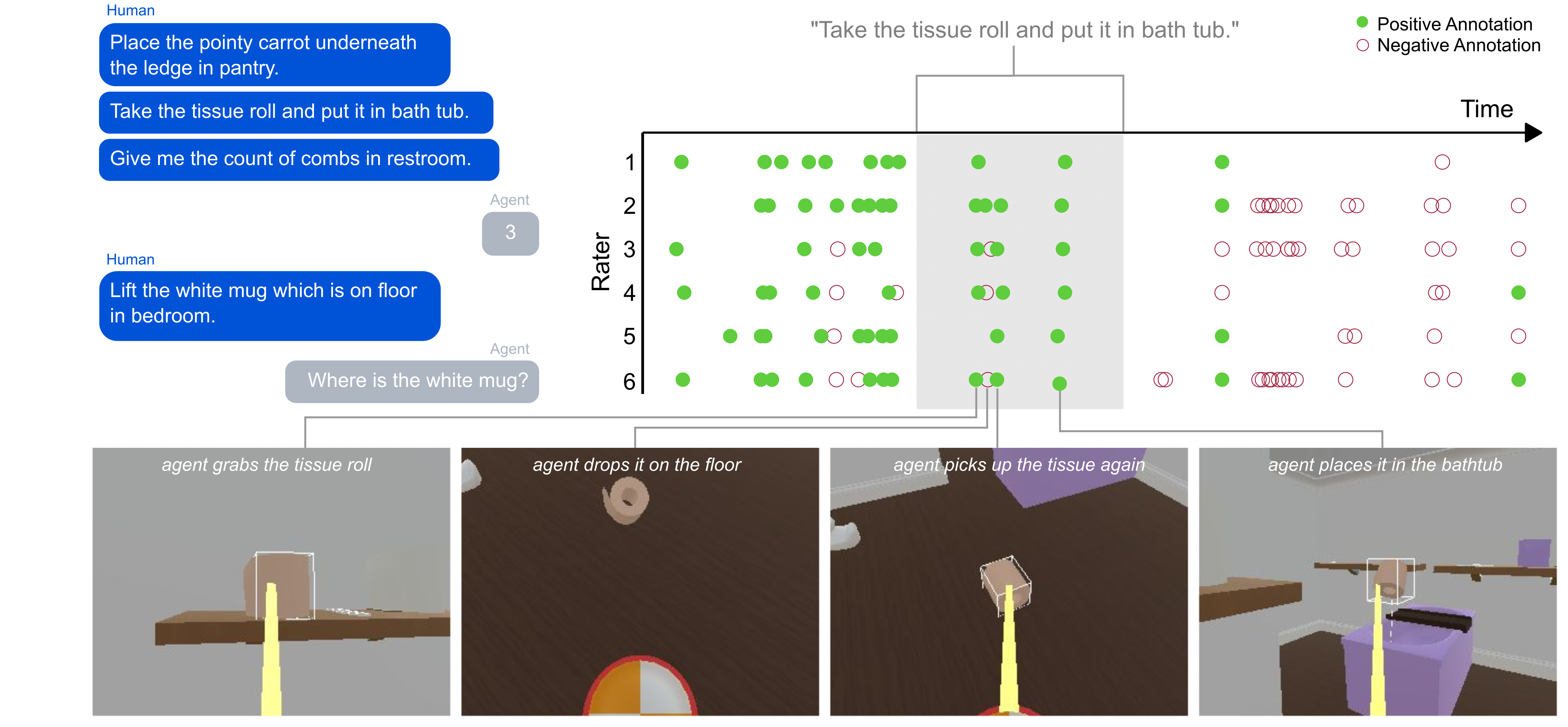
An important goal in artificial intelligence is to create agents that can both interact naturally with humans and learn from their feedback. Here we demonstrate how to use reinforcement learning from human feedback (RLHF) to improve upon simulated, embodied agents trained to a base level of competency with imitation learning. First, we collected data of humans interacting with agents in a simulated 3D world. We then asked annotators to record moments where they believed that agents either progressed toward or regressed from their human-instructed goal. Using this annotation data we leveraged a novel method - which we call "Inter-temporal Bradley-Terry" (IBT) modelling - to build a reward model that captures human judgments. Agents trained to optimise rewards delivered from IBT reward models improved with respect to all of our metrics, including subsequent human judgment during live interactions with agents. Altogether our results demonstrate how one can successfully leverage human judgments to improve agent behaviour, allowing us to use reinforcement learning in complex, embodied domains without programmatic reward functions. Videos of agent behaviour may be found at https://youtu.be/v_Z9F2_eKk4.
Motivation & Objective
- To develop a method for training embodied, multimodal agents using human feedback instead of hand-coded reward functions.
- To address the challenge of defining precise, robust reward functions for complex, ambiguous human interactions in open-ended environments.
- To improve agent performance in both mobile manipulation and bi-directional language interaction tasks using human-in-the-loop feedback.
- To create a scalable, generalizable framework applicable to digital assistants, game AIs, and language-instructable robots.
- To demonstrate that RLHF grounded in human judgments can surpass imitation learning baselines and even exceed average human performance in specific tasks.
Proposed method
- Collected human-human interaction data in a 3D simulated environment (Playhouse) to pre-train an initial agent via behavioral cloning (BC).
- Conducted human-in-the-loop interactions where participants evaluated agent progress toward goals in real-time, marking discrete moments of progress or regression.
- Introduced the Inter-temporal Bradley-Terry (IBT) model to learn reward functions from human judgments on temporal segments of agent trajectories.
- Trained a reward model using IBT to capture nuanced human preferences across time, enabling dense, sequential feedback.
- Fine-tuned agents using a combination of behavioral cloning and reinforcement learning (BC+RL) to optimize for the learned reward model.
- Evaluated agents via live human interactions, where participants gave instructions and rated agent success in real time.

Experimental results
Research questions
- RQ1Can human feedback on agent progress be effectively modeled to guide reinforcement learning in complex, multimodal interactive environments?
- RQ2Can a reward model trained on human judgments improve agent performance beyond imitation learning baselines in both manipulation and language interaction tasks?
- RQ3To what extent can RLHF with human feedback achieve performance comparable to or exceeding that of average human players in open-ended, naturalistic interactions?
- RQ4How can human feedback be structured to support dense, time-sensitive reward modeling in long-horizon, multi-modal tasks?
- RQ5Can the IBT model effectively capture human preferences across time without requiring full trajectory comparisons?
Key findings
- Agents trained with BC+RL achieved 93% of the success rate of human participants in live, interactive settings, significantly outperforming BC-only agents.
- In specific interaction types, such as question-answering and object manipulation, the BC+RL agents surpassed the average human performance.
- The Inter-temporal Bradley-Terry (IBT) model successfully captured human feedback on temporal segments, enabling effective reward shaping without full trajectory comparisons.
- The framework demonstrated generalizability across diverse tasks, including mobile manipulation and bi-directional language interaction.
- Human evaluations confirmed that the improved agents were perceived as more competent and goal-directed in real-time interactions.
- The method reduced reliance on hand-designed reward functions, enabling scalable training of agents in complex, ambiguous, real-world-like environments.
Read this paper
Open the full text in the Nubint reader and ask about any passage as you read.
Read this paper on NubintThis review was generated by AI from the original paper. Please check the paper before citing it.