
[论文解读] In or Out? Fixing ImageNet Out-of-Distribution Detection Evaluation
这篇论文表明,许多 ImageNet-1K OOD 数据集包含 ID 污染,提出 NINCO(No ImageNet Class Objects)具有 64 个 OOD 类和 5879 张经清洗的图像,并分析跨多种体系结构的广泛 OOD 检测器,强调预训练的影响以及对按类评估和 OOD 单元测试的需求。
Out-of-distribution (OOD) detection is the problem of identifying inputs which are unrelated to the in-distribution task. The OOD detection performance when the in-distribution (ID) is ImageNet-1K is commonly being tested on a small range of test OOD datasets. We find that most of the currently used test OOD datasets, including datasets from the open set recognition (OSR) literature, have severe issues: In some cases more than 50$\%$ of the dataset contains objects belonging to one of the ID classes. These erroneous samples heavily distort the evaluation of OOD detectors. As a solution, we introduce with NINCO a novel test OOD dataset, each sample checked to be ID free, which with its fine-grained range of OOD classes allows for a detailed analysis of an OOD detector's strengths and failure modes, particularly when paired with a number of synthetic "OOD unit-tests". We provide detailed evaluations across a large set of architectures and OOD detection methods on NINCO and the unit-tests, revealing new insights about model weaknesses and the effects of pretraining on OOD detection performance. We provide code and data at https://github.com/j-cb/NINCO.
研究动机与目标
- 识别并量化广泛使用的 ImageNet-1K OOD 测试数据集中出现的 ID 污染。
- 提出一个干净、具有挑战性的 OOD 测试集(NINCO),配有按类别的评估,以更好地理解检测器的弱点。
- 分析不同 OOD 检测方法在多种体系结构和预训练方案下的表现。
- 引入 OOD 单元测试,以探究超出自然图像的检测器弱点。
- 为 OOD 检测器的公正评估与报告提供建议。
提出的方法
- 对常用 OOD 数据集的每个数据集进行系统性手工随机抽样 400 个样本,以衡量 ID 污染。
- 构建 NINCO,涵盖 64 个 OOD 类、5879 张图像,手动验证为无 ID,并再加 17 个合成的 OOD 单元测试。
- 在多种架构(ViT、卷积网络)及不同预训练(IN-21K、CLIP、JFT 等)下,对 11 种 OOD 检测方法进行评估。
- 对 MSP 基线、基于特征的检测器(Maha、RMaha、ViM)以及其他方法(MaxLogit、Energy、KL-Matching、KNN、ReAct 等)的分析,包括对 pre-logit 特征的使用。
- 评估预训练如何影响 OOD 检测性能,以及聚合指标与按类别指标的可靠性。
实验结果
研究问题
- RQ1现有的 ImageNet-1K OOD 测试数据集在多大程度上被同分布对象污染?
- RQ2一个干净、无 ID 的 OOD 测试集(NINCO)是否能在跨架构上提供更可靠的 OOD 检测器评估?
- RQ3预训练类型和特征使用对 OOD 检测性能的影响是什么?
- RQ4合成 OOD 单元测试是否揭示了自然图像数据集未暴露的弱点?
- RQ5为公平地对 OOD 检测器进行基准测试,应采用哪些评估做法(按类别分布、单元测试)?
主要发现
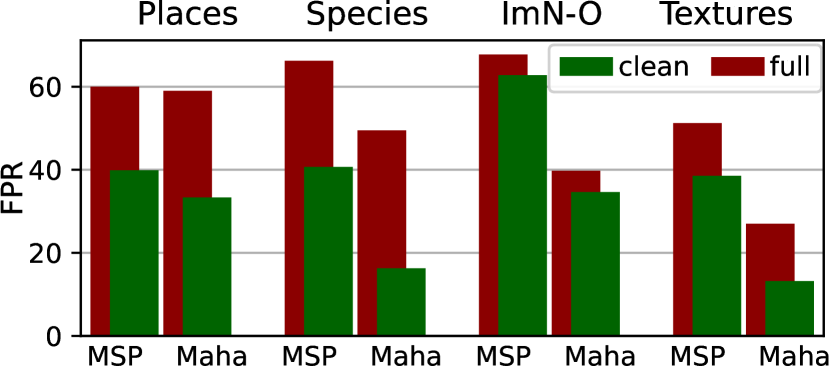
- 许多用于 IN-1K 的广泛使用的 OOD 数据集包含大量的 ID 污染,在 Places 和 Species 数据集等地方往往超过 50%。
- ID 污染可能不公平地惩罚强检测器并增加假阳性,因为检测器可能正确识别了不应被视为 OOD 的 ID 内容。
- NINCO 提供 64 个经人工验证的 OOD 类,包含 5,879 张无 ID 的图像,使对检测器的强项与失败模式进行详细分析成为可能,并附带 17 个合成的单元测试以探测弱点。
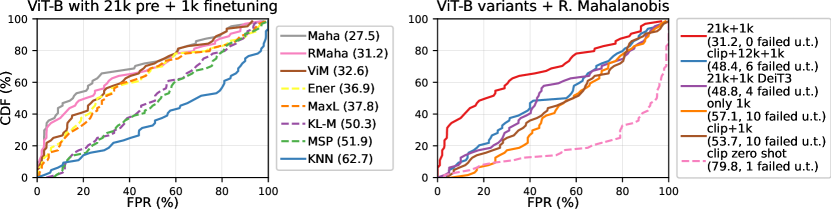
- 在更大的数据集上进行预训练通常会提升 OOD 检测,且基于预登录特征的检测方法(pre-logit)往往优于 MSP,但其收益对模型与预训练强烈依赖。
- 明确使用 pre-logit 特征(基于特征的检测器)在各模型上产生更一致的改进;然而,零样本 CLIP 基方法在 NINCO 上并不超过 IN-1K 分类器。
- 在 NINCO 上,先进检测器带来的平均 FPR 改进比在某些传统基准上更显著,且按类别的分析显示 OOD 类之间的表现差异很大。
更好的研究,从现在开始
从论文设计到论文写作,大幅缩短您的研究时间。
无需绑定信用卡
本解读由 AI 生成,并经人工编辑审核。