
[Paper Review] In Search for a Generalizable Method for Source Free Domain Adaptation
This paper proposes NOTELA, a novel source-free domain adaptation method that improves generalization by applying a Laplacian regularizer to the Noisy Student framework, significantly outperforming existing methods on challenging bioacoustics shifts and maintaining strong performance across vision benchmarks. The study reveals that current SFDA methods lack generalizability across modalities and shift types, advocating for broader evaluation scopes beyond vision datasets.
Source-free domain adaptation (SFDA) is compelling because it allows adapting an off-the-shelf model to a new domain using only unlabelled data. In this work, we apply existing SFDA techniques to a challenging set of naturally-occurring distribution shifts in bioacoustics, which are very different from the ones commonly studied in computer vision. We find existing methods perform differently relative to each other than observed in vision benchmarks, and sometimes perform worse than no adaptation at all. We propose a new simple method which outperforms the existing methods on our new shifts while exhibiting strong performance on a range of vision datasets. Our findings suggest that existing SFDA methods are not as generalizable as previously thought and that considering diverse modalities can be a useful avenue for designing more robust models.
Motivation & Objective
- To evaluate the generalizability of existing source-free domain adaptation (SFDA) methods beyond standard vision benchmarks.
- To identify why SFDA methods fail or underperform when applied to complex, real-world distribution shifts in audio data.
- To propose a new SFDA method that maintains strong performance across diverse domains, including bioacoustics and vision.
- To advocate for expanding SFDA evaluation to include diverse modalities and complex distribution shifts to improve method robustness.
- To demonstrate that leveraging feature space stability through regularization leads to more consistent and generalizable adaptation.
Proposed method
- Proposes NOTELA, a modified Noisy Student framework with a Laplacian regularizer applied to the feature space to stabilize adaptation.
- Uses spectrograms as input to treat audio data as image-like, enabling direct application of vision-based SFDA methods.
- Applies a Laplacian regularizer to the student model's features to encourage smoothness and consistency across similar examples.
- Employs a self-distillation process where the teacher model's soft labels guide the student, with the Laplacian regularizer improving generalization.
- Performs hyperparameter search using ImageNet-C as a validation domain to avoid target domain data leakage.
- Evaluates methods on a new bioacoustics benchmark with extreme covariate and label shifts, including multi-label, low-SNR, and multi-speaker recordings.
Experimental results
Research questions
- RQ1How do existing SFDA methods perform when applied to a new, challenging audio domain with extreme distribution shifts?
- RQ2Why do some SFDA methods degrade or underperform compared to the pre-trained model in non-vision domains?
- RQ3Can a simple modification to an existing SFDA method, such as adding a Laplacian regularizer, lead to more consistent and generalizable performance across diverse domains?
- RQ4To what extent do current SFDA evaluation protocols in vision fail to capture the true generalizability of methods?
- RQ5What role does the model's feature space play in stabilizing adaptation under low-confidence and high-shift conditions?
Key findings
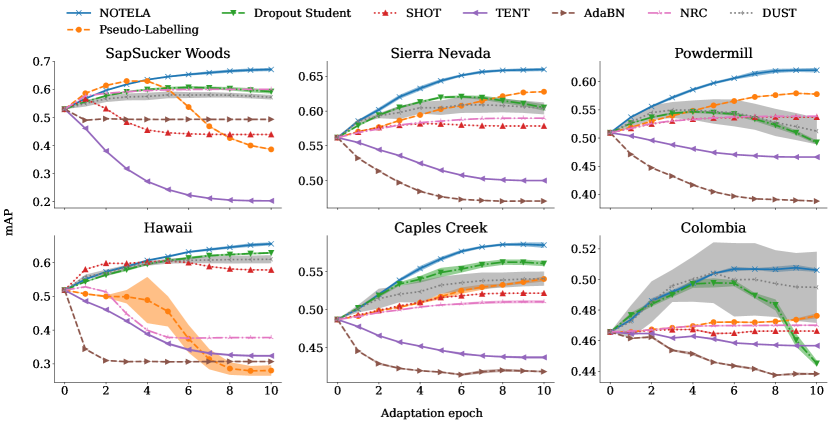
- Existing SFDA methods exhibit significantly different performance rankings on bioacoustics shifts compared to standard vision benchmarks, indicating poor cross-domain generalizability.
- In some cases, SFDA methods degrade performance relative to the pre-trained model, highlighting risks in real-world deployment without proper evaluation.
- NOTELA outperforms all baselines on the challenging bioacoustics benchmark, achieving state-of-the-art results on extreme distribution shifts.
- NOTELA maintains strong performance across multiple vision benchmarks, including ImageNet-R, ImageNet-Sketch, and VisDA-C, demonstrating cross-domain consistency.
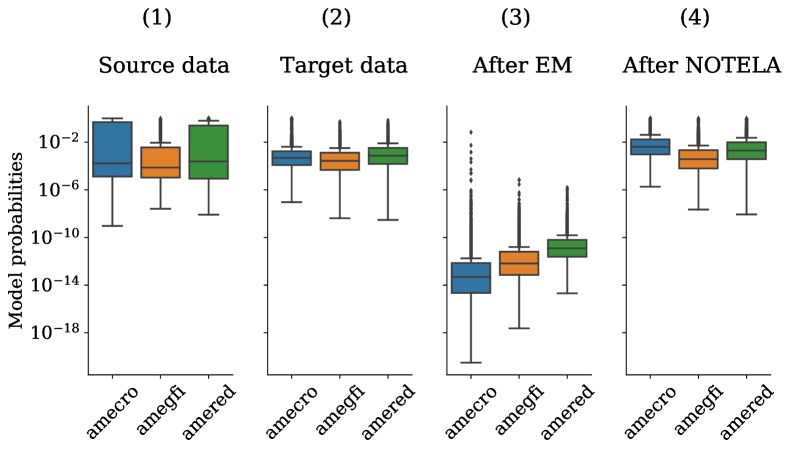
- The Laplacian regularizer stabilizes adaptation by leveraging the feature space, reducing sensitivity to low model confidence and improving calibration.
- The study reveals that current SFDA methods may be co-adapted to vision-specific characteristics, limiting their transferability to other modalities and complex real-world settings.
Read this paper
Open the full text in the Nubint reader and ask about any passage as you read.
Read this paper on NubintThis review was generated by AI from the original paper. Please check the paper before citing it.