
[Paper Review] Inferring phase transitions and critical exponents from limited observations with Thermodynamic Maps
Thermodynamic Maps use score-based generative modeling to learn the temperature dependence of thermodynamic observables from limited data, enabling inference of phase transitions and melting behavior in Ising and RNA systems.
Phase transitions are ubiquitous across life, yet hard to quantify and describe accurately. In this work, we develop an approach for characterizing generic attributes of phase transitions from very limited observations made deep within different phases' domains of stability. Our approach is called Thermodynamic Maps, which combines statistical mechanics and molecular simulations with score-based generative models. Thermodynamic Maps enable learning the temperature dependence of arbitrary thermodynamic observables across a wide range of temperatures. We show its usefulness by calculating phase transition attributes such as melting temperature, temperature-dependent heat capacities, and critical exponents. For instance, we demonstrate the ability of thermodynamic maps to infer the ferromagnetic phase transition of the Ising model, including temperature-dependent heat capacity and critical exponents, despite never having seen samples from the transition region. In addition, we efficiently characterize the temperature-dependent conformational ensemble and compute melting curves of the two RNA systems GCAA tetraloop and HIV-TAR, which are notoriously hard to sample due to glassy-like landscapes.
Motivation & Objective
- Motivate quantifying phase transitions in systems that remain at equilibrium across phases.
- Develop a generative framework that learns the temperature dependence of partition functions and free energies from limited observations.
- Demonstrate the method on the 2D Ising model to infer critical temperature and exponents.
- Apply TM to RNA systems to extract temperature-dependent conformational ensembles and melting curves.
Proposed method
- Introduce Thermodynamic Maps (TM) that map the temperature dependence of complex system ensembles onto a simple prior system using score-based diffusion models.
- Augment coordinates with auxiliary inverse-temperature variables to form a joint x, β space and train a diffusion-based map Mθ that inverts a forward diffusion between p(x,β) and q(x′,β′).
- Use score-based models with forward and backward SDEs to learn the temperature-tailed mapping without requiring explicit Jacobians.
- Extend Targeted Free Energy Perturbation (TFEP) to multi-ensemble thermodynamics by learning the mapping and using it to estimate free energy differences across temperatures.
- Represent the prior as a harmonic oscillator to give physical meaning to the temperature variable and enable generation at arbitrary temperatures.
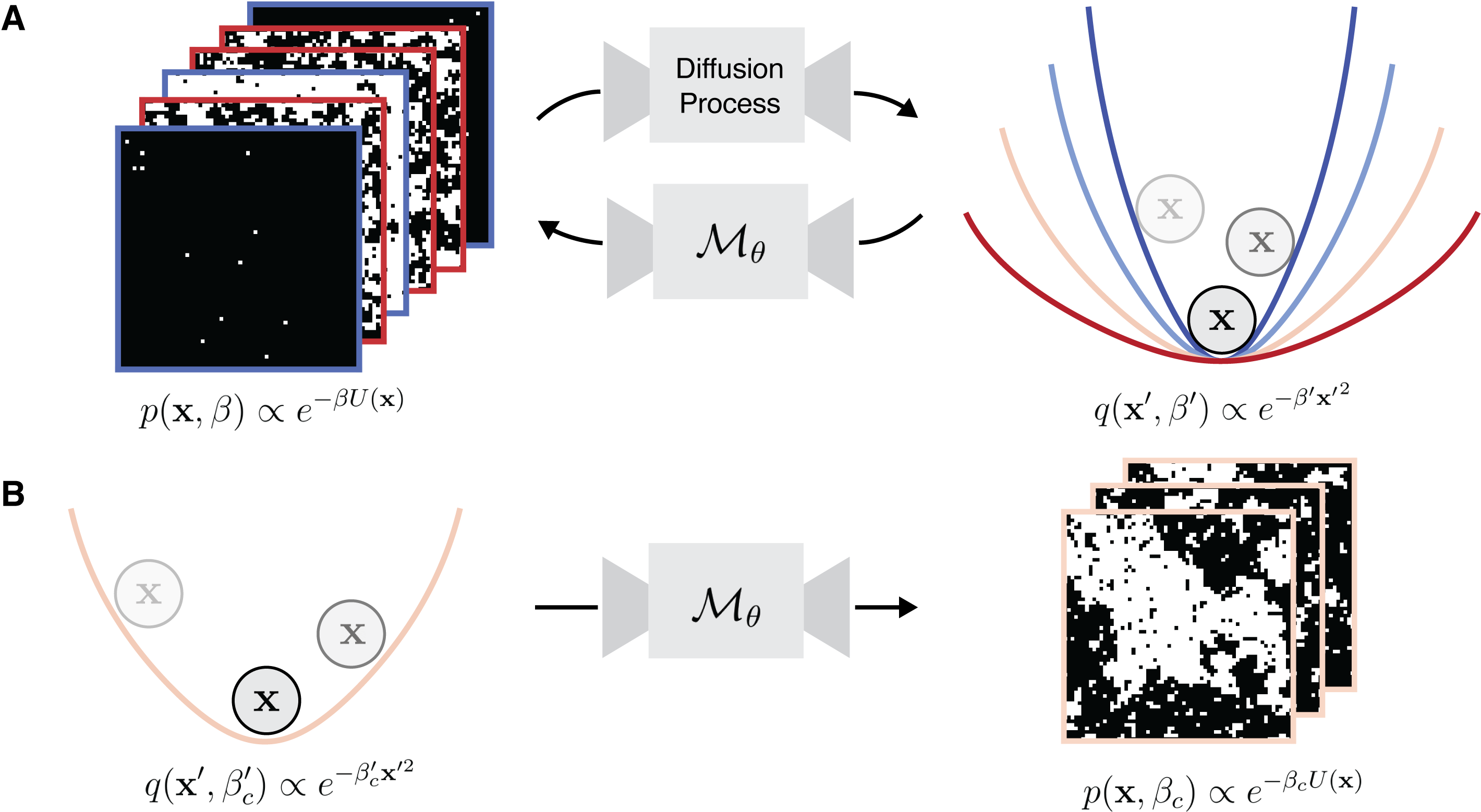
Experimental results
Research questions
- RQ1Can Thermodynamic Maps infer the critical behavior of phase transitions from data sampled deep inside stable phases?
- RQ2How well can TM recover temperature-dependent observables such as magnetization, heat capacity, and melting curves from limited sampling?
- RQ3Do TM-based predictions of critical temperature and exponents align with theory and benchmarks for Ising, and with MD and experiments for RNA systems?
- RQ4Can TM accelerate sampling of RNA conformational landscapes and yield reliable temperature-dependent equilibrium distributions?
Key findings
- TM correctly infers the Ising critical temperature and divergence of magnetization and heat capacity from data at two temperatures deep in distinct phases.
- Critical exponents inferred by TM (β ≈ 0.178 ± 0.012; α ≈ 0.236 ± 0.061) agree with MC results within finite-size effects.
- TM learns the temperature dependence of RNA conformational ensembles and yields melting curves in agreement with computational and experimental references.
- TM-aMD accelerates sampling of RNA landscapes, achieving substantial speedups with results consistent with replica-exchange benchmarks.
- TM demonstrates reliable generation of thermodynamically consistent samples at temperatures not present in the training data.

Better researchstarts right now
From reading papers to final review, dramatically reduce your research time.
No credit card · Free plan available
This review was created by AI and reviewed by human editors.