
[论文解读] Intelligent Agricultural Greenhouse Control System Based on Internet of Things and Machine Learning
本文设计并实现了一个基于物联网的温室控制系统,使用机器学习来监测环境参数并自适应调控温度、湿度、光照、灌溉等因素,以提升作物生长与资源利用效率。
This study endeavors to conceptualize and execute a sophisticated agricultural greenhouse control system grounded in the amalgamation of the Internet of Things (IoT) and machine learning. Through meticulous monitoring of intrinsic environmental parameters within the greenhouse and the integration of machine learning algorithms, the conditions within the greenhouse are aptly modulated. The envisaged outcome is an enhancement in crop growth efficiency and yield, accompanied by a reduction in resource wastage. In the backdrop of escalating global population figures and the escalating exigencies of climate change, agriculture confronts unprecedented challenges. Conventional agricultural paradigms have proven inadequate in addressing the imperatives of food safety and production efficiency. Against this backdrop, greenhouse agriculture emerges as a viable solution, proffering a controlled milieu for crop cultivation to augment yields, refine quality, and diminish reliance on natural resources [b1]. Nevertheless, greenhouse agriculture contends with a gamut of challenges. Traditional greenhouse management strategies, often grounded in experiential knowledge and predefined rules, lack targeted personalized regulation, thereby resulting in resource inefficiencies. The exigencies of real-time monitoring and precise control of the greenhouse's internal environment gain paramount importance with the burgeoning scale of agriculture. To redress this challenge, the study introduces IoT technology and machine learning algorithms into greenhouse agriculture, aspiring to institute an intelligent agricultural greenhouse control system conducive to augmenting the efficiency and sustainability of agricultural production.
研究动机与目标
- 在日益增长的粮食需求与气候挑战下,激发对智能、可持续温室管理的需求。
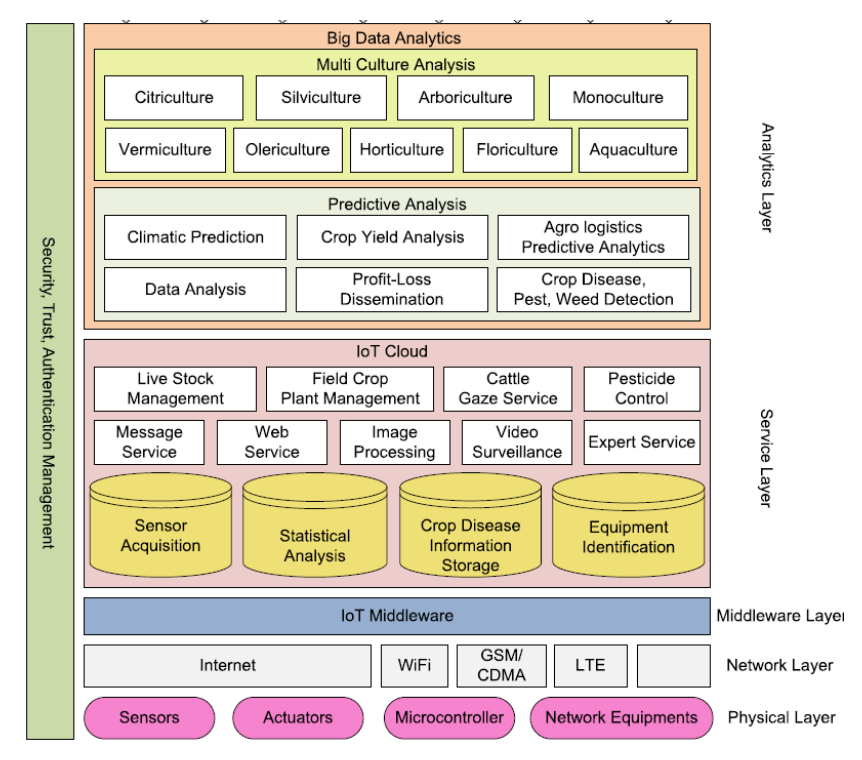
- 提出一个基于物联网、集成机器学习的架构,用于监测和控制温室内部条件。
- 展示实时数据收集、处理以及基于模型的调控,以提高作物生长效率并减少资源浪费。
- 解决部署智能温室系统时的隐私、安全、模块化及社会经济方面的考虑。
提出的方法
- 部署用于全面温室监测的传感器(温度、湿度、光照)并排布。
- 使用 IoT 将传感器数据传输到云端进行处理与存储。
- 应用数据预处理(异常值修复、归一化),并在历史时间序列数据上训练基于 RNN 的模型。
- 实现将 PID、MPC 和模糊控制结合的混合控制策略以实现实时调控。
- 利用机器学习输出通过反馈控制调整环境参数。
- 开发能源、灌溉和施肥模型以优化资源利用。
实验结果
研究问题
- RQ1如何利用 IoT 感知和云处理来支持对温室环境动态的准确建模?
- RQ2在 ML 预测引导下,结合 PID、MPC 与模糊控制框架,是否能实现对温室的精确实时调控?
- RQ3在不同作物中,基于 ML 驱动的温室控制能实现哪些潜在的能源、水和肥料节约?
- RQ4在智能温室部署中,数据隐私、系统维护与技术采纳面临哪些挑战?
主要发现
- 基于云的数据管线支持对温室传感器数据进行清洗、归一化和异常修复。
- 使用基于 RNN 的模型从历史时间序列数据预测未来的温室条件。
- 多算法控制策略(PID、MPC、模糊)提升了对变化条件的调控灵活性和响应性。
- 该系统实现作物特定的环境调调和能源与水资源的优化利用。
- 现实案例研究表明提高作物生长效率并减少资源浪费。
- 未来工作包括整合先进传感器、深度学习以及更广泛的生态系统互操作性。
更好的研究,从现在开始
从论文设计到论文写作,大幅缩短您的研究时间。
无需绑定信用卡
本解读由 AI 生成,并经人工编辑审核。