
[Paper Review] Inverse design of a pyrochlore lattice of DNA origami through model-driven experiments
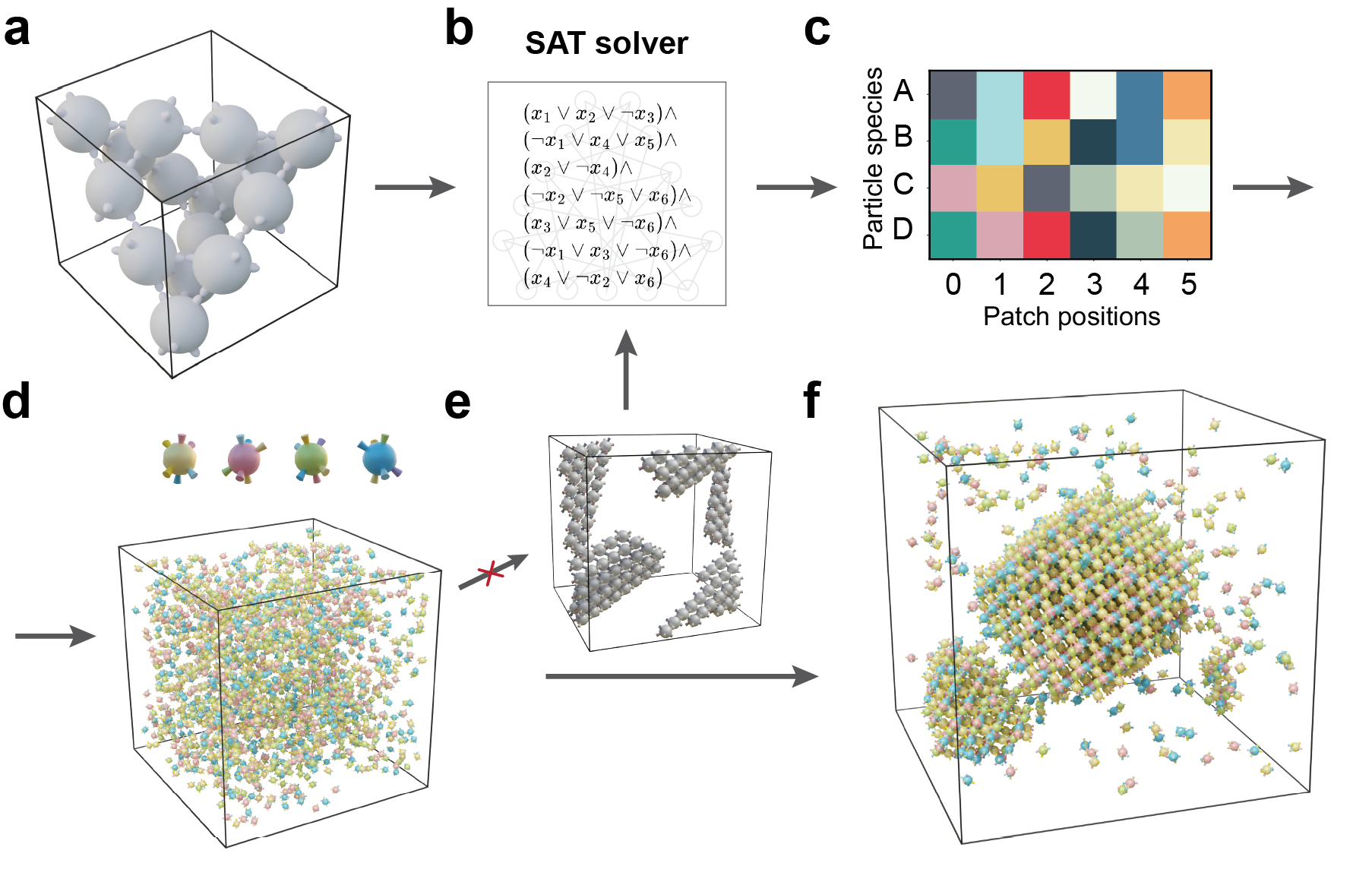
This paper presents a model-driven inverse design pipeline that combines SAT-assembly optimization with coarse-grained simulations to enable the experimentally verified self-assembly of a pyrochlore lattice using DNA origami. By iteratively banning kinetic traps and competing phases, the method achieves high-yield, trap-free assembly of the target 3D lattice, confirmed by SAXS and SEM, with lattice parameters of 156.4 nm and 159.1 nm for octahedral and icosahedral designs, respectively.
Sophisticated statistical mechanics approaches and human intuition have demonstrated the possibility to self-assemble complex lattices or finite size constructs, but have mostly only been successful in silico. The proposed strategies quite often fail in experiment due to unpredicted traps associated to kinetic slowing down (gelation, glass transition), as well as to competing ordered structures. An additional challenge that theoretical predictions face is the difficulty to encode the desired inter-particle interaction potential with the currently available library of nano- and micron-sized particles. To overcome these issues, we conjugate here SAT-assembly -- a patchy-particle interaction design algorithm based on constrained optimization solvers -- with coarse-grained simulations of DNA nanotechnology to experimentally realize trap-free self-assembly pathways. As a proof of concept we investigate the assembly of the pyrochlore (also known as tetrastack) lattice, a highly coveted 3D crystal lattice due to its promise in construction of optical metamaterials. We confirm the successful assembly with two different patchy DNA origami designs via SAXS as well as SEM visualization of the silica-coated lattice. Our approach offers a versatile modeling pipeline that starts from patchy particles designed in silico and ends with wireframe DNA origami that self-assemble into the desired structure.
Motivation & Objective
- To overcome kinetic traps and competing phases that commonly hinder the experimental realization of complex self-assembled nanostructures.
- To develop a generalizable design framework that bridges theoretical predictions with experimental success in DNA nanotechnology.
- To enable the experimental realization of the highly sought-after pyrochlore lattice, a promising structure for optical metamaterials.
- To create a scalable, open-source pipeline for designing both long-range and finite-size assemblies using patchy particle interactions.
- To demonstrate that complex lattice geometries can be achieved through a synergy of computational optimization, simulations, and targeted experiments.
Proposed method
- The SAT-assembly algorithm is used to design patchy particle interactions by translating lattice topology into Boolean clauses and solving for interaction matrices that satisfy unit cell constraints.
- Coarse-grained molecular dynamics simulations are performed across a range of temperatures to identify and screen out kinetic traps and competing phases.
- Undesired states are explicitly banned in subsequent SAT solver iterations, refining the interaction design to favor only the target pyrochlore lattice.
- The final patchy particle design is realized using DNA origami with specific DNA sequences and attachment points to encode directional interactions.
- Experimental validation is performed using small-angle X-ray scattering (SAXS) and scanning electron microscopy (SEM), including FIB cross-sectioning for internal structure analysis.
- A nucleotide-level coarse-grained model verifies compatibility between the designed patchy interactions and the DNA nanostructure realization.
Experimental results
Research questions
- RQ1Can a computational design pipeline based on constrained optimization and simulations successfully guide the experimental self-assembly of a complex 3D lattice like the pyrochlore structure?
- RQ2How can kinetic traps and competing ordered phases be systematically identified and eliminated during the inverse design of patchy particle interactions?
- RQ3To what extent can the design pipeline be generalized to other complex lattices or finite-size assemblies beyond the pyrochlore lattice?
- RQ4Can DNA origami be engineered to realize the required patchy particle interactions with sufficient precision to achieve long-range order in 3D?
- RQ5What experimental techniques can reliably confirm the formation of a pyrochlore lattice at the mesoscale, including lattice parameters and internal order?
Key findings
- The inverse design pipeline successfully eliminated kinetic traps and competing phases, resulting in a self-assembly pathway that exclusively forms the target pyrochlore lattice.
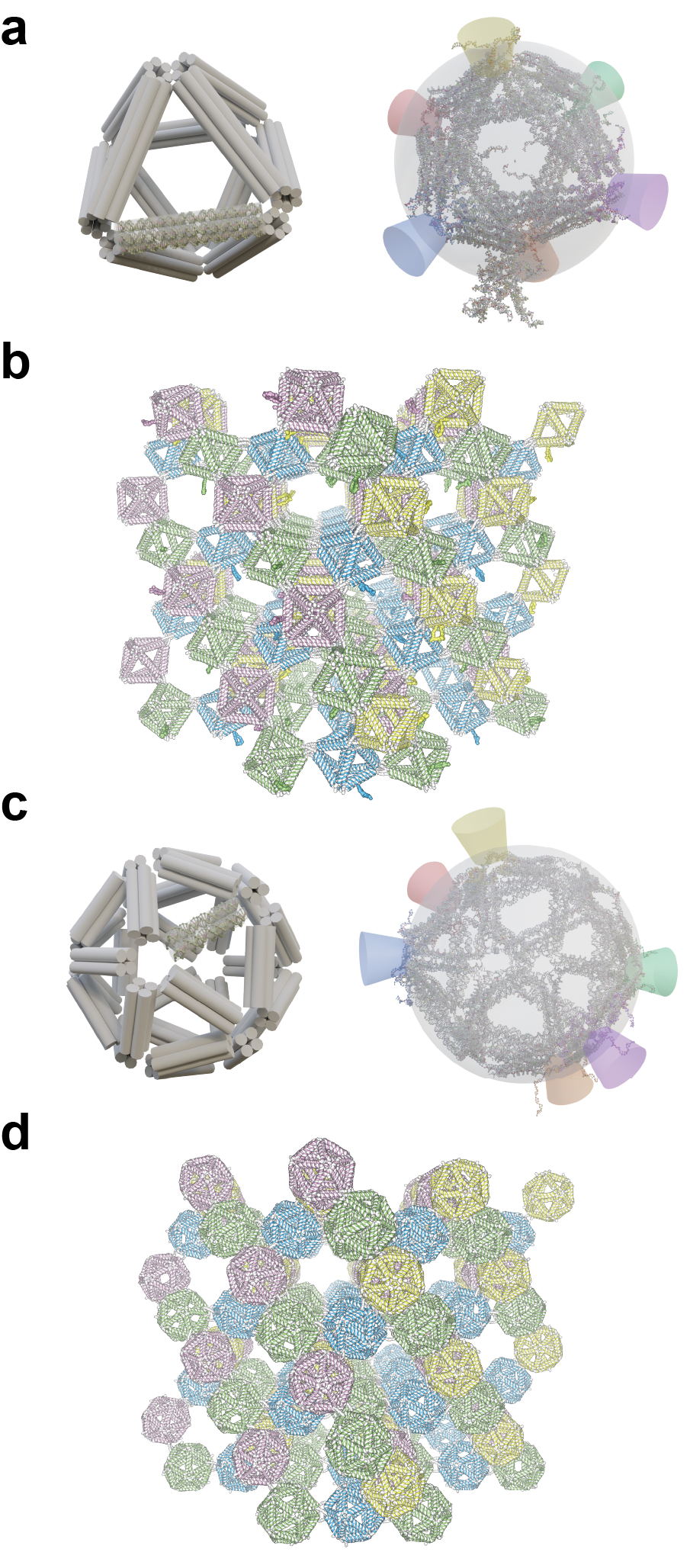
- SAXS measurements confirmed the lattice structure with lattice parameters of 156.4 nm for the octahedral DNA origami design and 159.1 nm for the icosahedral design.
- SEM and FIB cross-sectional imaging revealed long-range internal order without obvious defects, confirming the structural fidelity of the assembled lattice.
- The experimental realization was achieved with two distinct DNA origami designs, demonstrating the robustness and versatility of the design pipeline.
- The method enables precise control over lattice parameters through the size and internal features of the DNA origami building blocks, which influences the final optical properties of the lattice.
- The entire design and simulation pipeline is released as open-source software, enabling broad application to other complex nanostructures.
Better researchstarts right now
From reading papers to final review, dramatically reduce your research time.
No credit card · Free plan available
This review was created by AI and reviewed by human editors.