
[Paper Review] Is GPT-4 a reliable rater? Evaluating Consistency in GPT-4 Text Ratings
This study evaluates GPT-4's consistency in rating student responses in higher education macroeconomics tasks, using structured prompts to assess content and style across repeated evaluations. GPT-4 demonstrated high interrater reliability (ICC 0.94–0.99) and effectively distinguished between content and style, with content ratings stable under stylistic rephrasing and style ratings decreasing when style was non-adequate, indicating robust, consistent evaluation capabilities.
This study investigates the consistency of feedback ratings generated by OpenAI's GPT-4, a state-of-the-art artificial intelligence language model, across multiple iterations, time spans and stylistic variations. The model rated responses to tasks within the Higher Education (HE) subject domain of macroeconomics in terms of their content and style. Statistical analysis was conducted in order to learn more about the interrater reliability, consistency of the ratings across iterations and the correlation between ratings in terms of content and style. The results revealed a high interrater reliability with ICC scores ranging between 0.94 and 0.99 for different timespans, suggesting that GPT-4 is capable of generating consistent ratings across repetitions with a clear prompt. Style and content ratings show a high correlation of 0.87. When applying a non-adequate style the average content ratings remained constant, while style ratings decreased, which indicates that the large language model (LLM) effectively distinguishes between these two criteria during evaluation. The prompt used in this study is furthermore presented and explained. Further research is necessary to assess the robustness and reliability of AI models in various use cases.
Motivation & Objective
- To assess the consistency of GPT-4’s text ratings across multiple iterations, time spans, and stylistic variations in higher education contexts.
- To evaluate the reliability of GPT-4 as a rater in formative assessment, particularly for content and style dimensions in student responses.
- To examine whether GPT-4 can reliably distinguish between content quality and stylistic quality in written responses.
- To provide a foundation for integrating AI-generated feedback into authentic educational scenarios, such as those in the BMBF-funded DeepWrite project.
- To inform future prompt engineering and AI integration in educational assessment by analyzing rating stability and correlation.
Proposed method
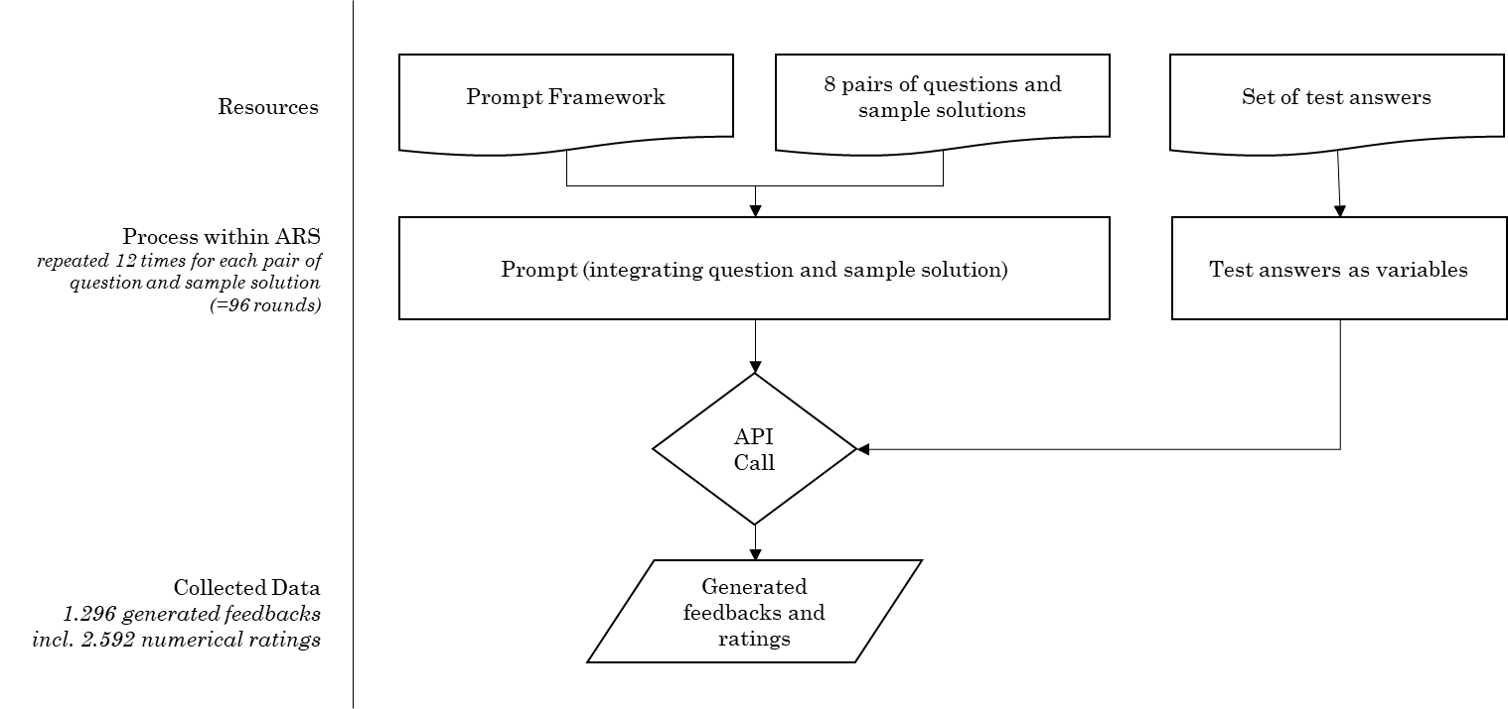
- GPT-4 was prompted to rate student responses in macroeconomics on two dimensions: content and style, using a standardized, detailed prompt.
- Ratings were collected across multiple time points and with rephrased versions of the same responses to test consistency under variation.
- Intraclass Correlation (ICC) was calculated to measure interrater reliability across repeated assessments.
- Pearson correlation was computed to assess the relationship between content and style ratings.
- Skewness of rating distributions was analyzed to detect bias or tendency in GPT-4’s scoring behavior.
- Statistical analysis included comparison of ICC values across different time intervals and response variants to evaluate stability.
Experimental results
Research questions
- RQ1How consistent are GPT-4’s ratings across repeated evaluations of the same responses over time?
- RQ2To what extent can GPT-4 reliably distinguish between content quality and stylistic quality in student writing?
- RQ3How do variations in response style affect GPT-4’s ratings of content and style?
- RQ4What is the interrater reliability of GPT-4’s ratings, as measured by ICC, across different time spans and response variants?
- RQ5Are there systematic biases in GPT-4’s ratings, as indicated by skewness in the distribution of scores?
Key findings
- GPT-4 demonstrated high interrater reliability with ICC scores ranging from 0.94 to 0.99 across different time spans, indicating strong consistency in repeated ratings.
- The correlation between content and style ratings was high at 0.87, suggesting that while related, the two dimensions are evaluated as distinct criteria.
- When responses were rephrased to use a non-adequate style, content ratings remained stable, while style ratings decreased, confirming GPT-4’s ability to separate content from style.
- Content ratings showed slight right-skewness (mean skewness ≈ 0.10), indicating a tendency toward more lenient or higher average content scores.
- Style ratings exhibited left-skewness (mean skewness ≈ -0.03), suggesting stricter or more conservative criteria for style evaluation.
- The ICC values were lower when ratings were compared across a several-week time gap, indicating reduced consistency over longer intervals, though still within high reliability range.
Read this paper
Open the full text in the Nubint reader and ask about any passage as you read.
Read this paper on NubintThis review was generated by AI from the original paper. Please check the paper before citing it.