
[论文解读] JWST/MIRI reveals the true number density of massive galaxies in the early Universe
本研究使用来自 PRIMER 计划的 JWST/MIRI 数据,稳健重新校准高红移星系的恒星质量,显示在 z>5 的大质量系统数量密度下降,并揭示在 redshift- and mass-dependent rise in baryon-to-star conversion efficiency within LCDM 的范围内的变化。
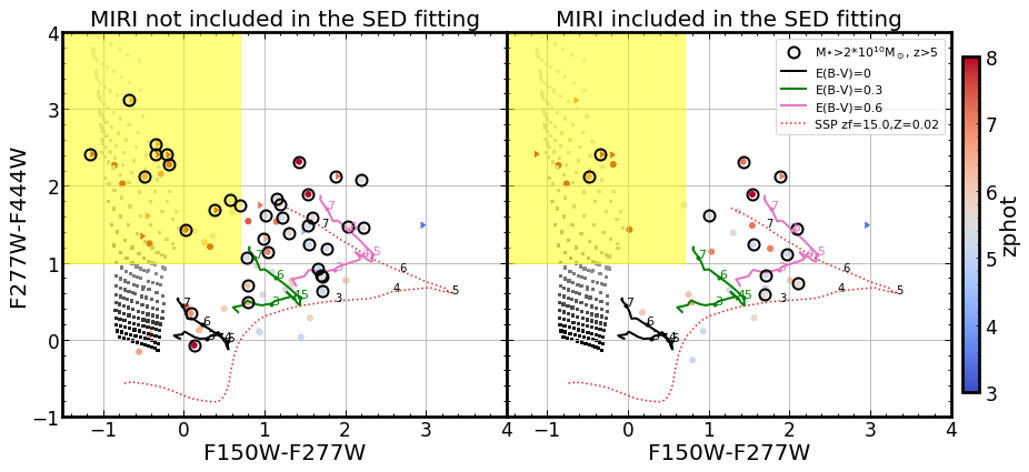
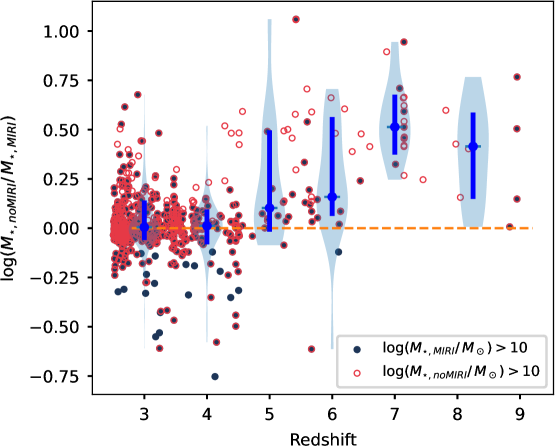
Early JWST studies reporting an unexpected abundance of massive galaxies at $z \sim 5$--$8$ challenge galaxy formation models in the $Λ$CDM framework. Previous stellar mass ($M_\star$) estimates suffered from large uncertainties due to the lack of rest-frame near-infrared data. Using deep JWST/NIRCam and MIRI photometry from PRIMER, we systematically analyze massive galaxies at $z \sim 3$--$8$, leveraging rest-frame $\gtrsim 1\,μ$m constraints. We find MIRI is critical for robust $M_\star$ measurements for massive galaxies at $z > 5$: excluding MIRI overestimates $M_\star$ by $\sim 0.4$ dex on average for $M_\star > 10^{10}\,M_\odot$ galaxies, with no significant effects at lower masses. This reduces number densities of $M_\star > 10^{10}\,M_\odot$ ($10^{10.3}\,M_\odot$) galaxies by $\sim 36\%$ ($55\%$). MIRI inclusion also reduces ``Little Red Dot'' (LRD) contamination in massive galaxy samples, lowering the LRD fraction from $\sim 32\%$ to $\sim 13\%$ at $M_\star > 10^{10.3}\,M_\odot$. Assuming pure stellar origins, LRDs exhibit $M_\star \sim 10^{9 ext{--}10.5}\,M_\odot$ with MIRI constraints, rarely exceeding $10^{10.5}\,M_\odot$. Within standard $Λ$CDM, our results indicate a moderate increase in the baryon-to-star conversion efficiency ($ε$) toward higher redshifts and masses at $z > 3$. For the most massive $z \sim 8$ galaxies, $ε\sim 0.3$, compared to $ε\lesssim 0.2$ for typical galaxies at $z < 3$. This result is consistent with models where high gas densities and short free-fall times suppress stellar feedback in massive high-$z$ halos.
研究动机与目标
- 需要使用静止帧 >1 μm 光度测量来准确测量高红移大质量星系的恒星质量的动机。
- 证明包含 JWST/MIRI 数据如何改变 SED 拟合结果并降低 z>4 时 M* 的高估。
- 量化从 z~3–9 的大质量星系(M*>10^9 Msun)的累计恒星质量密度,并与 LCDM 预测进行比较。
- 推断在 LCDM 框架下随红shift 和质量变化的气体转化为恒星的效率 ε,并在反馈无关的恒星爆发模型背景下进行解释。
提出的方法
- 使用 PRIMER 调查在 CANDELS-COSMOS/UDS 场域的多波段数据,构建一个包含 HST、JWST/NIRCam 和 JWST/MIRI 的大样本光度星系目录。
- 使用 EAZY 对有无 MIRI 光度数据进行不同情形的光度红移估计。
- 使用 BAGPIPES 和 FAST++ 在不同模板集和红移输入(有无 MIRI)下估算恒星质量。
- 通过将 Schechter 函数与高斯核卷积并拟合数据,评估质量完整性并量化 Eddington 偏差。
- 计算累计恒星质量密度并与基于晕结构的预期进行比较,以推导隐含的 ε(M*, z)。
实验结果
研究问题
- RQ1在包含 rest-frame >1 μm 光度测量时,z ~ 3–9 时的真实大质量星系密度是多少(M* > 10^10 M⊙)?
- RQ2包含 MIRI 光度数据如何影响推导的恒星质量和高红移时恒星质量函数的演化?
- RQ3在 LCDM 下,作为恒星质量和红shift 的函数,隐含的气体转化为恒星的效率 ε 是多少?
- RQ4观测到的高红移大质量星系是否与像反馈无关的恒星爆发等模型相一致,还是需要极端的效率?
主要发现
- 与无 MIRI 的拟合相比,包含 MIRI 光度显著降低了在 z>5 时大质量星系的数量和质量密度。
- 对于 z > 5 的 M* > 10^10.3 M⊙ 的星系,在包含 MIRI 时 M* 显著降低,减少了因年龄-衰减-发射线污染导致的高估。
- 观测到的累计恒星质量密度与不需要极端气体转化效率的 LCDM 预测一致,而 ε 随着 M* 和 z 的增加而增大。
- 在 z~8 时,所需的 ε 约为 0.3,相比典型低-z 星系的约 0.14,暗示早期宇宙中更高的效率。
- 结果与反馈无关的恒星爆发(FFB)模型相一致,在高气体密度和短自由坠落时间下抑制恒星反馈。
- 研究提供了一个框架,其中 ε(z, M*) 随着红shift 和质量上升,并在 ε_max ≈ 0.2 时与 FFB 的预测保持一致。
更好的研究,从现在开始
从论文设计到论文写作,大幅缩短您的研究时间。
无需绑定信用卡
本解读由 AI 生成,并经人工编辑审核。