
[论文解读] JWST Reveals CH$_4$, CO$_2$, and H$_2$O in a Metal-rich Miscible Atmosphere on a Two-Earth-Radius Exoplanet
JWST 转发光谱观测 TOI-270 d 显示一个高度金属富、可混合的 HMWV 主导包层,含 CH$_4$、CO$_2$、和 H$_2$O 的特征,约束内部组成并提出一种新的亚海王星分类。
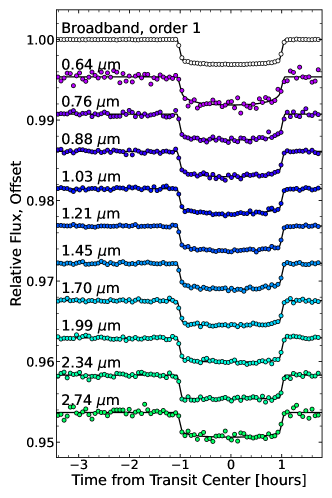
Even though sub-Neptunes likely represent the most common outcome of planet formation, their natures remain poorly understood. In particular, planets near 1.5-2.5$\,R_\oplus$ often have bulk densities that can be explained equally well with widely different compositions and interior structures, resulting in grossly divergent implications for their formation. Here, we present the full 0.6-5.2$\,μ\mathrm{m}$ JWST NIRISS/SOSS+NIRSpec/G395H transmission spectrum of the 2.2$\,R_\oplus$ TOI-270d ($4.78\,M_\oplus$, $T_\mathrm{eq}$=350-380 K), delivering unprecedented sensitivity for atmospheric characterization in the sub-Neptune regime. We detect five vibrational bands of CH$_4$ at 1.15, 1.4, 1.7, 2.3, and 3.3$\,μ$m (9.4$σ$), the signature of CO$_2$ at 4.3$\,μ$m (4.8$σ$), water vapor (2.5$σ$), and potential signatures of SO$_2$ at 4.0$\,μ\mathrm{m}$ and CS$_2$ at 4.6$\,μ\mathrm{m}$. Intriguingly, we find an overall highly metal-rich atmosphere, with a mean molecular weight of $5.47_{-1.14}^{+1.25}$. We infer an atmospheric metal mass fraction of $58_{-12}^{+8}\%$ and a C/O of $0.47_{-0.19}^{+0.16}$, indicating that approximately half the mass of the outer envelope is in high-molecular-weight volatiles (H$_2$O, CH$_4$, CO, CO$_2$) rather than H$_2$/He. We introduce a sub-Neptune classification scheme and identify TOI-270d as a "miscible-envelope sub-Neptune" in which H$_2$/He is well-mixed with the high-molecular-weight volatiles in a miscible supercritical metal-rich envelope. For a fully miscible envelope, we conclude that TOI-270d's interior is $90_{-4}^{+3}\,$wt$\,\%$ rock/iron, indicating that it formed as a rocky planet that accreted a few wt % of H$_2$/He, with the overall envelope metal content explained by magma-ocean/envelope reactions without the need for significant ice accretion. TOI-270d may well be an archetype of the overall population of sub-Neptunes.
研究动机与目标
- 理解近半径峡谷区域亚海王星组成的复杂性(此区域内的内部结构存在简并性)以促使认知提升。
- 利用广域的 JWST 波长覆盖,对约 2.2 R⊕ 的行星的上层大气化学进行表征。
- 通过大气丰度推断来约束内部组成与包层金属含量。
- 提出一个将可混合、金属富包层的亚海王星进行分类的框架。
- 评估对行星形成路径及内部-内部-包层耦合的含义。
提出的方法
- 使用 NIRISS/SOSS 和 NIRSpec/G395H(0.6–2.8 μm 和 2.7–5.2 μm)获取 TOI-270 d 的 0.6–5.2 μm JWST 透射光谱。
- 使用 NAMELESS 与 supreme-SPOON 测试数据处理管线进行降噪;纠正 1/f 噪声、背景和宇宙射线;提取光谱光曲线。
- 在 MCMC 框架下利用 ExoTEP 和 batman 遥传模型拟合白光和光谱光曲线,包含系统误差与边缘效应。
- 通过反演对大气进行建模,识别 CH$_4$、CO$_2$、H$_2$O 的特征,以及潜在的 SO$_2$ 与 CS$_2$ 信号;推断平均分子量与金属性。
- 将大气约束与内部结构建模相结合,以估算岩石/铁的比例及包层组成。
- 讨论云/霾存在与可混合包层假说的含义。

实验结果
研究问题
- RQ1JWST 透射光谱揭示 TOI-270 d 上层大气中存在哪些分子物种?
- RQ2行星包层的平均分子量与金属性含量是多少,这些约束如何推动对内部结构的理解?
- RQ3若存在 H/He 包层,是否与高分子量的挥发物以可混合、金属富的包层混合?
- RQ4哪些形成途径最能解释 TOI-270 d 的推断内部和大气组成?
- RQ5TOI-270 d 如何为靠近半径谷的更广泛亚海王星分类体系提供信息?
主要发现
- 在 1.15、1.4、1.7、2.3、3.3 μm 检测到五个 CH$_4$ 振动带(9.4σ)。
- 在约 4.3 μm 处检测到 CO$_2$ 信号(4.8σ)。
- 在 1.4 和 1.9 μm 处检测到 H$_2$O 吸收(2.5σ)。
- 在 4.0 μm 可能的 SO$_2$ 信号与 4.6 μm 的 CS$_2$ 信号;总体光谱表明包层高度金属富。
- 推断的平均分子量为 5.47$_{-1.14}^{+1.25}$,大气金属含量百分比为 58$_{-12}^{+8}$%,C/O = 0.47$_{-0.19}^{+0.16}$。
- 内部建模表明若包层实现完全可混合,TOI-270 d 约为 wt% 岩石/铁 90$_{-4}^{+3}$,这意味着其形成为一个带有少量 H$_2$/He 的岩质天体,熔岩海洋–包层相互作用可解释包层金属含量。
更好的研究,从现在开始
从论文设计到论文写作,大幅缩短您的研究时间。
无需绑定信用卡
本解读由 AI 生成,并经人工编辑审核。