
[Paper Review] Large-scale ASR Domain Adaptation using Self- and Semi-supervised Learning
This paper proposes a joint self- and semi-supervised learning approach for large-scale automatic speech recognition (ASR) domain adaptation, using only 3% of labeled target-domain data to fully close the performance gap with a full-data baseline. The method combines self-supervised pre-training with confidence-filtered noisy student training, achieving 13.5% relative WER improvement on target domains and improved generalization on source domains.
Self- and semi-supervised learning methods have been actively investigated to reduce labeled training data or enhance the model performance. However, the approach mostly focus on in-domain performance for public datasets. In this study, we utilize the combination of self- and semi-supervised learning methods to solve unseen domain adaptation problem in a large-scale production setting for online ASR model. This approach demonstrates that using the source domain data with a small fraction of the target domain data (3%) can recover the performance gap compared to a full data baseline: relative 13.5% WER improvement for target domain data.
Motivation & Objective
- Address the challenge of domain mismatch in large-scale ASR systems, where training data (source domain) differs from real-world test data (target domain).
- Reduce reliance on large amounts of labeled target-domain data for domain adaptation in production ASR systems.
- Investigate the complementary roles of self-supervised and semi-supervised learning in improving both out-of-domain and in-domain ASR performance.
- Optimize training strategies to enhance model generalization using minimal labeled target data.
Proposed method
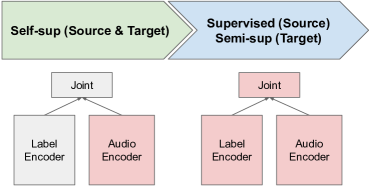
- Jointly train the RNN-T model with both RNN-T loss and self-supervised loss (e.g., Wav2vec2.0, APC, Wav2vec) using a shared causal audio encoder.
- Use a multi-layer perceptron (MLP) adapter to specialize the audio encoder’s final representation for both RNN-T and self-supervised objectives.
- Apply noisy student training (NST) with a non-causal teacher model to generate pseudo-labels for unlabeled target-domain data.
- Implement a confidence estimation module (CEM) to filter out low-confidence pseudo-labeled utterances, improving label quality and model robustness.
- Use a joint training scheme that enables Wav2vec2.0 to converge on causal encoders by leveraging RNN-T loss as a guide.
- Fine-tune the model using a combination of labeled source data and filtered pseudo-labeled target data, with hyperparameter λ = 0.5 for loss weighting.
Experimental results
Research questions
- RQ1Can self- and semi-supervised learning jointly close the out-of-domain generalization gap in large-scale ASR systems with minimal labeled target data?
- RQ2How do self-supervised and semi-supervised learning contribute differently to domain adaptation and in-domain performance?
- RQ3What is the optimal training strategy for combining self-supervised pre-training and semi-supervised fine-tuning in a causal, online ASR model?
- RQ4How does confidence filtering of pseudo-labels affect model performance on both source and target domains?
- RQ5Can joint training of RNN-T and self-supervised objectives overcome convergence issues in causal Wav2vec2.0 training?
Key findings
- Using only 3% of labeled target-domain data with self- and semi-supervised learning achieves 13.5% relative WER improvement on the target domain compared to a full-data baseline.
- The combined method reduces target domain WER to 3.1% (MF) and source domain WER to 5.7% (SF), outperforming supervised training with 100% target data.
- Self-supervised learning improves overall model generalization, while semi-supervised learning directly closes the out-of-domain generalization gap.
- Confidence filtering reduces 24% of target-domain utterances but improves target WER from 3.2% to 3.1% and source WER from 5.8% to 5.7%.
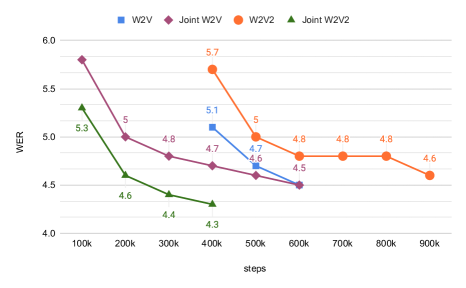
- Joint training of RNN-T and self-supervised loss enables Wav2vec2.0 to converge on causal encoders, achieving 4.3% WER—better than standalone Wav2vec2.0 pre-training.
- The joint training approach reduces total training steps by up to 80% compared to two-stage pre-training and fine-tuning, with faster convergence and better final performance.
Read this paper
Open the full text in the Nubint reader and ask about any passage as you read.
Read this paper on NubintThis review was generated by AI from the original paper. Please check the paper before citing it.