
[论文解读] Laser-Induced Cavitation for Controlling Crystallization from Solution
本研究证明,在低于光学击穿阈值的激光诱导热空化作用下,通过局部溶剂蒸发在气液界面处产生瞬态过饱和峰值,从而触发过饱和KCl溶液中的初级成核。高速显微成像与有限元模拟表明,成核概率、晶体量及形貌与该过饱和峰值的大小和持续时间密切相关,而该峰值由潜热与显热耗散之间的竞争所决定,提供了一种非光化学机制以控制结晶动力学。
We demonstrate that a cavitation bubble initiated by a Nd:YAG laser pulse below breakdown threshold induces crystallization from supersaturated aqueous solutions with supersaturation and laser-energy-dependent nucleation kinetics. Combining high-speed video microscopy and simulations, we argue that a competition between the dissipation of absorbed laser energy as latent and sensible heat dictates the solvent evaporation rate and creates a momentary supersaturation peak at the vapor-liquid interface. The number and morphology of crystals correlate to the characteristics of the simulated supersaturation peak.
研究动机与目标
- 阐明非光化学激光诱导成核(NPLIN)在过饱和溶液中的物理机制。
- 通过将热空化确定为主导因素,解决现有假设(如光化学反应、冲击波或杂质加热)中的模糊性。
- 通过实验与计算方法,将成核结果与激光诱导空化气泡的动力学相关联。
- 量化溶剂蒸发与过饱和峰值在触发成核中的作用,且不产生光化学副反应。
- 建立一个将激光能量、气泡动力学与结晶结果相联系的模型,以实现在材料与药物合成中的预测性控制。
提出的方法
- 使用频率倍频的Nd:YAG激光(532 nm,4 ns脉冲)聚焦,生成低于光学击穿阈值的局部热空化气泡。
- 添加高锰酸钾(3.26 mg/100 g水)作为可溶性光吸收剂,通过热空化实现可重复的气泡形成,避免等离子体形成。
- 高速视频显微成像以微秒级分辨率实时捕捉气泡动力学、晶体成核与生长过程。
- 一维有限元模拟对气泡周围温度、溶质浓度与过饱和度的演化进行建模,边界条件通过实验测得的气泡尺寸与寿命进行验证。
- 成核速率估算为 $ J \propto N / t_{\text{S}} $,其中 $ N $ 为平均晶体量,$ t_{\text{S}} $ 为过饱和度($ S > 1 $)的持续时间。
- 界面能 $ \gamma $ 通过 $ J $ 与 $ S_{\text{max}} $ 的关系曲线斜率估算,得到 $ \gamma = 3.7^{+0.47}_{-0.65} $ mJ/m²,对应约185–191 °C,与文献中NPLIN的值一致。
![Figure 1: Sketch of the experimental setup to generate a microbubble. The setup construction is detailed in our previous work [ 26 ] . The green arrow indicates the direction of laser pulse.](https://ar5iv.labs.arxiv.org/html/2302.01218/assets/x1.png)
实验结果
研究问题
- RQ1非光化学激光诱导成核(NPLIN)在过饱和水溶液中的物理机制是什么?
- RQ2激光诱导空化如何在无光化学反应的情况下于气液界面产生瞬态过饱和?
- RQ3激光能量与体相过饱和度在多大程度上控制所形成晶体的数量、形貌与成核概率?
- RQ4有限元模拟能否定量再现实验观测到的气泡动力学与成核结果?
- RQ5所观测到的结晶是由溶剂蒸发与过饱和峰值驱动,还是由冲击波或等离子体效应等其他机制驱动?
主要发现
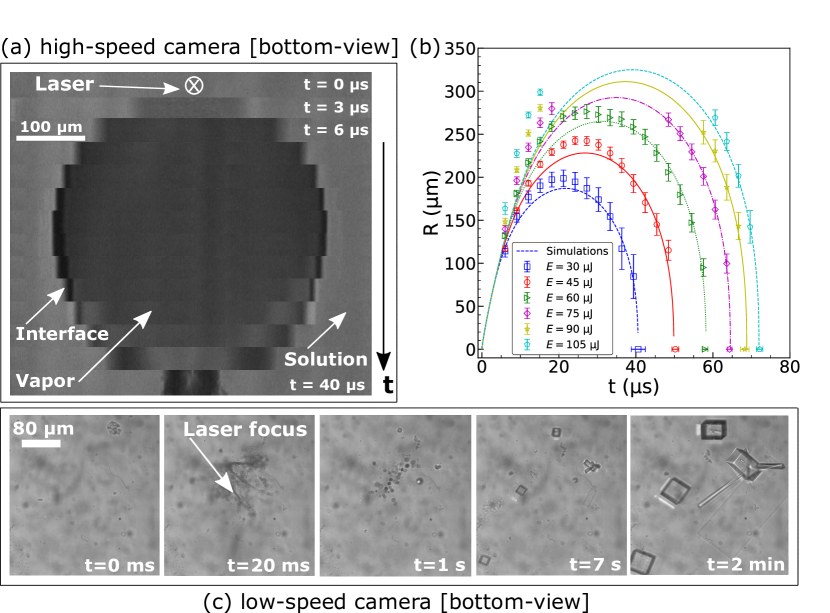
- 在气泡膨胀过程中,气液界面处形成持续约1–10 μs的瞬态过饱和峰值,过饱和度比约为1.03–1.05 S,其持续时间随激光能量与过饱和度增加而延长。
- 最大气泡半径与激光能量呈幂律关系,实验与模拟趋势高度一致(R² > 0.95),验证了模拟模型的可靠性。
- 成核速率 $ J $ 随峰值过饱和度 $ S_{\text{max}} $ 与持续时间 $ t_{\text{S}} $ 增加而上升,估算的界面能 $ \gamma = 3.7^{+0.47}_{-0.65} $ mJ/m² 在高温下与已报道的NPLIN值一致。
- 晶体量 $ N $ 随激光能量与过饱和度增加,且形貌与过饱和峰值的大小和持续时间相关,表明可直接调控成核结果。
- 热边界层厚度(约10 μm)与冲击波影响尺度相当,表明冲击波对成核贡献有限,因过饱和度不足。
- 通过使用可溶性染料(KMnO₄)替代纳米颗粒,并在光学击穿阈值以下工作,确认无光化学效应,确保成核完全由热空化诱导的蒸发驱动。
更好的研究,从现在开始
从阅读论文到最终审阅,大幅缩短您的研究时间。
无需绑定信用卡
本解读由 AI 生成,并经人工编辑审核。