
[论文解读] Latency and Privacy-Aware Resource Allocation in Vehicular Edge Computing
本文提出一种面向 Vehicular Edge Computing (VEC) 的隐私与时延感知资源分配方法,该方法将边缘处理分为用户端与 RSU/云层,并使用启发式方法根据隐私、实时需求与处理资源来分配任务。
The rapid increase in the number of connected vehicles has led to the generation of vast amounts of data. As a significant portion of this data pertains to vehicle-to-vehicle and vehicle-to-infrastructure communications, it is predominantly generated at the edge. Considering the enormous volume of data, real-time applications, and privacy concerns, it is crucial to process the data at the edge. Neglecting the management of processing resources in vehicular edge computing (VEC) could lead to numerous challenges as a substantial number of vehicles with diverse safety, economic, and entertainment applications, along with their data processing, emerge in the near future [1]. Previous research in VEC resource allocation has primarily focused on issues such as response time and privacy preservation techniques. However, an approach that takes into account privacy-aware resource allocation based on vehicular network architecture and application requirements has not yet been proposed. In this paper, we present a privacy and latency-aware approach for allocating processing resources at the edge of the vehicular network, considering the specific requirements of different applications. Our approach involves categorizing vehicular network applications based on their processing accuracy, real-time processing needs, and privacy preservation requirements. We further divide the vehicular network edge into two parts: the user layer (OBUs) is considered for processing applications with privacy requirements, while the allocation of resources in the RSUs and cloud layer is based on the specific needs of different applications. In this study, we evaluate the quality of service based on parameters such as privacy preservation, processing cost, meeting deadlines, and result quality. Comparative analyses demonstrate that our approach enhances service quality by 55% compared to existing state-of-the-art methods.
研究动机与目标
- 随着 V2V/V2I 数据的增长,激发在 VEC 中对隐私感知、低时延资源管理的需求。
- 定义一个异构的 VEC 架构,并按隐私、时延和精度要求对应用进行分类。
- 开发一个资源分配框架,根据应用类型将处理任务分配给边缘、RSU 或云端。
- 通过在用户设备(OBUs)上处理私有数据,在云/ RSU 处理非私有数据,纳入隐私保护拆分。
- 在 QoS、QoR 和处理成本方面,将所提系统与最先进方法进行比较评估。
提出的方法
- 将 VEC 架构建模为包含边缘(OBUs)、RSUs 和云层的多层结构。
- 按隐私、实时性需求和精度要求对应用进行分类,以确定处理位置。
- 提出一个启发式 PVEC 算法,将私有和实时任务分配给用户端边缘,同时将非私有任务路由到 RSU 或云端,并在可接受的情况下应用近似处理。
- 将 QoS 定义为处理成本、错过的截止期限和隐私的函数。
- 将处理成本定义为 PT * SRP,仅用于云端处理。
- 对不需要精确结果的应用使用近似处理以节省边缘资源。
![Figure 1 : Vehicular Edge Architecture [ 15 ]](https://ar5iv.labs.arxiv.org/html/2501.02804/assets/x1.jpg)
实验结果
研究问题
- RQ1应如何在边缘、RSU 和云之间分配处理,以满足多样化 VEC 应用的隐私和时延要求?
- RQ2在 VEC 中应用隐私与时延感知的资源分配时,对 QoS、QoR 和 成本的影响是什么?
- RQ3在资源受限的边缘设备上进行近似处理是否能在降低成本的同时保持可接受的 QoR?
- RQ4将私有应用分离至用户层对总体系统性能和隐私保障有何影响?
主要发现
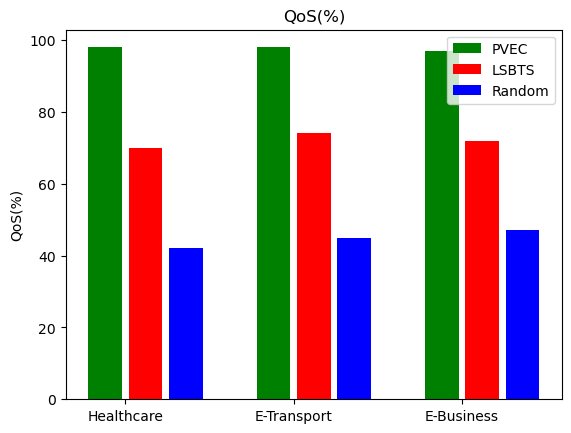
- 与基线方法(LSBTS 和 Random)相比,PVEC 方法在医疗保健、电子交通和电子商务工作负载中将 QoS 提升 30-55%。
- 边缘端近似处理带来微不足道的 QoR 损失,误差在 5% 区间内,95% 置信区间。
- 该方法相比基线将云处理成本降低了 49-63%。
- 边缘处理更适合实时、近似和私有数据任务,而云端处理则处理精确、软实时和非私有数据。
- 在评估中,所提出的框架在 QoS 上相对于现有技术实现约 55% 的提升。
更好的研究,从现在开始
从论文设计到论文写作,大幅缩短您的研究时间。
无需绑定信用卡
本解读由 AI 生成,并经人工编辑审核。