
[论文解读] Little Red Dots at an Inflection Point: Ubiquitous "V-Shaped" Turnover Consistently Occurs at the Balmer Limit
该研究使用 RUBIES 和公开的 PRISM 光谱分析极端红的 Hα 发射体(Little Red Dots),拟合断裂幂律以在静止波长系 UV–光学连续体中找到 Balmer 极限(0.3645 μm)处的一致拐点。
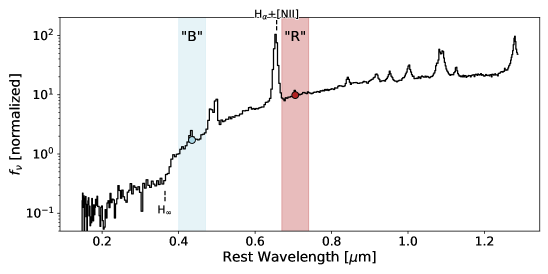
Among the most puzzling early discoveries of JWST are "Little Red Dots" -- compact red sources that host broad Balmer emission lines and, in many cases, exhibit a "V shaped" change in slope in the rest-optical. The physical properties of Little Red Dots currently have order-of-magnitude uncertainties, because models to explain the continuum of these sources differ immensely. Here, we leverage the complete selection of red sources in the RUBIES program, supplemented with public PRISM spectra, to study the origin of this "V shape". By fitting a broken power law with a flexible inflection point, we find that a large fraction (20/44, nearly all spatially unresolved) of extremely red H$α$ emitters at $2
研究动机与目标
- 调查 Little Red Dots 的连续谱形状,以理解它们 V 形转折的起源。
- 确定在大样本中,V 形的拐点是否位于 Balmer 极限附近。
- 评估观测到的光谱特征是否更支持恒星主导或 AGN 主导的连续体。
- 评估连续体拐点如何与静止波长系 UV–光学发射及 Balmer 系列相关。
- 为能够再现观测形状的物理模型(恒星群体 vs. AGN 场景)提供约束。
提出的方法
- 从 JWST/NIRSpec PRISM 光谱中选择一个极端红的 H-alpha 发射体样本(B-R > 0.95;EW(H-α) > 400 Å;mF444W < 26.5)。
- 将静止波长系 0.15–0.6 μm 上拟合一个灵活的断裂幂律连续体,含拐点波长和蓝斜率/红斜率的参数。
- 使用 emcee 对模型参数(归一化、拐点波长、k_blue、k_red)进行采样,设定先验;应用信噪比下限以及一个自由白噪声膨胀项。
- 对强发射特征进行掩蔽,在 log(fν) 下进行拟合,以降低负通量问题和模型不匹配。
- 评估拐点强度 Δk = k_red − k_blue 与拐点位置 λ_break,包括明确确定的情况(拐点宽度 < 750 Å)。
- 将强拐点源的光谱叠加,以研究 Balmer 极限周围的总体拐点行为。
实验结果
研究问题
- RQ1极端红的 H-alpha 发射体群体在静止波长系 UV–光学连续体中是否表现出共同的拐点?
- RQ2拐点波长是否在各源中一致地位于 0.3645 μm 的 Balmer 极限附近?
- RQ3哪些物理情景(恒星主导、AGN 主导,或混合)能够再现观测到的 V 形连续谱?
- RQ4连续体拐点与 Balmer 线的存在及整体 SED 的关系如何?
- RQ5样本中有多少比例显示出统计显著的斜率变化,并且最可靠被约束的位置在哪?
主要发现
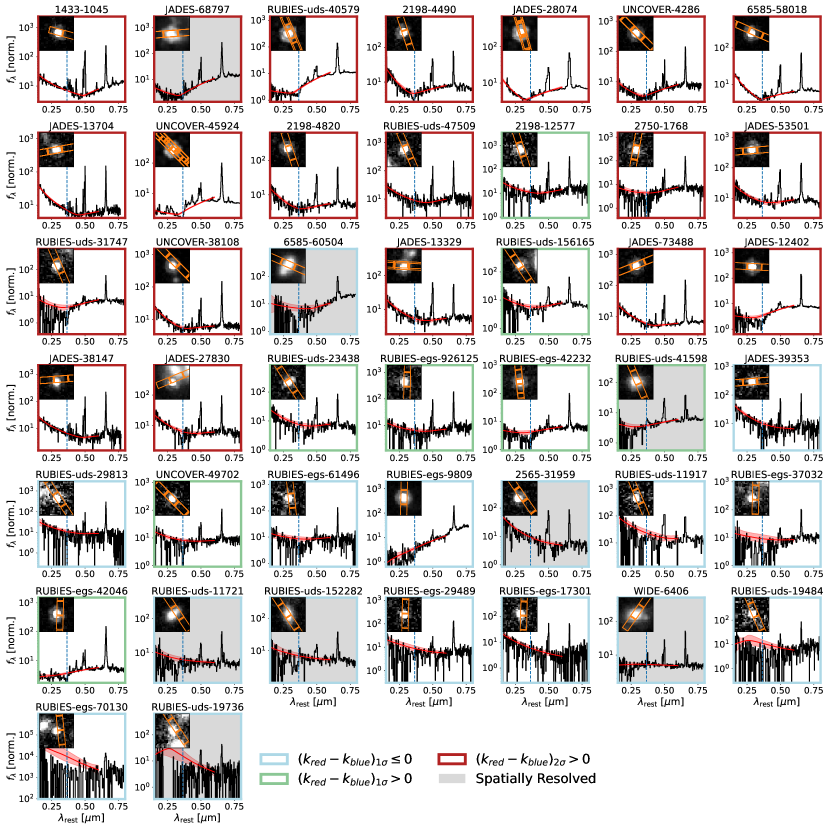
- 在 44 个极端红的 Hα 发射体中,大约 20 个(几乎全部未分辨)显示出光谱斜率的强烈且具统计显著性的变化。
- 强拐点的拐点位于靠近 Balmer 极限 0.3645 μm(H∞)的区域,许多拟合将 λ_break 放在接近该值。
- 最强拐点源的堆叠显示 Balmer 极限以北的强烈蓝斜率,以及多样的红斜率,指示一个与 Balmer 相关的共同转变。
- 推断出的 Δk = k_red − k_blue 对强拐点群体为正,与 V 形连续体一致,且对模型变体具有鲁棒性。
- 简单的 toy 模型表明,纯幂律 AGN 连续体若不包含 Balmer- break 类特征或恒星主导成分,将难以产生观测到的 Balmer 极限拐点。
- 总体结果表明拐点很可能由一个主导静止波–紫外到光学的单一连续体引起,合理地与 T ~ 10^4 K 的氢特征相关,而不是统一的 AGN 驱动的紫外尾部。
更好的研究,从现在开始
从论文设计到论文写作,大幅缩短您的研究时间。
无需绑定信用卡
本解读由 AI 生成,并经人工编辑审核。