
[论文解读] Long-range interacting quantum systems
A comprehensive review of quantum many-body systems with power-law long-range interactions, outlining universal features, experimental platforms, and both equilibrium and dynamical critical behaviours.
The presence of non-local and long-range interactions in quantum systems induces several peculiar features in their equilibrium and out-of-equilibrium behavior. In current experimental platforms control parameters such as interaction range, temperature, density and dimension can be changed. The existence of universal scaling regimes, where diverse physical systems and observables display quantitative agreement, generates a common framework, where the efforts of different research communities can be -- in some cases rigorously -- connected. Still, the application of this general framework to particular experimental realisations requires the identification of the regimes where the universality phenomenon is expected to appear. In the present review we summarise the recent investigations of many-body quantum systems with long-range interactions, which are currently realised in Rydberg atom arrays, dipolar systems, trapped ion setups and cold atoms in cavity experiments. Our main aim is to present and identify the common and (mostly) universal features induced by long-range interactions in the behaviour of quantum many-body systems. We will discuss both the case of very strong non-local couplings, i.e. the non-additive regime, and the one in which energy is extensive, but nevertheless low-energy, long wavelength properties are altered with respect to the short-range limit. Cases of competition with other local effects in the above mentioned setups are also reviewed.
研究动机与目标
- Characterize universal features induced by long-range interactions in quantum many-body systems.
- Summarize experimental realizations (trapped ions, cavity QED, Rydberg/dipolar gases) and their tunable interaction ranges.
- Differentiate weak vs strong long-range regimes and relate quantum critical behaviour to classical counterparts.
- Discuss equilibrium and dynamical critical phenomena, including relaxation, thermalisation, and dynamical phase transitions.
提出的方法
- Classify long-range interactions by decay exponent alpha and ratio to dimension d.
- Review weak and strong long-range regimes and competing non-local interactions.
- Map experimental platforms to theoretical models (Ising/XY, Lipkin-Meshkov-Glick, Dicke, etc.).
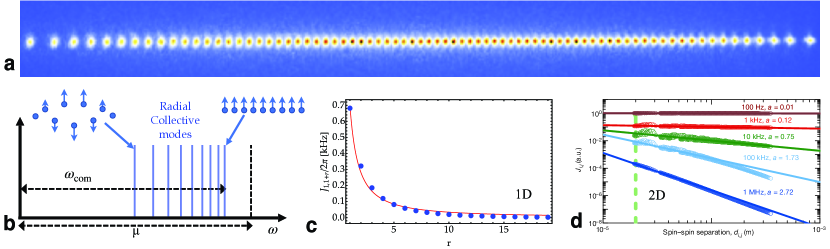
- Derive effective spin models from phonon-mediated couplings and describe tunable power-law interactions.
- Discuss critical behaviour and universality in quantum systems, correlating with classical long-range results.
实验结果
研究问题
- RQ1What universal features arise in quantum many-body systems with power-law decaying interactions?
- RQ2How do weak vs strong long-range regimes modify quantum critical behaviour and universality classes?
- RQ3What are the key experimental platforms that realize tunable long-range interactions and how do they map to theoretical spin models?
- RQ4How do non-local interactions affect dynamical properties such as relaxation, thermalisation, and dynamical phase transitions?
主要发现
- Long-range interactions induce distinct universal regimes, including mean-field-like behaviour in certain parameter ranges and modified critical exponents in others.
- Weak long-range couplings (d < alpha < alpha*) can yield non-trivial, alpha-dependent critical behaviour distinct from purely short-range cases.
- Strong long-range interactions (alpha < d) lead to non-extensive energy and non-additivity, with phenomena like ensemble inequivalence and quasi-stationary states.
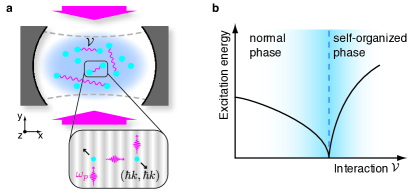
- Cavity-mediated (alpha ~ 0) and phonon-mediated (tunable alpha) interactions in trapped ions and Rydberg/dipolar systems realize diverse long-range Hamiltonians (e.g., Ising, XY, Lipkin-Meshkov-Glick, Dicke).
- Experimental platforms demonstrate tunable power-law exponents (0 < alpha < 3) and reproduce long-range physics across equilibrium and non-equilibrium settings.
更好的研究,从现在开始
从论文设计到论文写作,大幅缩短您的研究时间。
无需绑定信用卡
本解读由 AI 生成,并经人工编辑审核。