
[Paper Review] Loss of Plasticity in Continual Deep Reinforcement Learning
This paper identifies and analyzes catastrophic loss of plasticity in deep reinforcement learning agents during continual training on sequential Atari 2600 games, where agents lose gradient update capacity due to activation sparsity. It proposes Concatenated ReLUs (CReLUs) as a simple yet effective mitigation, restoring gradient flow and enabling sustained learning across non-stationary environments.
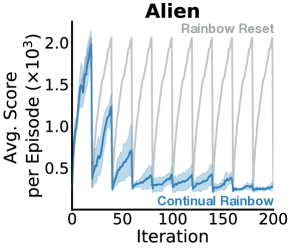
The ability to learn continually is essential in a complex and changing world. In this paper, we characterize the behavior of canonical value-based deep reinforcement learning (RL) approaches under varying degrees of non-stationarity. In particular, we demonstrate that deep RL agents lose their ability to learn good policies when they cycle through a sequence of Atari 2600 games. This phenomenon is alluded to in prior work under various guises -- e.g., loss of plasticity, implicit under-parameterization, primacy bias, and capacity loss. We investigate this phenomenon closely at scale and analyze how the weights, gradients, and activations change over time in several experiments with varying dimensions (e.g., similarity between games, number of games, number of frames per game), with some experiments spanning 50 days and 2 billion environment interactions. Our analysis shows that the activation footprint of the network becomes sparser, contributing to the diminishing gradients. We investigate a remarkably simple mitigation strategy -- Concatenated ReLUs (CReLUs) activation function -- and demonstrate its effectiveness in facilitating continual learning in a changing environment.
Motivation & Objective
- To investigate why canonical deep RL agents like Rainbow fail in continual learning settings with non-stationary environments.
- To analyze the underlying mechanisms—specifically weight, gradient, and activation dynamics—causing loss of plasticity during long-term training on sequential Atari games.
- To evaluate whether architectural modifications can restore learning capacity in continual RL despite distribution shifts and memory constraints.
- To demonstrate that CReLUs mitigate activation sparsity and restore gradient flow, enabling sustained policy improvement across repeated game visits.
Proposed method
- Trained a Rainbow DQN agent on a sequence of 5–10 Atari 2600 games without resets, cycling through games over 50 days and 2 billion environment interactions.
- Monitored and analyzed the evolution of network weights, gradient norms (ℓ₂, ℓ₁, ℓ₀), and activation sparsity (ℓ₀ norm) across layers during continual training.
- Compared standard ReLU activations with Concatenated ReLUs (CReLUs), which use two parallel ReLU units to preserve activation diversity and prevent collapse.
- Used a baseline of uninterrupted single-game training (200M frames per game) to establish an upper performance bound for comparison.
- Evaluated performance across repeated game visits to detect forgetting, primacy bias, and plasticity loss.
- Analyzed gradient flow and activation footprint changes to link structural network behavior to learning degradation.
Experimental results
Research questions
- RQ1To what extent do standard deep RL agents like Rainbow lose plasticity when trained continuously on a sequence of non-stationary Atari games?
- RQ2How do weight updates, gradient norms, and activation sparsity evolve over time in continual learning setups with distribution shifts?
- RQ3Can architectural modifications such as CReLUs reverse or mitigate the loss of plasticity observed in standard ReLU-based agents?
- RQ4Does the CReLU activation function restore sufficient gradient flow to enable meaningful policy improvement across repeated game visits?
- RQ5How does the performance of a continual agent with CReLUs compare to a non-continual agent trained from scratch on each game?
Key findings
- Rainbow agents trained on sequential Atari games exhibit catastrophic loss of plasticity, with performance deteriorating on repeated visits to the same game, indicating failure to learn or retain knowledge.
- Activation sparsity increases significantly over time, with only a tiny fraction of network units producing non-zero activations, leading to diminished gradient flow and reduced learning capacity.
- The use of CReLUs effectively mitigates activation sparsity and restores gradient norms, enabling sustained learning across repeated game visits.
- Despite CReLUs improving plasticity, the continual agent still fails to match the performance of a non-continual agent trained from scratch on each game, indicating unresolved catastrophic interference.
- The performance gap between continual CReLU agents and non-continual baselines widens over successive game visits, especially in games like Atlantis and Boxing, highlighting persistent forgetting.
- The phenomenon of loss of plasticity is linked to structural changes in the network—specifically, activation collapse and gradient suppression—rather than just data distribution shifts.

Read this paper
Open the full text in the Nubint reader and ask about any passage as you read.
Read this paper on NubintThis review was generated by AI from the original paper. Please check the paper before citing it.