
[Paper Review] MeshRIR: A Dataset of Room Impulse Responses on Meshed Grid Points For Evaluating Sound Field Analysis and Synthesis Methods
MeshRIR is a novel dataset of room impulse responses (RIRs) measured at finely spaced grid points (0.05 m intervals) across 3D cuboidal and 2D square regions, enabling high-resolution evaluation of sound field analysis and synthesis methods. It supports applications like sound field reconstruction and control, with demonstrated mean square error (MSE) of -13.7 dB and signal-to-distortion ratio (SDR) of 3.85 dB in sample applications.
A new impulse response (IR) dataset called "MeshRIR" is introduced. Currently available datasets usually include IRs at an array of microphones from several source positions under various room conditions, which are basically designed for evaluating speech enhancement and distant speech recognition methods. On the other hand, methods of estimating or controlling spatial sound fields have been extensively investigated in recent years; however, the current IR datasets are not applicable to validating and comparing these methods because of the low spatial resolution of measurement points. MeshRIR consists of IRs measured at positions obtained by finely discretizing a spatial region. Two subdatasets are currently available: one consists of IRs in a three-dimensional cuboidal region from a single source, and the other consists of IRs in a two-dimensional square region from an array of 32 sources. Therefore, MeshRIR is suitable for evaluating sound field analysis and synthesis methods. This dataset is freely available at https://sh01k.github.io/MeshRIR/ with some codes of sample applications.
Motivation & Objective
- To address the lack of publicly available, high-spatial-resolution RIR datasets suitable for evaluating sound field analysis and synthesis methods.
- To enable realistic validation of spatial audio processing techniques such as sound field reconstruction and control using dense measurement grids.
- To provide a freely available dataset with fine-grained impulse responses for benchmarking and comparison across methods.
- To support research in spatial audio, including wavefield reconstruction, interpolation, and active sound field control.
- To extend existing datasets by offering subdatasets with 3969 and 441 measurement points in 3D and 2D regions, respectively.
Proposed method
- The dataset was created by measuring RIRs at 0.05 m intervals across a 3D cuboidal region (1.0×1.0×0.4 m) from a single source and a 2D square region (1.0×1.0 m) from 32 source positions.
- All RIRs were recorded in a real room (7.0×6.4×2.7 m) at 48 kHz with 32768-sample length, using swept-sine excitation signals for high accuracy.
- Sound field reconstruction was performed using spherical harmonic analysis of infinite order, equivalent to kernel interpolation with zeroth-order spherical Bessel functions.
- Sound field control was implemented via the pressure matching method, minimizing error between synthesized and desired fields using 16 control points.
- The dataset includes sample code for both reconstruction and control applications, with time-domain filter design and downsampled signals (8 kHz) for computational efficiency.
- The measurement region was discretized into a uniform mesh, enabling use of any subset as input and others as ground truth for validation.
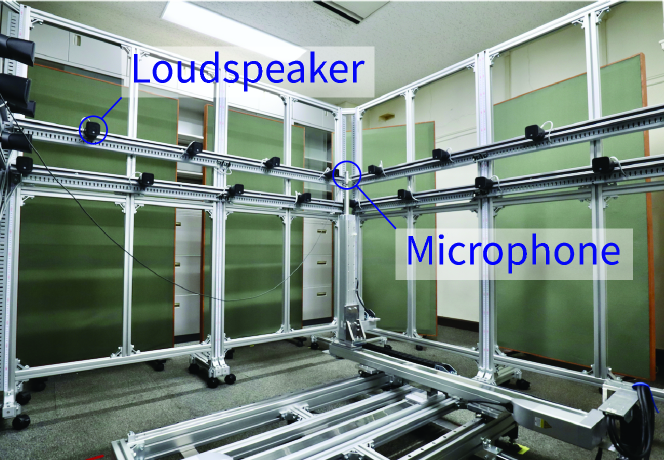
Experimental results
Research questions
- RQ1Can a high-resolution RIR dataset with dense spatial sampling improve the evaluation of sound field reconstruction methods?
- RQ2How accurately can a sound field be reconstructed from a sparse set of measurements using spherical harmonic decomposition?
- RQ3To what extent can a desired sound field, such as a plane wave, be synthesized using multiple loudspeakers in a controlled region?
- RQ4What is the achievable signal-to-distortion ratio (SDR) in sound field control when using a dense RIR dataset?
- RQ5Can a publicly available, non-restrictive dataset with fine-grained RIRs enable standardized benchmarking of spatial audio processing methods?
Key findings
- The sound field reconstruction experiment achieved a mean square error (MSE) of -13.7 dB when estimating pressure distribution from 18 microphones on a 2D plane.
- The sound field control experiment achieved a signal-to-distortion ratio (SDR) of 3.85 dB when synthesizing a plane wave in a 1.0×1.0 m target region.
- The dataset provides 3969 RIRs in a 3D cuboidal region and 441 RIRs in a 2D square region, both with 0.05 m spatial resolution.
- The 3D subdataset (S1-M3969) has a reverberation time (T60) of 0.38 s, while the 2D subdataset (S32-M441) has T60 = 0.19 s.
- The dataset is publicly available at https://sh01k.github.io/MeshRIR/ under a non-restrictive license, with sample code for reconstruction and control.
- The dataset enables validation of methods that require dense spatial sampling, such as wavefield reconstruction and active sound field control, which are not adequately supported by existing datasets.
Read this paper
Open the full text in the Nubint reader and ask about any passage as you read.
Read this paper on NubintThis review was generated by AI from the original paper. Please check the paper before citing it.