
[Paper Review] Meta-learning approaches for few-shot learning: A survey of recent advances
This survey provides a comprehensive, up-to-date review of meta-learning methods for few-shot learning, categorizing state-of-the-art approaches into metric-based, memory-based, and learning-based frameworks. It analyzes their mechanisms, benchmarks, and limitations, offering insights into challenges like catastrophic forgetting, domain shift, and computational cost, while proposing future research directions for robust, generalizable few-shot learning systems.
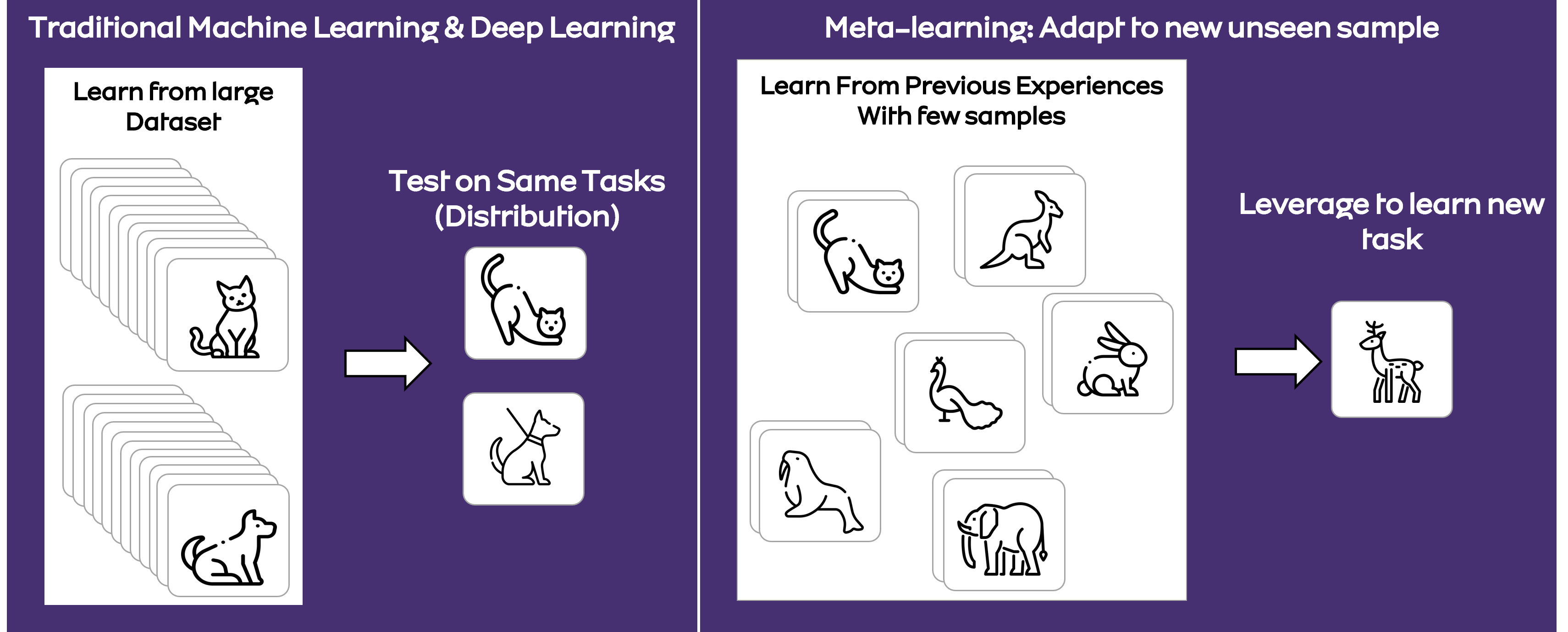
Despite its astounding success in learning deeper multi-dimensional data, the performance of deep learning declines on new unseen tasks mainly due to its focus on same-distribution prediction. Moreover, deep learning is notorious for poor generalization from few samples. Meta-learning is a promising approach that addresses these issues by adapting to new tasks with few-shot datasets. This survey first briefly introduces meta-learning and then investigates state-of-the-art meta-learning methods and recent advances in: (I) metric-based, (II) memory-based, (III), and learning-based methods. Finally, current challenges and insights for future researches are discussed.
Motivation & Objective
- To provide a systematic and up-to-date review of meta-learning techniques in few-shot learning, addressing rapid advancements in the field.
- To clarify the distinction between meta-learning, transfer learning, and multi-task learning, which are often confused in practice.
- To identify key challenges in meta-learning, including catastrophic forgetting, sensitivity to data distribution shifts, and high computational costs.
- To propose future research directions focused on multi-domain, multi-modal, and cross-domain few-shot learning with improved stability and generalization.
- To evaluate the performance of leading methods across benchmarks like Omniglot and miniImageNet, highlighting limitations in real-world applicability.
Proposed method
- Categorizes meta-learning methods into three main families: metric-based (e.g., prototypical networks), memory-based (e.g., memory-augmented networks), and learning-based (e.g., MAML, Meta-OptNet).
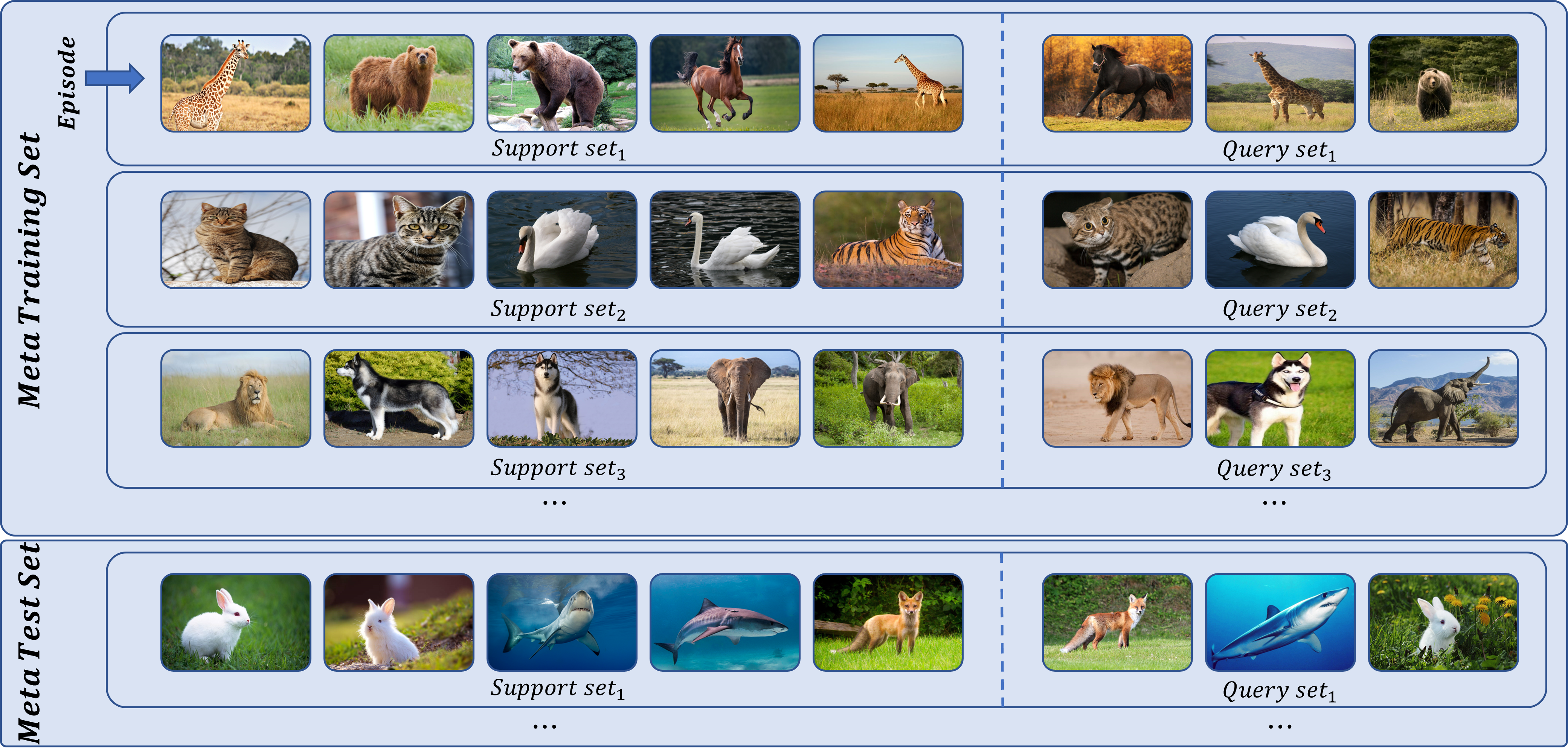
- Analyzes episodic training paradigms where each episode simulates a new few-shot task using support and query sets to train the meta-learner.
- Reviews architectural components such as embedding backbones (e.g., CNNs, ResNets), metric learning (e.g., cosine similarity), and memory mechanisms for task-specific adaptation.
- Evaluates performance across standard benchmarks including Omniglot and miniImageNet, comparing accuracy and robustness across different method types.
- Discusses techniques to mitigate catastrophic forgetting, such as experience replay and task grouping, and explores adversarial robustness in meta-learners.
- Proposes future methodological improvements, including multi-domain and multi-modal meta-learning, and the use of larger or multi-scale backbones for better representation learning.
Experimental results
Research questions
- RQ1How do metric-based, memory-based, and learning-based meta-learning methods differ in architecture, optimization, and performance across few-shot benchmarks?
- RQ2Why do metric-based models like prototypical networks underperform on complex datasets like miniImageNet despite strong performance on Omniglot?
- RQ3What are the key challenges in maintaining performance on both base and novel classes during episodic training, especially regarding catastrophic forgetting?
- RQ4How can meta-learning be extended to multi-domain, cross-domain, and multi-modal settings to improve real-world generalization?
- RQ5What is the impact of backbone architecture and representation learning on the performance and computational cost of state-of-the-art meta-learning models?
Key findings
- Metric-based methods like prototypical networks achieve strong performance on Omniglot but struggle with distribution shifts, showing lower accuracy on miniImageNet due to increased complexity.
- Learning-based methods such as MAML and Meta-OptNet show high performance on standard benchmarks but are computationally expensive and sensitive to adversarial examples.
- Memory-based methods show promise in mitigating catastrophic forgetting and improving generalization, especially when combined with metric-based approaches.
- Current meta-learners exhibit poor robustness to domain shifts, with performance declining significantly when base and novel datasets differ in distribution.
- The use of larger backbones like ResNet or multi-scale networks can improve representation learning, but their impact on performance and computational cost requires further empirical validation.
- Despite progress, no method consistently outperforms others across diverse benchmarks, indicating a need for more robust, generalizable, and efficient meta-learning frameworks.
Read this paper
Open the full text in the Nubint reader and ask about any passage as you read.
Read this paper on NubintThis review was generated by AI from the original paper. Please check the paper before citing it.