
[Paper Review] MotionBERT: A Unified Perspective on Learning Human Motion Representations
MotionBERT proposes a unified framework for learning generalizable human motion representations by pretraining a Dual-stream Spatio-temporal Transformer (DSTformer) to reconstruct 3D motion from corrupted 2D skeleton sequences. This approach achieves state-of-the-art performance across 3D pose estimation, human mesh reconstruction, and action recognition by fine-tuning the pretrained encoder with simple heads, demonstrating strong transferability and versatility across diverse human-centric video tasks.
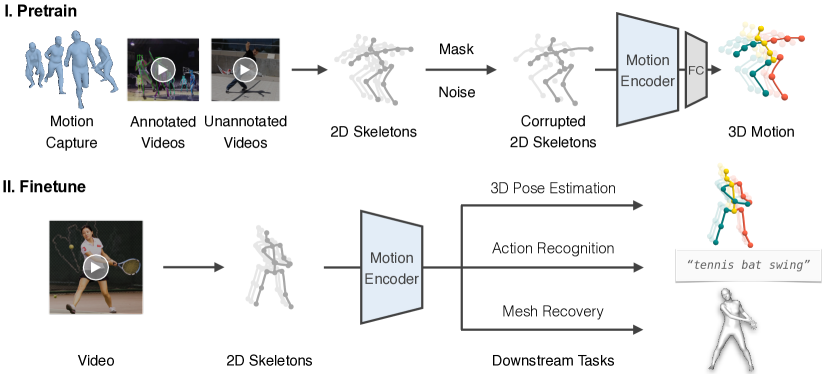
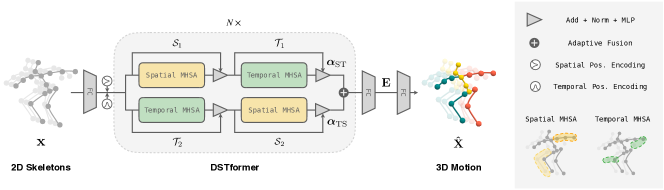
We present a unified perspective on tackling various human-centric video tasks by learning human motion representations from large-scale and heterogeneous data resources. Specifically, we propose a pretraining stage in which a motion encoder is trained to recover the underlying 3D motion from noisy partial 2D observations. The motion representations acquired in this way incorporate geometric, kinematic, and physical knowledge about human motion, which can be easily transferred to multiple downstream tasks. We implement the motion encoder with a Dual-stream Spatio-temporal Transformer (DSTformer) neural network. It could capture long-range spatio-temporal relationships among the skeletal joints comprehensively and adaptively, exemplified by the lowest 3D pose estimation error so far when trained from scratch. Furthermore, our proposed framework achieves state-of-the-art performance on all three downstream tasks by simply finetuning the pretrained motion encoder with a simple regression head (1-2 layers), which demonstrates the versatility of the learned motion representations. Code and models are available at https://motionbert.github.io/
Motivation & Objective
- To develop a unified framework for solving diverse human-centric video tasks using shared motion representations.
- To address the challenge of heterogeneous data sources—such as 3D mocap, in-the-wild RGB videos, and action-labeled datasets—by learning generalizable motion knowledge from them.
- To improve transferability and performance in downstream tasks by pretraining on a self-supervised 2D-to-3D motion reconstruction task.
- To design a universal motion encoder capable of capturing long-range spatio-temporal dependencies across skeletal joints.
- To enable efficient multi-task inference by sharing a single pretrained backbone across multiple tasks via partial fine-tuning.
Proposed method
- Pretrain a motion encoder using a self-supervised pretext task: reconstructing 3D human motion from noisy, masked 2D skeleton sequences.
- Use a Dual-stream Spatio-temporal Transformer (DSTformer) as the motion encoder, with separate spatial and temporal attention streams that are adaptively fused.
- Apply random masking and noise augmentation to 2D skeleton sequences during pretraining to encourage robustness and generalization.
- Leverage diverse data sources: high-precision 3D mocap data and diverse in-the-wild RGB videos to enrich motion representation learning.
- Fine-tune the pretrained motion encoder with a simple regression head (1–2 fully connected layers) for each downstream task.
- Enable partial fine-tuning by freezing the motion encoder and only training the head, enabling efficient multi-task deployment.
Experimental results
Research questions
- RQ1Can a unified motion representation be learned from heterogeneous human motion data sources to benefit multiple downstream tasks?
- RQ2Does pretraining on a 2D-to-3D motion reconstruction task lead to more generalizable and transferable motion representations?
- RQ3How do architectural choices in the motion encoder—such as dual-stream attention and fusion mechanisms—affect performance and generalization?
- RQ4Can a single pretrained motion encoder achieve state-of-the-art performance across diverse tasks like 3D pose estimation, mesh reconstruction, and action recognition?
- RQ5To what extent does the pretraining strategy improve downstream performance compared to training from scratch or using random initialization?
Key findings
- The proposed pretraining strategy with 2D-to-3D reconstruction significantly improves downstream performance: MPJPE drops from 50.1mm (scratch) to 39.25mm (DSTformer with pretraining).
- The pretrained motion encoder achieves state-of-the-art performance on 3D pose estimation (MPJPE: 39.25 ±0.27 mm), mesh reconstruction (MPVE: 80.5 mm), and action recognition (1-shot accuracy: 60.7%).
- Partial fine-tuning—freezing the pretrained encoder and only training the head—still achieves competitive results, demonstrating strong transferability of the learned representations.
- The dual-stream design (S-T + T-S) in DSTformer outperforms single-stream and early-fusion variants, confirming the benefit of complementary spatial and temporal modeling.
- Introducing corruptions during pretraining and using in-the-wild videos further improves generalization, especially on diverse downstream tasks.
- The method generalizes across different backbone architectures: TCN and PoseFormer both benefit from the proposed pretraining, confirming the universality of the learned representations.
Read this paper
Open the full text in the Nubint reader and ask about any passage as you read.
Read this paper on NubintThis review was generated by AI from the original paper. Please check the paper before citing it.