
[Paper Review] Multi-Differential Cross Section Measurements of Muon-Neutrino-Argon Quasielastic-like Reactions with the MicroBooNE Detector
This paper presents the first multi-differential cross section measurements of muon-neutrino-argon quasielastic-like reactions using the MicroBooNE detector at Fermilab, reporting single- and double-differential cross sections in kinematic imbalance variables and neutrino energy estimators. The GENIE v3.0.6 G18_10a_02_11a tune with MicroBooNE-specific tuning best reproduces the data, while older or untuned models show significant discrepancies, highlighting the need for improved nuclear effects modeling in neutrino-nucleus interactions.
We report on a flux-integrated multi-differential measurement of charged-current muon neutrino scattering on argon with one muon and one proton in the final state using the Booster Neutrino Beam and MicroBooNE detector at Fermi National Accelerator Laboratory. The data are studied as a function of various kinematic imbalance variables and of a neutrino energy estimator, and are compared to a number of event generator predictions. We find that the measured cross sections in different phase-space regions are sensitive to nuclear effects. Our results provide precision data to test and improve the neutrino-nucleus interaction models needed to perform high-accuracy oscillation analyses. Specific regions of phase-space are identified where further model refinements are most needed.
Motivation & Objective
- To measure multi-differential cross sections of muon-neutrino-argon quasielastic-like reactions with high precision using the MicroBooNE detector.
- To assess the performance of various neutrino interaction generators and models (GENIE, GiBUU, NuWro, NEUT) in describing kinematic imbalance and energy estimator distributions.
- To identify phase-space regions where current models fail to reproduce data, particularly in final-state interactions (FSI) and nuclear effects.
- To provide benchmark data for improving neutrino-nucleus interaction models used in long-baseline neutrino oscillation experiments.
- To evaluate the impact of tuning and theoretical assumptions in event generators on cross section predictions across different kinematic variables.
Proposed method
- Utilized data from the MicroBooNE detector exposed to the Fermilab Booster Neutrino Beam, focusing on events with a single muon and proton in the final state.
- Performed single-differential cross section measurements in kinematic imbalance variables (e.g., transverse momentum imbalance δpT) and double-differential cross sections in these variables and neutrino energy estimators.
- Applied event reconstruction and kinematic fitting to extract neutrino energy and momentum transfer, using a calorimetric energy estimator to reduce uncertainties.
- Compared measured cross sections to predictions from multiple event generators: GENIE v2.12.10, v3.0.6 (untuned and tuned), GiBUU 2021, NuWro v19.02.2, and NEUT v5.4.0.
- Used χ²/degrees of freedom tests to quantify agreement between data and model predictions across different kinematic regions.
- Evaluated model performance by analyzing systematic deviations in shape and normalization, particularly in FSI-dominated regions.
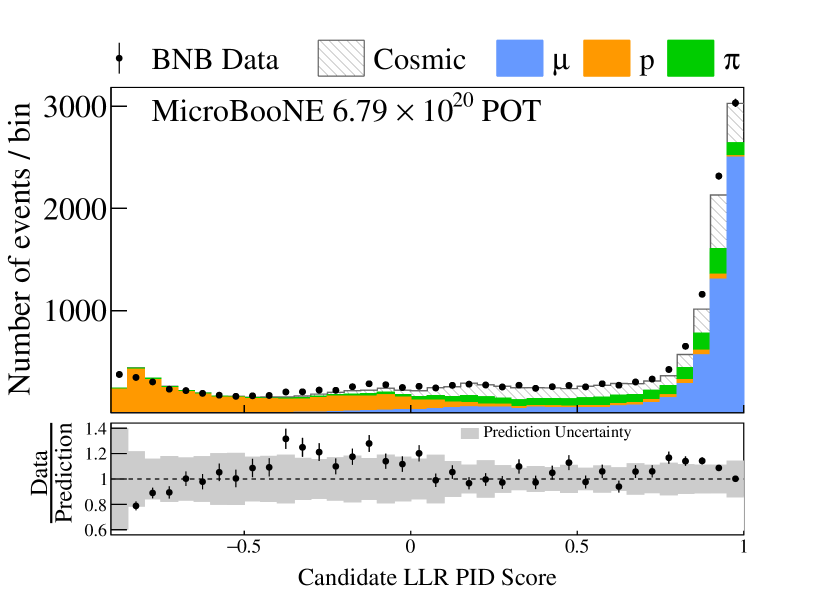
Experimental results
Research questions
- RQ1How well do current neutrino interaction models describe the double-differential cross sections in kinematic imbalance variables for νμ-argon quasielastic-like events?
- RQ2To what extent do different GENIE configurations (untuned, tuned, theory-driven) reproduce the measured cross sections across phase space?
- RQ3What is the impact of final-state interactions (FSI) and nuclear effects on model-data discrepancies in different kinematic regions?
- RQ4Why do some models (e.g., NuWro, NEUT) show good agreement in calorimetric energy distributions but poor agreement in phase-space-resolved cross sections?
- RQ5Which model configurations best describe the data, and what does this imply for future tuning and theoretical development in neutrino-nucleus scattering?
Key findings
- The GENIE v3.0.6 G18_10a_02_11a configuration with MicroBooNE-specific tuning provides the best agreement with data across all measured kinematic variables, with χ²/degrees of freedom indicating good fit quality.
- The GENIE v2.12.10 (Gv2) configuration shows significant shape differences and systematic deviations from data, indicating poor predictive power without tuning.
- The untuned GENIE v3.0.6 G18_10a_02_11a configuration exhibits a ~20% systematic deficit in cross sections, necessitating the development of the tuned version.
- The theory-driven GENIE v3.2.0 G21_11b_00_000 configuration shows good agreement with data across most variables without additional tuning, suggesting improved theoretical foundations.
- GiBUU 2021 shows good agreement except in δpT, where a systematic shift to higher values is observed, likely due to modeling of the meson-exchange current (MEC) effects.
- NuWro v19.02.2 and NEUT v5.4.0 both predict cross sections that fall below data, especially in FSI-dominated regions, with mismodeling that remains hidden when integrated into the calorimetric energy estimator.

Read this paper
Open the full text in the Nubint reader and ask about any passage as you read.
Read this paper on NubintThis review was generated by AI from the original paper. Please check the paper before citing it.