
[Paper Review] Multi-fidelity experimental design for ice-sheet simulation
This paper proposes a multi-fidelity experimental design (MFED) framework using Gaussian processes and UCB-based optimization to reduce computational costs in ice-sheet simulations while maintaining predictive accuracy. By leveraging lower-resolution simulations to inform high-resolution predictions, the method achieves significant cost savings—up to 10× reduction in required high-fidelity runs—especially when physical processes like partial basal melting enable information transfer across fidelities.
Computer simulations are becoming an essential tool in many scientific fields from molecular dynamics to aeronautics. In glaciology, future predictions of sea level change require input from ice sheet models. Due to uncertainties in the forcings and the parameter choices for such models, many different realisations of the model are needed in order to produce probabilistic forecasts of sea level change. For these reasons, producing robust probabilistic forecasts from an ensemble of model simulations over regions of interest can be extremely expensive for many ice sheet models. Multi-fidelity experimental design (MFED) is a strategy that models the high-fidelity output of the simulator by combining information from various resolutions in an attempt to minimize the computational costs of the process and maximize the accuracy of the posterior. In this paper, we present an application of MFED to an ice-sheet simulatorand demonstrate potential computational savings by modelling the relationship between spatial resolutions. We also analyze the behavior of MFED strategies using theoretical results from sub-modular maximization.
Motivation & Objective
- To reduce the computational burden of probabilistic ice-sheet simulations for sea-level rise projections.
- To address the challenge of high-fidelity model costs in glaciology, where high-resolution runs take weeks to complete.
- To develop a cost-efficient experimental design strategy that leverages low-fidelity simulations to predict high-fidelity outcomes.
- To incorporate uncertainty in fidelity-lengthscale estimation and improve exploration-exploitation trade-offs in multi-fidelity settings.
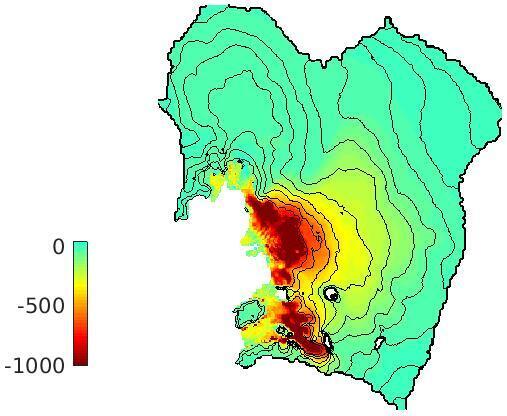
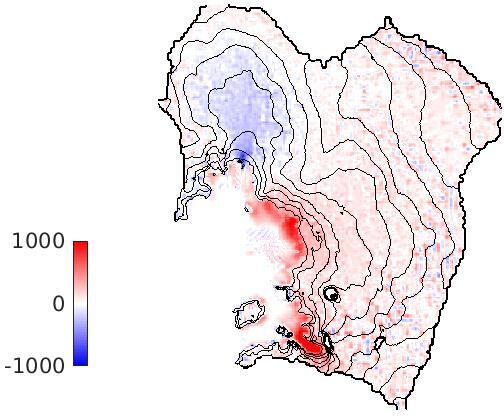
- To demonstrate the practical viability of MFED in real-world ice-sheet modeling using the WAVI simulator over the Amundsen Sea Sector.
Proposed method
- Models the ice-sheet simulator as a joint Gaussian process over input parameters and fidelity levels (spatial resolution).
- Uses a cost-adjusted utility function based on conditional integrated variance (CIV) reduction at the highest fidelity (τ=0).
- Applies an upper confidence bound (UCB) strategy to balance exploration (unknown fidelity relationships) and exploitation (high-utility points).
- Introduces a confidence parameter ν to control exploration, with higher ν encouraging sampling of lower fidelities to learn fidelity relationships.
- Employs a continuous fidelity representation via exponential quadratic kernels with a shared lengthscale β across fidelities.
- Optimizes budget allocation under cost constraints using a submodular maximization framework, approximating the NP-hard knapsack problem.
Experimental results
Research questions
- RQ1Can low-resolution ice-sheet simulations provide reliable information to predict high-resolution outcomes in a cost-efficient manner?
- RQ2How can uncertainty in the fidelity-lengthscale parameter β be managed to avoid underestimating the utility of low-fidelity runs?
- RQ3What is the optimal trade-off between exploration (learning fidelity relationships) and exploitation (maximizing information gain) in multi-fidelity experimental design?
- RQ4How does the inclusion of physical processes like partial basal melting affect the information transfer between fidelities?
- RQ5To what extent can MFED reduce computational costs while preserving predictive accuracy in probabilistic sea-level rise modeling?
Key findings
- When partial basal melting is enabled, 10 km resolution simulations provide significant information and are 10× more cost-effective than 5 km runs, leading to higher cost-adjusted utility.
- With partial melting disabled, the model learns that fidelities do not share information, and CIV-based utility correctly discards low-fidelity points.
- The shape of the cost-adjusted utility surface is modulated by the learned fidelity lengthscale β, which is high when information transfer exists (e.g., with partial melting) and low when it does not.
- The MF-UCB algorithm successfully identifies that lower fidelities can be informative when physical processes support cross-fidelity correlation.
- The method reduces computational cost by up to 10× compared to relying solely on high-resolution simulations, particularly in physically consistent configurations.
- The confidence parameter ν in UCB controls exploration: higher ν increases sampling of low-fidelity points to better learn fidelity relationships, improving long-term utility.
Better researchstarts right now
From reading papers to final review, dramatically reduce your research time.
No credit card · Free plan available
This review was created by AI and reviewed by human editors.