
[Paper Review] Multi-Modal Data Augmentation for End-to-End ASR
This paper proposes Multi-Modal Data Augmentation (MMDA), an end-to-end ASR framework that jointly trains on acoustic inputs and synthetic symbolic inputs (e.g., phoneme sequences) to improve performance using large text corpora. By sharing attention and decoder components between acoustic and symbolic encoders, MMDA achieves up to 10% relative WER improvement over baselines, especially with Rep-Phonestream augmentation that models phoneme duration.
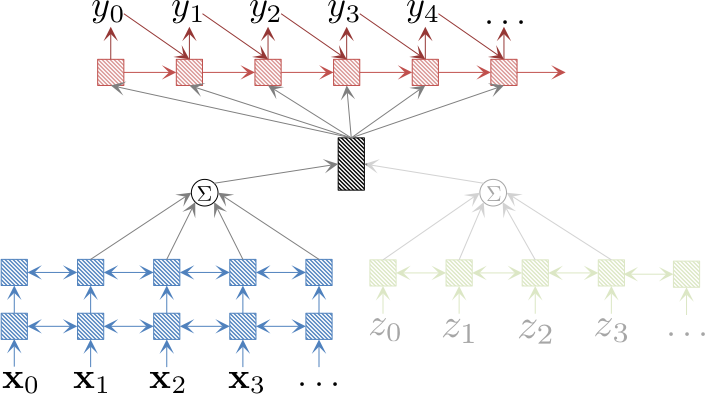
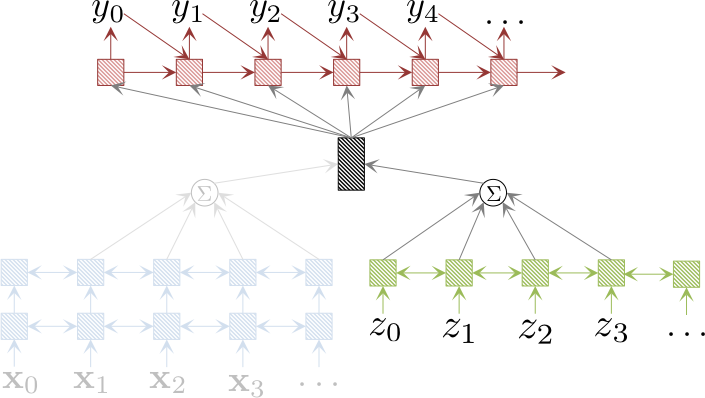
We present a new end-to-end architecture for automatic speech recognition (ASR) that can be trained using \emph{symbolic} input in addition to the traditional acoustic input. This architecture utilizes two separate encoders: one for acoustic input and another for symbolic input, both sharing the attention and decoder parameters. We call this architecture a multi-modal data augmentation network (MMDA), as it can support multi-modal (acoustic and symbolic) input and enables seamless mixing of large text datasets with significantly smaller transcribed speech corpora during training. We study different ways of transforming large text corpora into a symbolic form suitable for training our MMDA network. Our best MMDA setup obtains small improvements on character error rate (CER), and as much as 7-10\% relative word error rate (WER) improvement over a baseline both with and without an external language model.
Motivation & Objective
- To improve end-to-end ASR performance on limited speech datasets by leveraging large-scale text corpora.
- To address the gap in performance between end-to-end models and conventional systems on smaller benchmarks like Librispeech and Fisher.
- To explore multi-modal data augmentation in ASR by transforming text into symbolic inputs that mimic acoustic features.
- To enable seamless integration of external language models with the MMDA framework without modifying decoding procedures.
- To investigate whether synthetic symbolic inputs can improve robustness and generalization in end-to-end ASR.
Proposed method
- The MMDA model uses two separate encoders: one for acoustic features and another for symbolic inputs (e.g., character or phoneme sequences), both sharing the same attention mechanism and decoder.
- Symbolic inputs are generated via three schemes: Charstream (raw characters), Phonestream (phonemes via G2P), and Rep-Phonestream (phonemes with duration modeling based on real speech statistics).
- The augmenting encoder processes embedded symbolic tokens and produces context representations that are fused with acoustic representations through a shared attention mechanism.
- Multi-task training is performed on paired data: real speech-transcript pairs and synthetic text-synthetic input pairs, with a 1:1 ratio of acoustic to symbolic training examples.
- The framework supports integration with external language models during decoding, enabling further performance gains without architectural changes.
- The model is trained end-to-end using cross-entropy loss on the output sequence, with no modification to standard beam search or decoding pipelines.
Experimental results
Research questions
- RQ1Can symbolic input derived from large text corpora improve end-to-end ASR performance when combined with limited speech data?
- RQ2How does the similarity of synthetic input to real acoustic features affect ASR performance?
- RQ3Does multi-modal data augmentation via symbolic inputs reduce error types that produce non-lexical words (e.g., 'accino' instead of 'casino')?
- RQ4Can MMDA be effectively combined with external language models to further improve WER and CER?
- RQ5How does the choice of synthetic input representation (e.g., Charstream vs. Rep-Phonestream) impact model generalization and error patterns?
Key findings
- Rep-Phonestream augmentation achieved a 2% absolute and 10% relative WER improvement over the baseline on the WSJ English dataset, outperforming Charstream and Phonestream.
- The MMDA model reduced nonsense word errors by 25% on the WSJ dev/test set (20.25% vs. 32.93% in the baseline), indicating better generalization.
- With an external language model, the Rep-Phonestream MMDA system achieved 6.7% CER and 16.0% WER on WSJ eval, a 10% relative WER improvement over the baseline.
- On Italian (Voxforge) and Spanish (HUB4), MMDA with Rep-Phonestream reduced WER by 2.9 and 2.0 percentage points respectively, showing consistent gains across languages.
- The MMDA system tends to replace entire incorrect words with valid ones (e.g., 'quota' → 'colors'), while the baseline often produces non-words via character-level substitutions.
- The combination of MMDA and RNNLM re-scoring reduced nonsense errors to 20.25%, suggesting complementary effects between the two methods.
Read this paper
Open the full text in the Nubint reader and ask about any passage as you read.
Read this paper on NubintThis review was generated by AI from the original paper. Please check the paper before citing it.