
[论文解读] Multi-modal learning for geospatial vegetation forecasting
本论文将气象引导的视频预测扩展到在欧洲对高分辨率植被(NDVI)进行预测,通过基于过去/未来天气和海拔进行条件化,使用扩展的 EarthNet2021 数据和四种气象引导模型,在大陆尺度的植被预测上达到State-of-the-art。
The innovative application of precise geospatial vegetation forecasting holds immense potential across diverse sectors, including agriculture, forestry, humanitarian aid, and carbon accounting. To leverage the vast availability of satellite imagery for this task, various works have applied deep neural networks for predicting multispectral images in photorealistic quality. However, the important area of vegetation dynamics has not been thoroughly explored. Our study breaks new ground by introducing GreenEarthNet, the first dataset specifically designed for high-resolution vegetation forecasting, and Contextformer, a novel deep learning approach for predicting vegetation greenness from Sentinel 2 satellite images with fine resolution across Europe. Our multi-modal transformer model Contextformer leverages spatial context through a vision backbone and predicts the temporal dynamics on local context patches incorporating meteorological time series in a parameter-efficient manner. The GreenEarthNet dataset features a learned cloud mask and an appropriate evaluation scheme for vegetation modeling. It also maintains compatibility with the existing satellite imagery forecasting dataset EarthNet2021, enabling cross-dataset model comparisons. Our extensive qualitative and quantitative analyses reveal that our methods outperform a broad range of baseline techniques. This includes surpassing previous state-of-the-art models on EarthNet2021, as well as adapted models from time series forecasting and video prediction. To the best of our knowledge, this work presents the first models for continental-scale vegetation modeling at fine resolution able to capture anomalies beyond the seasonal cycle, thereby paving the way for predicting vegetation health and behaviour in response to climate variability and extremes.
研究动机与目标
- 将 EarthNet2021 拓展用于植被建模,改进云遮罩和评估。
- 开发基于天气条件、多模型深度学习的方法,在欧洲以20m分辨率预测NDVI。
- 将气象引导模型与强基线比较,包括非ML方法和 EarthNet2021 领头模型。
- 展示对碳监测用总初级生产力估算的下游应用性。
提出的方法
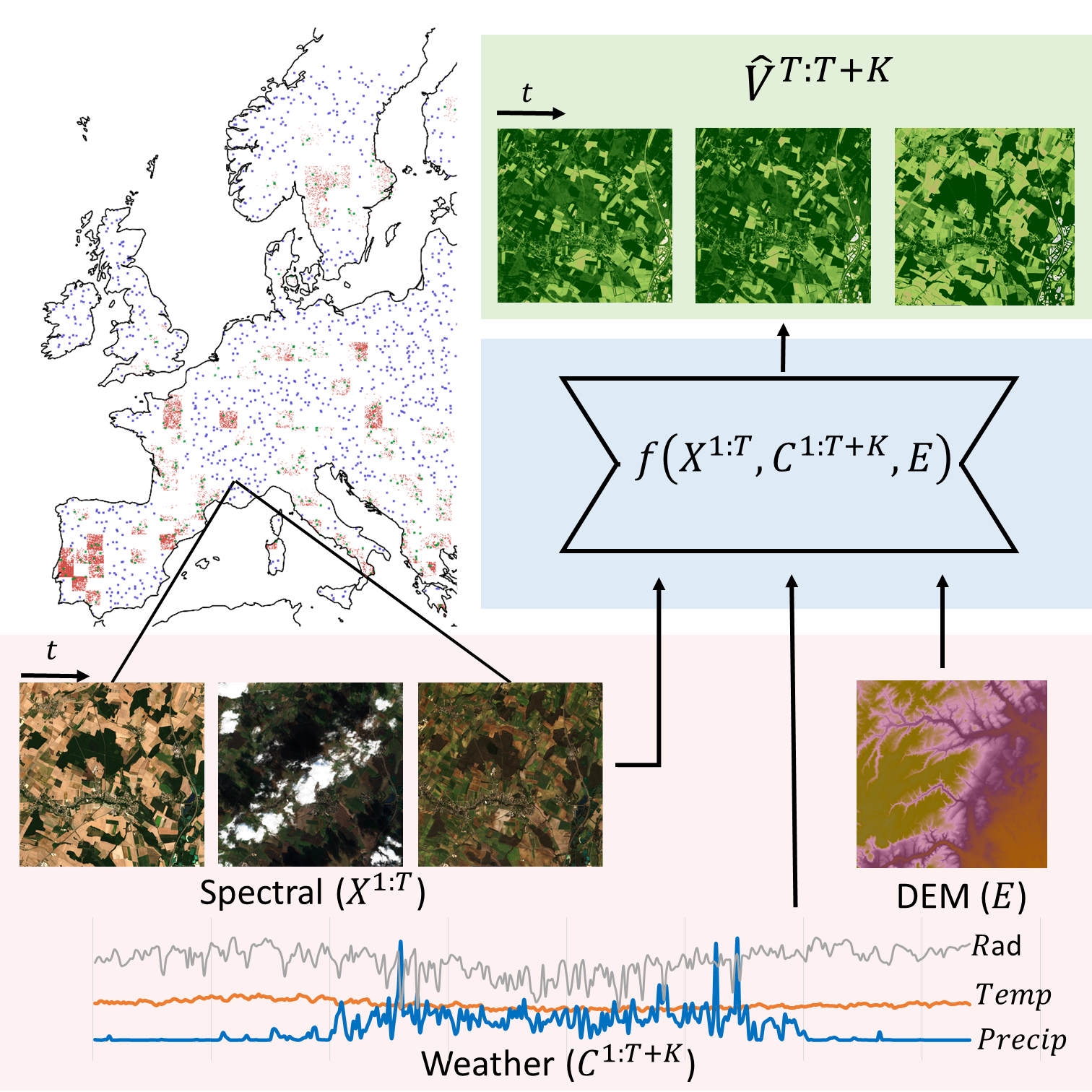
- 使用深度神经网络,在过去影像、未来天气和海拔条件下预测未来NDVI。
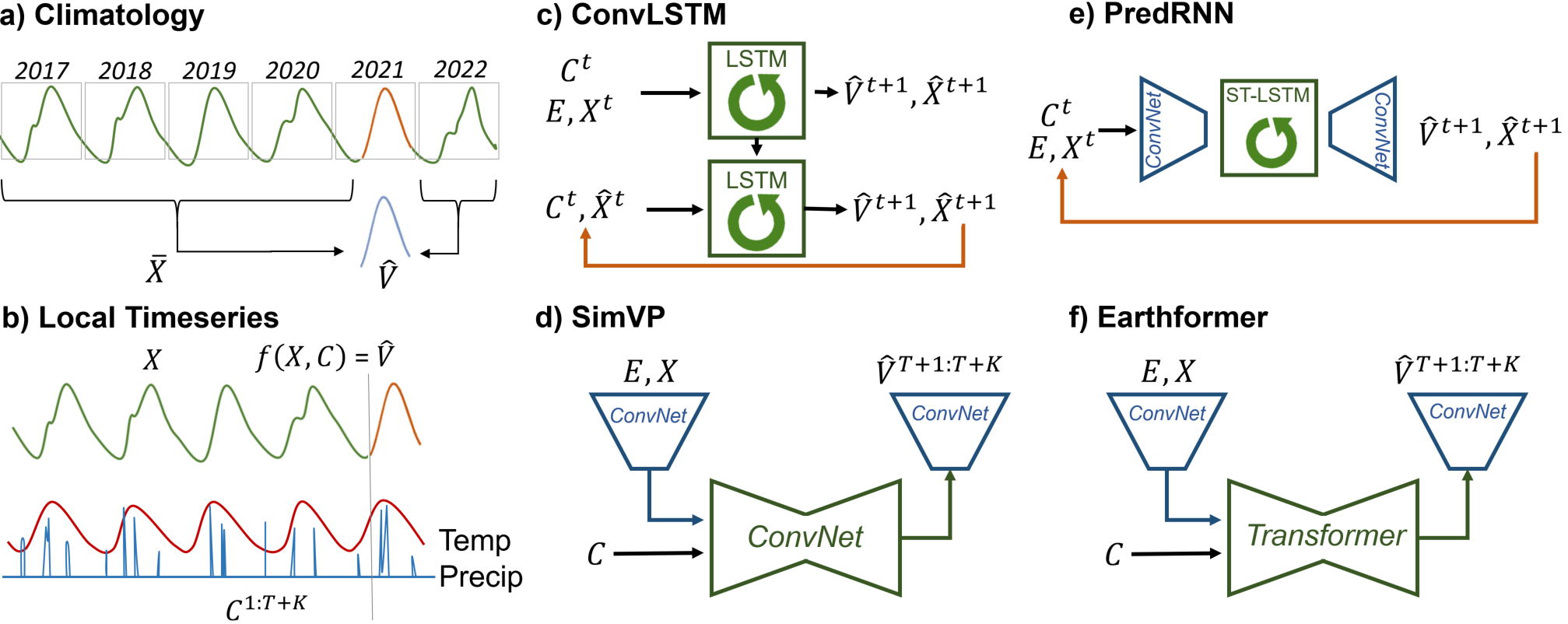
- 评估四类气象引导模型:ConvLSTM、PredRNN、SimVP,以及 Earthformer,带有气象条件。
- 纳入学习到的云遮罩以及新颖的时空OOD评估方案,以稳健评估植被预测。
- 使用带云和土地覆盖掩码的高斯似然目标,在20m NDVI 目标上训练模型。
实验结果
研究问题
- RQ1能否从过去的 Sentinel-2 图像和天气数据预测20m分辨率的大陆尺度植被动态?
- RQ2天气条件如何影响前沿视频预测模型在植被预测中的能力?
- RQ3哪种模型类别和天气条件策略在时空分布外(OOD)情境下对NDVI的预测表现最好?
- RQ4对碳监测的植物动态预测的下游效用(总初级生产力)如何?
主要发现
| 模型 | R^2↑ | RMSE↓ | NSE↑ | |bias|↓ | 超越基线↑ | RMSE 25天↓ | #参数 |
|---|---|---|---|---|---|---|---|
| Persistence | 0.00 | 0.23 | -1.28 | 0.17 | 21.8% | 0.09 | 0 |
| Previous year | 0.56 | 0.20 | -0.40 | 0.14 | 19.3% | 0.18 | 0 |
| Climatology | 0.58 | 0.18 | -0.34 | 0.13 | 0.0% | 0.16 | 0 |
| Kalman filter | 0.41 | 0.19 | -0.57 | 0.13 | 27.0% | 0.16 | O(10) |
| LightGBM | 0.51 | 0.17 | -0.22 | 0.12 | 42.2% | 0.11 | n.a. |
| Prophet | 0.57 | 0.16 | -0.05 | 0.11 | 60.6% | 0.13 | O(10) |
| EN21 ConvLSTM | 0.51 | 0.18 | -0.37 | 0.12 | 43.9% | 0.12 | 0.2M |
| SG-ConvLSTM | 0.53 | 0.19 | -0.33 | 0.14 | 45.8% | 0.11 | 0.7M |
| Earthformer | 0.49 | 0.17 | -0.27 | 0.12 | 47.2% | 0.11 | 60.6M |
| ConvLSTM-meteo | 0.62 ± 0.01 | 0.14 ± 0.00 | 0.11 ± 0.03 | 0.10 ± 0.00 | 68.2% ± 1.8% | 0.10 ± 0.00 | 1.0M |
| PredRNN-meteo | 0.62 ± 0.00 | 0.15 ± 0.00 | 0.03 ± 0.00 | 0.10 ± 0.00 | 64.7% ± 1.2% | 0.10 ± 0.00 | 1.4M |
| SimVP-meteo | 0.60 ± 0.00 | 0.15 ± 0.00 | 0.03 ±0.01 | 0.09 ± 0.00 | 64.1% ± 1.0% | 0.10 ± 0.00 | 6.6M |
| Earthformer-meteo | 0.52 | 0.16 | -0.13 | 0.10 | 56.5% | 0.09 | 60.6M |
- 气象引导模型在欧洲范围20m NDVI预测的多项指标上优于基线。
- ConvLSTM-meteo、PredRNN-meteo、和 SimVP-meteo 在 R^2、RMSE、NSE 和偏差方面的表现高于 Earthformer-meteo 与非ML基线。
- 将未来天气与 FiLM 或跨注意力条件化相结合,可带来显著性能提升,某些方法受益于潜在融合策略。
- 这四种模型在时序和时空分布外测试(OOD-t 与 OOD-st)中展示了稳健的预测能力。
- 对NDVI的预测使得对碳监测的总初级生产力估算成为可能。
更好的研究,从现在开始
从论文设计到论文写作,大幅缩短您的研究时间。
无需绑定信用卡
本解读由 AI 生成,并经人工编辑审核。