
[Paper Review] Multiple Appropriate Facial Reaction Generation in Dyadic Interaction Settings: What, Why and How?
This paper introduces the novel task of Multiple Appropriate Facial Reaction Generation (fMARG) in dyadic interactions, proposing a framework that predicts, generates, and evaluates multiple contextually appropriate facial reactions using deep learning. It establishes the first objective evaluation metrics—accuracy, diversity, realism, and synchrony—demonstrating that models can generate varied, realistic, and temporally aligned facial reactions to the same speaker behavior across different contexts.
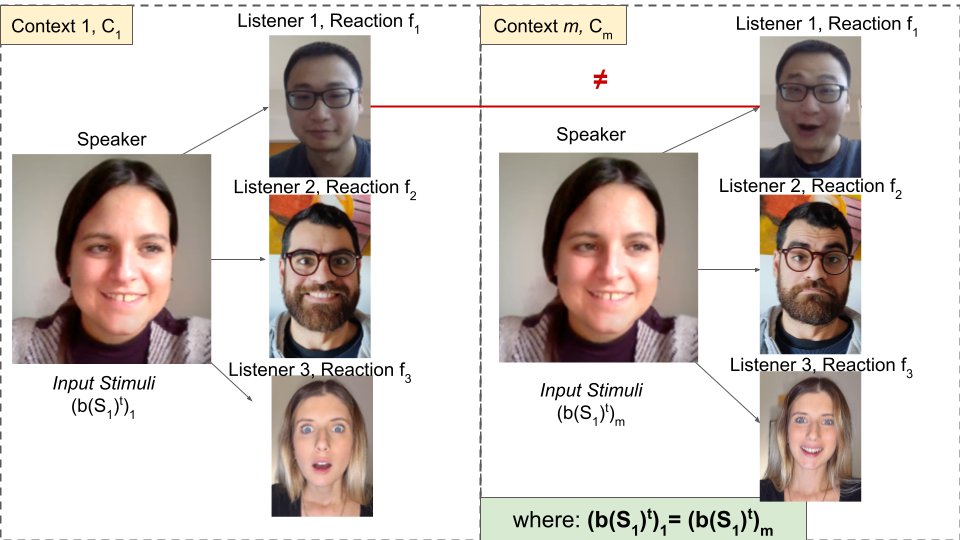
According to the Stimulus Organism Response (SOR) theory, all human behavioral reactions are stimulated by context, where people will process the received stimulus and produce an appropriate reaction. This implies that in a specific context for a given input stimulus, a person can react differently according to their internal state and other contextual factors. Analogously, in dyadic interactions, humans communicate using verbal and nonverbal cues, where a broad spectrum of listeners' non-verbal reactions might be appropriate for responding to a specific speaker behaviour. There already exists a body of work that investigated the problem of automatically generating an appropriate reaction for a given input. However, none attempted to automatically generate multiple appropriate reactions in the context of dyadic interactions and evaluate the appropriateness of those reactions using objective measures. This paper starts by defining the facial Multiple Appropriate Reaction Generation (fMARG) task for the first time in the literature and proposes a new set of objective evaluation metrics to evaluate the appropriateness of the generated reactions. The paper subsequently introduces a framework to predict, generate, and evaluate multiple appropriate facial reactions.
Motivation & Objective
- To define the Multiple Appropriate Facial Reaction Generation (fMARG) task for the first time in the literature, addressing the lack of systematic study on generating multiple appropriate nonverbal reactions in dyadic interactions.
- To develop a framework that predicts, generates, and evaluates multiple appropriate facial reactions in response to a single speaker behavior, considering contextual and individual differences.
- To introduce a set of objective evaluation metrics—accuracy, diversity, realism, and synchrony—to assess the quality of generated facial reactions beyond subjective human judgment.
- To enable automatic labeling of appropriate facial reactions using a context-aware strategy based on similarity thresholds and real reaction distributions.
- To validate the framework’s capability to generate diverse, realistic, and temporally synchronized facial reactions that align with human behavioral norms in dyadic settings.
Proposed method
- The framework uses a deep learning-based model to generate multiple facial reactions (α per input) from a single speaker behavior, conditioned on context and listener-specific states.
- It employs a similarity threshold (T) to determine whether a generated reaction is appropriate, using the cosine similarity between generated and real facial reactions in the same context.
- The accuracy metric is computed as the proportion of generated reactions that are similar (above threshold) to at least one real appropriate reaction in the dataset.
- Diversity is measured via Facial Reaction Variance (FRVar), Sum of MSE among generated reactions (S-MSE), and inter-condition diversity (FRDvs) to ensure varied outputs.
- Realism is evaluated using Fréchet Inception Distance (FID) between generated and real facial reaction distributions.
- Synchrony is assessed using Time Lagged Cross Correlation (TLCC) between speaker behavior and generated facial reaction time-series to ensure temporal alignment.
Experimental results
Research questions
- RQ1What defines an appropriate facial reaction in a dyadic interaction, and how can multiple appropriate reactions coexist for the same speaker behavior?
- RQ2How can we objectively evaluate the appropriateness, diversity, realism, and synchrony of generated facial reactions in a context-aware manner?
- RQ3Can a deep learning framework generate multiple distinct, realistic, and temporally synchronized facial reactions in response to a single speaker behavior?
- RQ4How do contextual and individual differences influence the generation of appropriate facial reactions in dyadic interactions?
- RQ5What objective metrics can reliably assess the quality of multiple facial reaction generations without relying on subjective human evaluation?
Key findings
- The proposed fMARG framework successfully generates multiple distinct facial reactions per input speaker behavior, demonstrating high diversity across generated outputs.
- The accuracy metric shows that a significant proportion of generated reactions are similar to real appropriate reactions, with the threshold-based similarity strategy enabling reliable appropriateness assessment.
- The diversity metrics—FRVar, S-MSE, and FRDvs—confirm that the model generates varied facial reactions both within and across input conditions.
- The realism score, measured via FID, indicates that generated facial reactions are visually and statistically close to real human reactions in distribution.
- The synchrony metric (FRSyn) confirms that generated facial reactions are temporally aligned with speaker behaviors, reflecting natural interaction dynamics.
- The framework establishes a new benchmark for evaluating facial reaction generation using objective, reproducible metrics, enabling future research in affective computing and human-robot interaction.

Read this paper
Open the full text in the Nubint reader and ask about any passage as you read.
Read this paper on NubintThis review was generated by AI from the original paper. Please check the paper before citing it.