
[Paper Review] New Post-DART Collision Period for the Didymos System: Evidence for Anomalous Orbital Decay
This study presents new photometric observations from the Thacher Observatory showing a post-DART period change in the Didymos binary asteroid system of ΔP = -34.2 ± 0.1 minutes, a 3.5σ deviation from prior measurements. The result suggests anomalous orbital decay not explainable by known mechanisms, challenging current models of post-impact dynamics in near-Earth binary systems.
On September 26, 2022, NASA's DART spacecraft impacted Dimorphos, the secondary asteroid in the (65803) Didymos system, so that the efficiency with which a satellite could divert an asteroid could be measured from the change in the system's period. We present new data from the Thacher Observatory and measure a change in period, $ΔP = -34.2 \pm 0.1$ min, which deviates from previous measurements by $3.5\,σ$. This suggests that the system period may have decreased by $\sim 1$ minute in the 20 to 30 days between previous measurements and our measurements. We find that no mechanism previously presented for this system can account for this large of a period change, and drag from impact ejecta is an unlikely explanation. Further observations of the (65803) Didymos system are needed to both confirm our result and to further understand this system post impact.
Motivation & Objective
- To measure the post-impact orbital period change in the (65803) Didymos binary asteroid system using ground-based photometry.
- To assess whether known mechanisms such as YORP, tidal forces, or ejecta drag can explain the observed period change.
- To determine if the system exhibits anomalous orbital decay inconsistent with pre-impact trends or predicted post-impact behavior.
- To provide updated observational constraints for NASA’s DART and ESA’s Hera missions.
Proposed method
- Photometric observations of the Didymos system were conducted over 10 nights using a 0.7 m telescope at the Thacher Observatory in r' band with non-sidereal tracking.
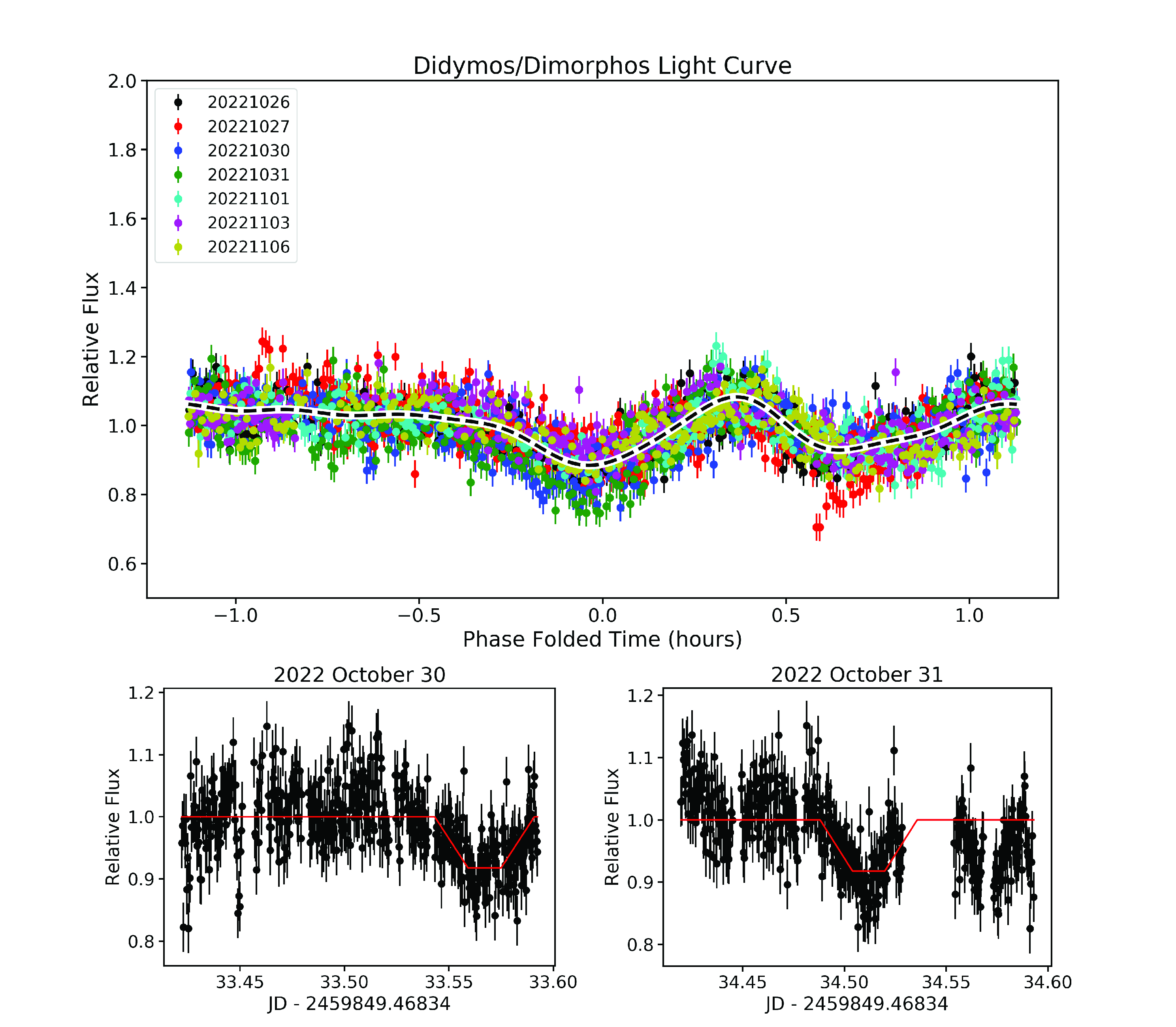
- Light curves were phase-folded to the 2.26-hour rotation period of the primary asteroid to model rotational modulation using a 7-term Fourier decomposition.
- Mutual events (eclipses and occultations) were identified by subtracting the Fourier model from the data, focusing on two consecutive nights with clear 10% dips.
- A linear ephemeris was fitted to the mutual event times, and residuals were interpolated via cubic spline to correct for geocentric phase angle effects.
- The period change ΔP was determined by minimizing χ² as a function of ΔP in 0.02-second steps over the range -35 to -32 minutes.
- An order-of-magnitude estimate for required ejecta mass was derived using the formula Δm = mi[(Pi/Pf)^(1/3) - 1], assuming constant system mass.
Experimental results
Research questions
- RQ1Does the Didymos system exhibit a period change larger than predicted by pre-impact trends or known post-impact mechanisms?
- RQ2Can the observed period change of ΔP = -34.2 ± 0.1 min be explained by drag from impact ejecta?
- RQ3Is the observed orbital decay consistent with the binary YORP effect, tidal forces, or other known dynamical effects?
- RQ4What is the required mass of ejecta in the orbit of Dimorphos to produce the observed period change?
- RQ5How does the observed post-impact period change compare to the previously measured ΔP = -33.0 ± 0.3 min from Thomas et al. (2023)?
Key findings
- The study measures a post-impact period change of ΔP = -34.2 ± 0.1 minutes, representing a 3.5σ deviation from the previously reported value of -33.0 ± 0.3 minutes.
- The observed period change is inconsistent with the pre-impact quadratic drift in mean anomaly, which contributed only (1.5 ± 0.4) × 10⁻⁹ to the period change rate.
- No known mechanism—including binary YORP, tidal forces, differential Yarkovsky effect, nodal precession, or mass loss—can account for the observed period change.
- An estimated 3 × 10⁶ kg of ejecta would be required to produce the observed period change, representing 5–30% of the total estimated ejecta mass from the impact.
- The required ejecta mass is considered implausibly high given the low escape velocity (~0.2 m/s), estimated ejecta speeds, and rapid removal by solar radiation pressure.
- The results suggest the presence of an anomalous orbital decay mechanism not accounted for in current models of binary asteroid systems post-impact.
Read this paper
Open the full text in the Nubint reader and ask about any passage as you read.
Read this paper on NubintThis review was generated by AI from the original paper. Please check the paper before citing it.