
[Paper Review] Non-metricity with bounday terms: $f(Q,C)$ gravity and cosmology
The paper formulates f(Q,C) gravity in symmetric teleparallel geometry by including the boundary term C with the non-metricity scalar Q in the action, derives the general field equations, and explores FRW cosmology for three connection types, yielding a geometrical dark-energy sector and possible matter–dark-energy interactions, including phantom-divide crossing in a specific model.
We formulate $f(Q,C)$ gravity and cosmology. Such a construction is based on the symmetric teleparallel geometry, but apart form the non-metricity scalar $Q$ we incorporate in the Lagrangian the boundary term $C$ of its difference form the standard Levi-Civita Ricci scalar $\mathring R$. We extract the general metric and affine connection field equations, we apply them at a cosmological framework, and adopting three different types of symmetric teleparallel affine connections we obtain the modified Friedmann equations. As we show, we acquire an effective dark-energy sector of geometrical origin, which can lead to interesting cosmological phenomenology. Additionally, we may obtain an effective interaction between matter and dark energy. Finally, examining a specific model, we show that we can obtain the usual thermal history of the universe, with the sequence of matter and dark-energy epochs, while the effective dark-energy equation-of-state parameter can be quintessence-like, phantom-like, or cross the phantom-divide during evolution.
Motivation & Objective
- Introduce and motivate f(Q,C) gravity by incorporating the boundary term C alongside Q in the Lagrangian.
- Derive the metric and affine connection field equations in symmetric teleparallel geometry.
- Apply the theory to cosmology and obtain modified Friedmann equations for three symmetric teleparallel connections.
- Identify the effective geometrical dark-energy sector and possible matter–dark energy interactions.
- Demonstrate a specific model yielding standard cosmic history and phantom-divide crossing.
Proposed method
- Propose the action S = ∫ (1/2κ) f(Q,C) √(-g) d^4x and perform variations to obtain field equations (metric and connection).
- Compute Q and C in symmetric teleparallel settings and derive covariant metric field equations (including f_Q and f_C terms).
- Define the effective stress-energy T^{eff}_{μν} and show how the usual Einstein tensor relates to T^{eff} in f(Q,C) gravity.
- Specialize to FRW with three symmetric teleparallel connections, deriving the corresponding Friedmann equations (3.7–3.12 out of context).
- Extract explicit expressions for the effective dark-energy density and pressure ρ_DE, p_DE for each connection type (Eqs. 4.10–4.11, 4.20–4.21, 4.28–4.29).
- Discuss energy conservation and possible matter–dark-energy exchanges via the connection field equations (Eqs. 3.17–3.20, 4.22, 4.30).
Experimental results
Research questions
- RQ1How does including the boundary term C in the Q-based gravity modify cosmological dynamics compared to f(Q) or f(R)-based theories?
- RQ2What are the resulting Friedmann equations and cosmological phenomenology for the three symmetric teleparallel connections in FRW spacetime?
- RQ3Can f(Q,C) gravity produce an effective geometrical dark-energy sector and permit interactions with matter?
- RQ4Under what conditions can the effective dark-energy equation of state cross the phantom divide (w_DE = -1)?
Key findings
- f(Q,C) gravity yields an effective geometrical dark-energy sector in FRW cosmology.
- For Connection Type I the Friedmann equations acquire ρ_DE and p_DE given by equations (4.10)–(4.11).
- Connection Type II introduces an effective interaction in the continuity equation (4.22) through the γ-dependent terms.
- Connection Type III yields a different but related ρ_DE, p_DE structure (4.28–4.29) and a corresponding interaction term (4.30).
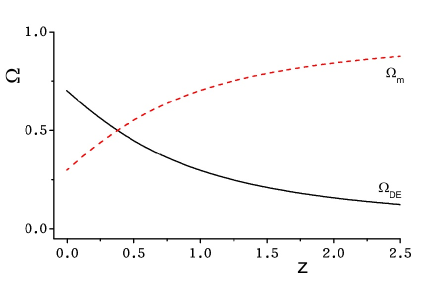
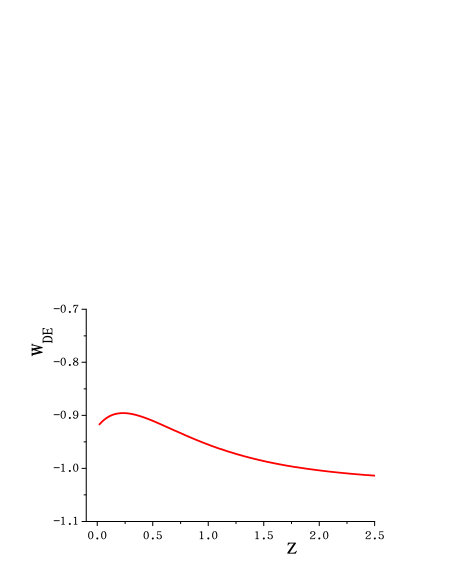
- A concrete example with Type II and γ(t) = γ0/a^3(t) yields standard cosmic history and a w_DE that can be quintessence-like, phantom-like, or cross the phantom divide (Figures 1–2).
Better researchstarts right now
From reading papers to final review, dramatically reduce your research time.
No credit card · Free plan available
This review was created by AI and reviewed by human editors.