
[Paper Review] How different connections in flat FLRW geometry impact energy conditions in $f(Q)$ theory?
This paper investigates how different affine connections in flat FLRW spacetime affect energy conditions in $f(Q)$ gravity, showing that connection type I decouples from the time-varying parameter $\gamma(t)$, while connections II and III introduce $\gamma(t)$-dependent dynamics. Using observational cosmological parameters, the study derives $\omega^{\text{eff}} = -0.82$ and identifies viable parameter ranges for $f(Q) = Q + \beta Q^2$ and $f(Q) = Q + \beta\sqrt{-Q}$, demonstrating that energy conditions constrain $\beta$ and $\gamma$ non-trivially across connection classes.
In this study of the modified $f(Q)$ theory of gravity in the spatially flat Friedmann-Lemaître-Robertson-Walker (FLRW) spacetime, we explore all the affine connections compatible with the symmetric teleparallel structure; three classes of such connections exist, each involving an unknown time-varying parameter $γ(t)$. Assuming ordinary barotropic fluid as the matter source, we first derive the Friedmann-like pressure and energy equations. Next we impose constraints on the parameters of two separate $f(Q)$ models, $f(Q)=Q+βQ^2$ and $f(Q)=Q+β\sqrt{-Q}$ from the traditional energy conditions. Observational values of some prominent cosmological parameters are used for this purpose, yielding an effective equation of state $ω^{eff}=-0.82$.
Motivation & Objective
- To analyze the impact of three distinct affine connections compatible with symmetric teleparallelism on energy conditions in $f(Q)$ gravity within flat FLRW geometry.
- To determine how the time-varying parameter $\gamma(t)$, intrinsic to each connection class, influences the cosmological dynamics and energy conditions.
- To constrain the model parameter $\beta$ in two popular $f(Q)$ models—$f(Q) = Q + \beta Q^2$ and $f(Q) = Q + \beta\sqrt{-Q}$—using observational values of cosmological parameters.
- To identify viable parameter ranges for $\beta$ and $\gamma$ that satisfy weak, null, dominant, and strong energy conditions across all connection types.
Proposed method
- Derive Friedmann-like equations for energy density $\rho^m$ and pressure $p^m$ in flat FLRW spacetime under three classes of affine connections, each parameterized by $\gamma(t)$.
- Use the symmetric teleparallel structure to define three distinct connection types: I ($C_1 = \gamma$, $C_2 = C_3 = 0$), II ($C_1 = \gamma + \dot\gamma/\gamma$, $C_2 = 0$, $C_3 = \gamma$), and III ($C_1 = -\dot\gamma/\gamma$, $C_2 = \gamma$, $C_3 = 0$).
- Compute the non-metricity scalar $Q$ for each connection, showing that only connection I yields $Q = -6H^2$ independently of $\gamma(t)$, while II and III require specific $\gamma(t)$ ansätze to match this value.
- Apply observational constraints from late-time cosmology to fix $H$, $q$, and $\dot{H}$, enabling numerical evaluation of energy conditions.
- Construct linear combinations of $\rho^m$ and $p^m$ to test WEC, NEC, DEC, and SEC, and derive inequalities for $\beta$ and $\gamma$ that satisfy each condition.
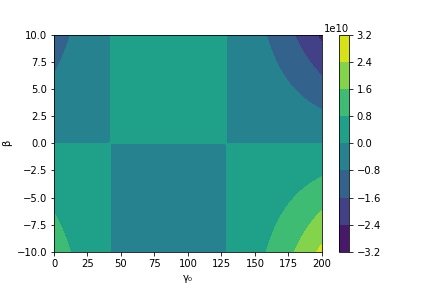
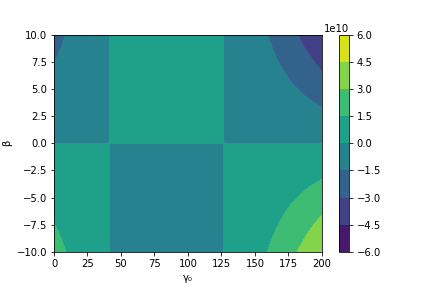
- Plot parameter space regions where energy conditions hold, particularly for $\gamma(t) = \gamma_0$, $\gamma(t) \propto a(t)$, $\gamma(t) \propto H(t)$, and special cases like $\gamma(t) \propto a^{-3}(t)$ and $\gamma(t) \propto a^{-1}(t)$.
Experimental results
Research questions
- RQ1How do different affine connections in symmetric teleparallel $f(Q)$ gravity affect the energy conditions in a spatially flat FLRW universe?
- RQ2What role does the time-varying parameter $\gamma(t)$ play in modifying the cosmological dynamics and energy condition constraints across connection classes I, II, and III?
- RQ3For the models $f(Q) = Q + \beta Q^2$ and $f(Q) = Q + \beta\sqrt{-Q}$, what are the viable ranges of $\beta$ and $\gamma$ that satisfy all classical energy conditions?
- RQ4How does the effective equation of state $\omega^{\text{eff}}$ behave under different connection types, and what value is obtained using observational cosmological parameters?
- RQ5Can the connection-independent $Q = -6H^2$ result in connection I be used to distinguish $f(Q)$ gravity from $f(T)$ gravity, and what are the implications for cosmological modeling?
Key findings
- The effective equation of state parameter is found to be $\omega^{\text{eff}} = -0.82$ when observational values of cosmological parameters are applied, indicating late-time acceleration consistent with current data.
- For connection type I, the energy and pressure terms are independent of $\gamma(t)$, and all energy conditions are satisfied solely based on the sign of $\beta$: positive $\beta$ satisfies all ECs for both $f(Q)$ models.
- In connection types II and III, $\gamma(t)$ actively influences the dynamics, and the viable parameter ranges for $\beta$ become dependent on $\gamma$; for example, in Case 3 ($\gamma = \gamma_2 a$), NEC, WEC, and DEC are satisfied within a specific inequality involving $\gamma_2$.
- For connection type II with $\gamma = \gamma_4 / a$, the WEC, DEC, and NEC are satisfied when $\beta \gamma_4 > -47054.5$, while SEC remains constant at $\kappa(\rho^m + 3p^m) = -21034.9$, indicating a persistent violation.
- The study identifies that connection type I cannot distinguish $f(Q)$ from $f(T)$ gravity in the coincident gauge, making connections II and III essential for exploring novel cosmological features in $f(Q)$ gravity.
- The analysis provides explicit, plot-based parameter space regions for $\beta$ and $\gamma$ where all energy conditions are satisfied, offering a technical and physically grounded route to filter viable $f(Q)$ models.
Read this paper
Open the full text in the Nubint reader and ask about any passage as you read.
Read this paper on NubintThis review was generated by AI from the original paper. Please check the paper before citing it.