
[论文解读] NV center magnetometry up to 130 GPa as if at ambient pressure
该论文提出在金刚石压砧尖端加工微柱结构,以创造准静水应力环境,使氮空位(NV)中心在高达130 GPa的压力下仍能实现可靠的光学检测磁共振(ODMR)。通过抑制偏应力,该方法使NV中心的磁灵敏度保持在常压水平,从而可直接探测超过100 GPa的超导氢化物中的迈斯纳效应。
Engineering a layer of nitrogen-vacancy (NV) centers on the tip of a diamond anvil creates a multipurpose quantum sensors array for high pressure measurements, especially for probing magnetic and superconducting properties of materials. Expanding this concept above 100 GPa appears to be a substantial challenge. We observe that deviatoric stress on the anvil tip sets a limit at 40-50 GPa for practical magnetic measurements based on optically detected magnetic resonance (ODMR) of NV centers under pressure. We show that this limit can be circumvented up to at least 130 GPa by machining a micropillar on the anvil tip to create a quasi-hydrostatic stress environment for the NV centers. This is quantified using the pressure dependence of the diamond Raman shift, the NV ODMR dependence on applied magnetic field, and NV photoluminescence spectral shift. This paves the way for direct and reliable detection of the Meissner effect in superconductors above 100 GPa, such as super-hydrides.
研究动机与目标
- 克服标准金刚石压砧中偏应力导致的限制,该限制使NV中心在50 GPa以上磁传感性能下降。
- 利用NV中心作为量子传感器,在高压环境中实现高灵敏度、空间分辨的磁测量。
- 证明对压砧尖端进行微柱微结构加工,可在超过100 GPa的压力下为NV中心恢复类静水条件。
- 实现对超导材料(如氢化物)在兆巴压力下迈斯纳效应的直接观测。
提出的方法
- 使用聚焦离子束(FIB)或飞秒激光在金刚石压砧的顶面加工微柱,以缓解应力集中。
- 通过FIB在压砧表面以下约10 nm深度处植入高密度NV中心层(约10⁴ NV/µm²),以实现局部传感。
- 采用带有切口并填充环氧树脂的铼垫片,利用类似楞次透镜效应聚焦微波激发,以增强ODMR信号检测。
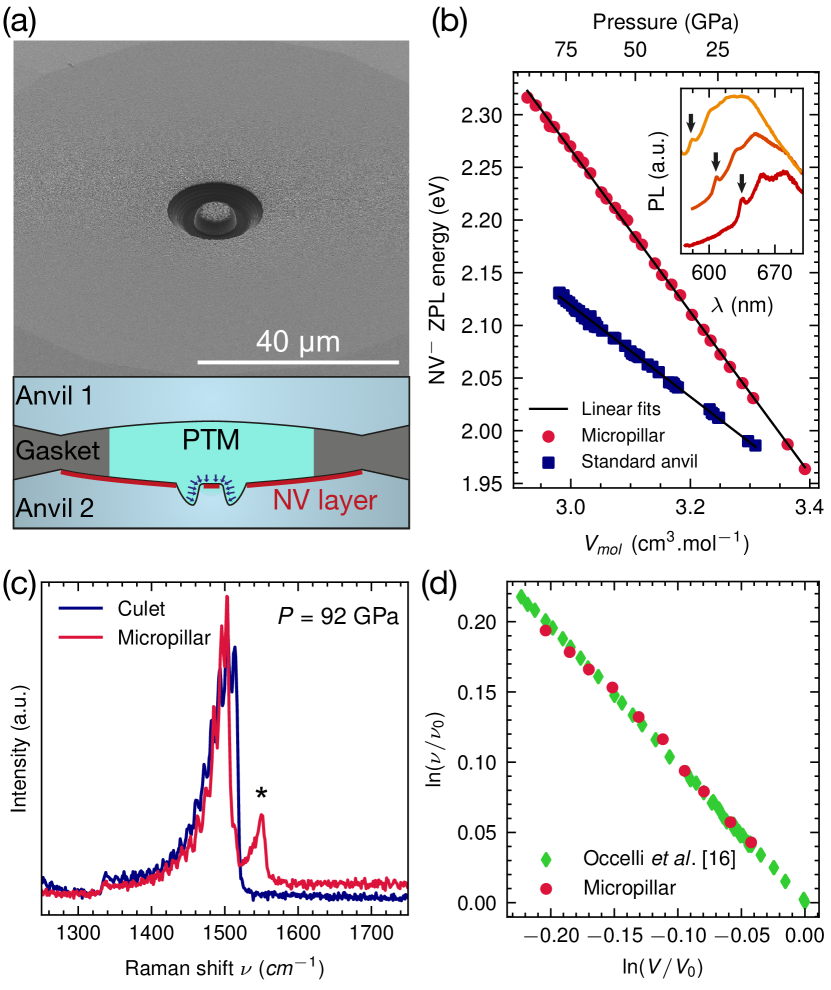
- 通过校准的金刚石拉曼位移测量压力,并将其与NV中心的光学和磁响应相关联。
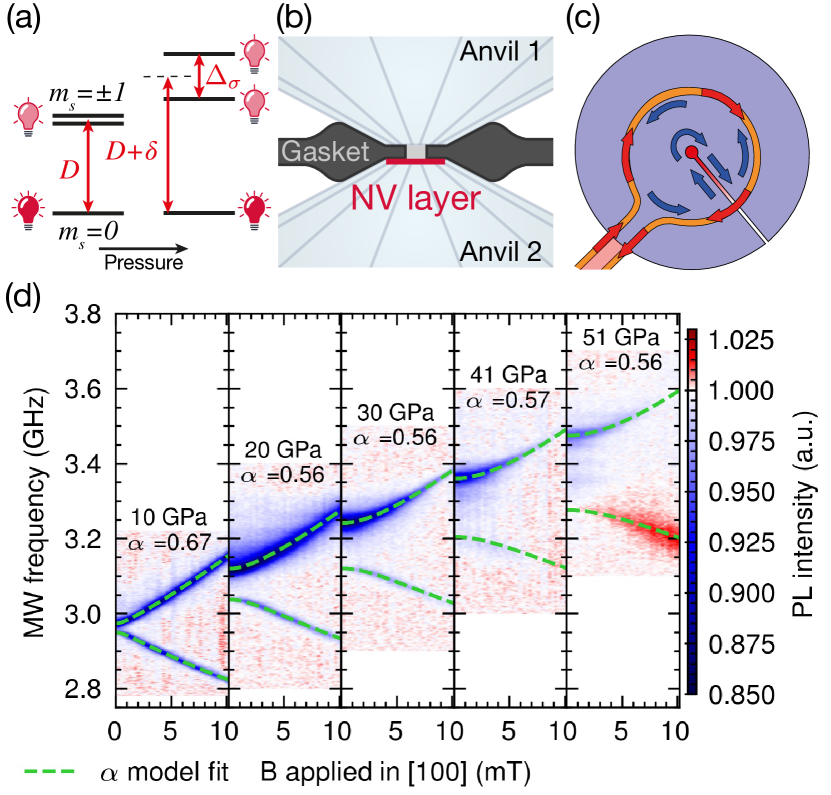
- 在[100]轴方向施加静态磁场,进行ODMR测量,并追踪零场分裂和共振中心的频率漂移。
- 应用具有各向异性参数α的自旋-机械相互作用模型,量化静水性并验证准静水条件。
实验结果
研究问题
- RQ1标准金刚石压砧尖端的偏应力是否限制了50 GPa以上NV中心的磁传感?其机制是什么?
- RQ2将压砧尖端微结构化为微柱是否可在100 GPa以上的压力下为NV中心恢复类静水条件?
- RQ3在极端压缩下,微柱结构中NV中心的ODMR响应在多大程度上保持类常压行为?
- RQ4该方法是否可使NV中心的磁感应强度在高达130 GPa的压力下保持不变?
- RQ5NV中心零场分裂和共振频率漂移在微柱结构中的压力依赖性如何定量描述?
主要发现
- 微柱设计使ODMR测量在高达130 GPa下保持稳定,对比度在100 GPa以内几乎恒定,仅在更高压力下略有下降。
- 微柱上ODMR中心频率漂移的压力依赖性为13.42 ± 0.14 MHz/GPa,显著低于标准压砧的9.68 ± 0.8 MHz/GPa,表明应力引起的能级分裂减小。
- 微柱上零场分裂(Δσ)仅以0.29 ± 0.03 MHz/GPa的速率增加,而标准压砧为3.89 ± 0.06 MHz/GPa,证实偏应力被有效抑制。
- 各向异性参数α ≈ 0.95在整个压力范围内保持恒定,表明微柱中NV中心接近完美静水性。
- NV中心零声子线(ZPL)呈现蓝移,其与压缩金刚石体积呈线性关系,斜率为-769 ± 4 meV/(cm³·mol⁻¹),显著陡于标准压砧的-434 ± 2 meV/(cm³·mol⁻¹)。
- 该微柱设计通过四种独立实验(FIB与飞秒激光两种制造方法)得到验证,证实了其可重复性与鲁棒性。
更好的研究,从现在开始
从阅读论文到最终审阅,大幅缩短您的研究时间。
无需绑定信用卡
本解读由 AI 生成,并经人工编辑审核。