
[论文解读] Observation of nonlocal Josephson effect on double InAs nanowires
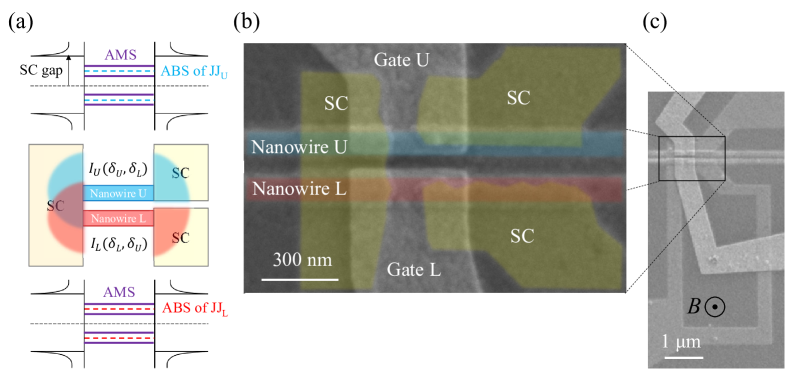
本研究通过实验首次展示了双InAs纳米线中两个约瑟夫森结(JJs)共享一个超导电极时的非局域约瑟夫森效应,其中一Josephson结的开关电流受另一结相位差的相干耦合调制。通过观测开关电流随磁通量的振荡行为,证实了Andreev分子态的存在,并为拓扑量子计算和超电流的非局域控制铺平了道路。
Short-range coherent coupling of two Josephson junctions (JJs) are predicted to generate a supercurrent in one JJ nonlocally modulated by the phase difference in the other. We report on observation of the nonlocal Josephson effect on double InAs nanowires as experimental evidence of the coherent coupling. We measured one JJ sharing one superconducting electrode with the other JJ and observed switching current oscillation as a control of the nonlocal phase difference. Our result is an important step toward engineering of novel superconducting phenomena with the short-range coherent coupling.
研究动机与目标
- 通过共享超导电极在双InAs纳米线上实现两个约瑟夫森结(JJs)之间的相干耦合。
- 提供非局域约瑟夫森效应的实验证据,即一个约瑟夫森结中的超电流受另一个结相位差的控制。
- 验证由共享超导体中Andreev束缚态杂化形成的Andreev分子态(AMS)的存在。
- 建立一个用于设计时间反演不变拓扑超导性和混合纳米线器件中非局域量子控制的平台。
提出的方法
- 采用选择性区域外延生长(SAG)技术制备双InAs纳米线,实现高产率、间距60 nm的平行纳米线。
- 在上、下纳米线上分别形成两个约瑟夫森结(JJU和JJL),共享一个超导电极,采用外延Al盖层以实现高透射率。
- 使用门调制的顶部栅极(Ti/Au)独立控制下部约瑟夫森结(JJL)的相位差,实现非局域相位控制。
- 在10 mK温度下采用锁相技术测量微分电导和开关电流,检测到JJU的开关电流随JJL电流和磁通量变化的非局域调制。
- 利用超导环调节通过共享电极的磁通量,实现开关电流随磁通量变化的振荡行为。
- 在单根纳米线双结器件中进行对照实验,改变结间距(0.2–1.0 µm),以确认相干耦合在该效应中的关键作用。
实验结果
研究问题
- RQ1在共享一个超导电极的双InAs纳米线系统中,是否能实验观测到非局域约瑟夫森效应?
- RQ2一个约瑟夫森结的开关电流是否通过共享超导体的相干耦合,受另一个结相位差的影响?
- RQ3所观测到的非局域调制是否与Andreev束缚态杂化形成的Andreev分子态(AMS)一致?
- RQ4磁通量和门电压在调制非局域超电流中的作用是什么?其行为如何证实相干耦合的存在?
- RQ5两个结之间的空间分离距离如何影响非局域约瑟夫森效应的可见度?
主要发现
- 上部约瑟夫森结(JJU)的开关电流随共享超导环中磁通量的变化表现出明显的振荡,证实了非局域相位控制。
- JJU的开关电流振荡受注入下部结(JJL)电流的调制,表明可通过相位差实现对超电流的非局域控制。
- 观测到的振荡周期为h/2e,与磁通量子一致,表明通过共享超导体实现了相干耦合。
- 在结间距大于0.6 µm的器件中,非局域效应完全消失,证实短程相干耦合是该效应的关键。
- 由于McCumber参数较低(β ≈ 0.025),IV曲线中无明显磁滞现象,表明系统处于阻尼过强的区域,但非局域振荡仍保持稳定。
- 开关电流对门电压的非局域依赖关系表明,该效应并非由电容串扰引起,而是源于通过Andreev分子态的真实相位相干耦合。
更好的研究,从现在开始
从阅读论文到最终审阅,大幅缩短您的研究时间。
无需绑定信用卡
本解读由 AI 生成,并经人工编辑审核。